Re-imaging the river
RAVI AGARWAL
Project Y (Public. Art. Outreach) was a project held on the banks of the River Yamuna in Delhi. The event was part of a twin city Yamuna-Elbe Project
1 which took place in Hamburg and Delhi in October and November 2011. The curatorial ideas to guide Project Y were to re-imagine and change the dominant narrative of the river as being ‘dirty’ to it being ‘beautiful’, and to ‘reproduce’ it as an ecological public space accessible to all. It was also a proposal for an ecologically sustainable Delhi, which is currently facing severe stress. Questions like ‘should rivers just be left alone and allowed to flow unfettered, irrespective of their utility’, or ‘how should we think of rivers, ecosystems, technology and urban spaces’ or ‘what happens when we replace economy with ecology’, and ‘does development answers the question of ecology’, were inscribed within.|
|
|
|
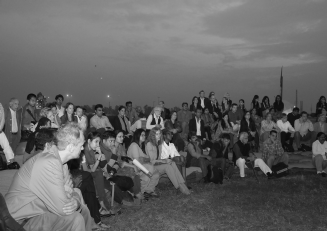
Amphitheatre, Project Y |
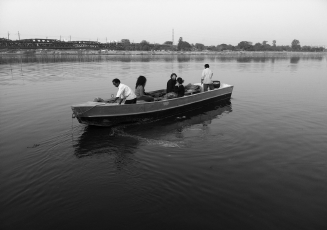
Boat Ride, Project Y |
From the very beginning, Project Y intentionally avoided the label of being a conventional ‘art’ project. In Delhi’s cultural space, public art is an exception rather than the rule, and is commonly thought of as sculpture or decorative murals on buildings. Project Y attempted to present art as an idea that would catalyze a new vision of a public space. The project also wanted to use art as a device to open up a multi-disciplinary conversation about ecology and the river. As early as December 2010, a year before the event, a seminar was held in Delhi to bring together scientists, policy people, activists and artists to discus the river.
2 One of the outcomes of this was the Yamuna Manifesto,3 a bilingual publication on the state and future of the river.
T
he discursive space the project located in was important. In both Hamburg as well as in Delhi, there has been an intense discussion about the two rivers. Both cities are built on rivers, which in their own respective ways influence local cultures. Though very diverse in their economies and histories, both are closely bound by common questions of global capital and its impact on local ecologies. Some believe that one day the Yamuna too will be like a European river, but this is a fallacy. In fact, despite being located in a rich, developed economy, the pristine Elbe faces intense ecological challenges. As its estuarine waters ebb and fall by over 3.5 m twice a day, Hamburg’s shipping channel silts rapidly, making it hard for large ships to navigate, rendering the port globally uncompetitive. The Yamuna which too floods and silts once a year, has been reduced to a sewer flowing through the densely populated capital city even as its flood plains are slated for urbanization. Climate change has worsened matters, as water flows have become more unpredictable. Development clearly has been unable to answer the question of ecology.
T
he ecological questions which confront both rivers have a great deal in common. Rivers are increasingly being controlled for ‘usage’. Global technology and capital is proposed as the way forward, in the process bringing to the surface submerged ideas of man-nature relationships and ecology. Rivers shape the ecology of the cities they flow through. They connect water systems, flora, fauna, as well as support agriculture and the economy. Even a minute change in the water flow has significant impacts, many of which are impossible to see or document. Hence, debates on ‘should the river in Hamburg be deepened’, or ‘should the Yamuna flood plains be embanked, urbanized, and the river canalized’, need to be engaged with. Both Hamburg and Delhi4 are today considering large capital intensive technological interventions to change the way the river functions. Between technology and capital, the debate needs space for new imaginaries, new understanding, and even a new language of ecology. Public art can help fulfil this function.
T
o think of the polluted river Yamuna as ‘beautiful’ boggles the imagination, unless one has a deeper encounter with it. There is, however, little incentive to do so. The river is a black sewage artery flowing through the body of the city and the riverbank is largely inaccessible to the city’s inhabitants, except to those who live alongside it. Most city people have never even actually seen the river. At best they encounter it as a distant feature while crossing one of the many bridges which span its banks, or read about its degraded state in newspapers. However, what is less known is that the river, as its flows 40 km (approx.) through the capital city, is only semi-urbanized. For almost 20 km as it flows downstream from Palla (the village where it enters the city) to Wazirabad (where Delhi’s waterworks are located), it bisects a rural (though fast changing) landscape, which is dotted with villages, cultivated land, lush marigold fields, haystacks, cow dung piles and farming communities.5 In fact land along the river, even in the more urbanized spaces, is under cultivation. Enabling people to engage with these spaces provided an unusual opportunity for the project.
|
|
|
|
Opening Project Y |
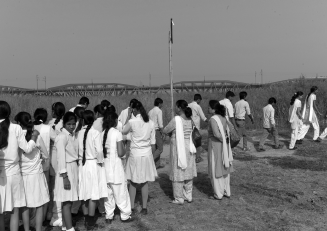
Schools, Project Y |
A
nother approach which Project Y supported was about exploring ways to coexist with the river rather than control it. The fertile flood plains could be protected both for their groundwater recharge potential as well as the rich biodiversity, providing an exchange value to the city. This was contrary to the prevailing attempts to canalize the river, ‘bund’ it, and reclaim the flood plains as real estate, to build high end housing with a ‘river view’.6In the recent past, the river’s imaginary had changed from being a rich, complex cultural and ecological natural body to a mere ‘water’ channel. Institutional
plans had fortified this reductive view.7 The land and the water interphase was marked as fixed, whereas in reality it was a shifting and changing boundary, a wetland, which was neither land nor water. This ‘non-area’ supported a host of biodiversity, resident and migratory birds, besides farmers, washermen, waste pickers, priests, livestock and others who lived and worked there. The river was also part of a citywide network of monsoon-fed freshwater streams and rivulets (and still is, though these have now turned into sewage drains). Much as the engineers who exercised control over the river would have liked to believe, it was not governed only by the laws of hydraulics, but also those of biology, zoology, sociology, geography and politics.
T
he challenge was to not allow ‘art’ to be used to gentrify the riverbank, but to help ‘democratize’ it. Thinking of the embedded history of the site and the publics it could attract, thus became an important strategy. The selection of the site – the DDA Golden Jubilee Park – was critical to the project. The park is located on the river front, and overlooks the old Yamuna Bridge, built by the British in 1866. Besides being a historic site, it is also one of the only places where the river can be viewed and accessed from the road. The bridge is like a dividing line between two cities of Delhi – that of the elite and the poor, the old and the new.
O
n one side of the landscaped park lies a long stretch of the river front which has for long been cultivated by farmers. However, they are now being threatened with eviction, since the city wishes to landscape the area. Behind it are a row of VIP memorials, sports stadiums and the new impressive Delhi Secretariat. However, just across and below the Yamuna Bridge live the very poor who have been discarded by society. Picking waste, smoking pot, or just hanging around, they are citizens no one wants to see. A step away is the very old Yamuna Bazar, with its row of river front temples, inhabited by the growing families of priests, and temple caretakers. Some temples have wrestling enclosures/akharas and cow sheds/gao-shallas. At the end of this chain is Delhi’s famous cremation ground – Nigambodh Ghat.Importantly, the park represents the new globalizing New Delhi, one that is being built literally on the debris of the past. Before it became a park, it was ‘Yamuna Pushta’, a slum where close to 100,000 people resided. It was brutally razed to the ground in 2004 citing environmental concerns, as the slum was considered to be very polluting for the river. However, even after the colony was removed, the river is no cleaner, illustrating the hollowness of the argument. Digging into the ground during the installation of the art works for Project Y, one clearly saw an archeology of layers of plastics and silt, marking each year’s floods and resettlement. Future plans for the park included museums, fountains and jetties with no thought about the river’s annual flooding or ecology. A 3-D model of this plan was installed as part of the art project, as evidence.
8
J
ust how ‘public’ a site is, becomes known when permission has to be obtained for its use. This exercise, even for a site which hardly anyone in the city visits, was a major challenge. Clearances had to be obtained from innumerable government bodies, each with its own impenetrable procedures. A public art intervention is treated like any other event, needing security clearance and no objection certificates from the police, fire and electric wiring clearances, flood and water department, food, health, municipal permissions and tax authority waivers. Often government functionaries have no sympathy for even non-commercial projects such as this one. Clearing these hurdles was a frustrating task for the project team, in spite of the fact that the Government of Delhi was a project partner and the chief minister herself had blessed the venture. It is worthwhile mentioning that on the night before the inauguration of the project, all clearances were summarily withdrawn, citing ‘security’ concerns. It was only owing to the good offices of supporters that these were resorted the following day, after much persuasion. In fact, the final permission was being signed even as the chief secretary of Delhi was inaugurating the event! The lack of public-ness of this site was evident.|
|
|
|
Site View 2, Project Y |
Site View 4, Project Y |
T
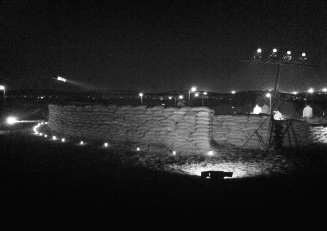
he site needed to be functionally transformed as well. Two temporary architectural features were added to the project site. One was an amphitheatre made of stacked sand-filled jute bags, where many events took place. The other was a circular metal pier, which extended over 30 feet into the water, and provided a unique view of the river away from the shore. Free boat rides were offered to those who braved to go out on the dirty river. Besides, all the structures were made of jute or bamboo and the lighting partially supported by solar panels. The local Yamuna bazaar tea shop vendor set up shop along with an organic food stall. Local waste pickers were employed to clean the site daily. The Delhi Transport Corporation (DTC) made two special stops to help people reach the site and private buses were hired to service the route between Connaught Place and the Project Y site. Entry was free.
I
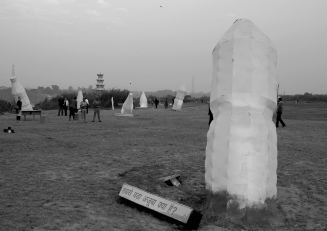
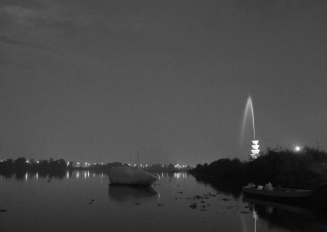
t is ultimately the art interventions at site, which can change its aesthetics. The project hosted a number of artists from Delhi and Germany. The art works consisted of multimedia, interactive, performative works, on-site installations, photographs and video projections. They dealt with themes of mythology, biodiversity, recycling, urbanization, and site histories.9 Sheba Chachhi’s evocation of feminine river mythologies through her projected video installation, Gigi Scaria’s and Atul Bhalla’s large sculptures on water recycling and its commercialization, Nana Petzet’s and Jochen Laempert’s work on local biodiversity, or Asim Waqif’s meandering river lights tracing the water each evening, amongst others, transformed the site into one of beauty.
A
longside, an outreach programme was devised to create events, which allowed for diverse and wide participation. It invited citizens (from across class divides), especially students and those who were actively engaged in some aspect of the river. These included, among others, artists, activists, academics, filmmakers, musicians, farmers, local tea shops, local residents, school students, and policy planners. Events like water walks around the network of ancient water systems in Delhi conducted by water historian Sohail Hashmi, a series of art workshops for schoolchildren, an art writing course run by FICA (Foundation of Indian Contemporary Art), a series of interactions with local farmers led by Amita Baviskar, musical events at site by Vidya Shah and Suchet Malhotra with Glenn Louvet, and an inter-school debate on the Yamuna, were held. Other offsite discussions and film shows were held at the School of Arts and Aesthetics, JNU, India International Centre, the Goethe Institute and Delhi University.A large variety of people from all walks of life visited the project site over the ten days of its duration, including scores of schoolchildren. They engaged with the art works while viewing the river – many for the first time – and attending events. Many were surprised at how ‘beautiful’ the river landscape was, even though the river itself was so dirty. Hopefully, the temporary intervention has left a more permanent trace on their minds.
There are many lessons which can be drawn from the project. It was clear that people would visit hitherto inaccessible sites if only these were made more interesting and easier to reach. Those who saw the river up-close for the first time thought about questions of its future and why its condition could not be improved. Those who went for guided walks around the river were surprised to see a rural landscape in the midst of the city. Many who came were fearful that the people who lived there were dangerous, but soon found that they could have a conversation with the ‘poor’. Probably the best way to connect with nature is to be in it, rather than talk about it. Experiencing the city can be one way of creating a new aware citizenry and activating new spaces.
H
owever, holding such an event is far from easy. If such events were to be held on a more regular basis, it would require help and empathy from many quarters. We need to appreciate that: (a) Public art is not an event like a fete or a reception; it needs to be treated with a different sensibility. (b) Public funding needs to be mobilized for such projects. (c) Public spaces need to be made accessible and permissions more easily granted. A list of sites could be drawn up and projects invited. (d) Site specific temporary works can help generate new ideas without being burdened by permanent installations, which may need layers of decision making. (e) An effort should be made to involve the general public around socioeconomic projects, the youth and schools.Public art has the potential of transforming and democratizing spaces. It can create new citizenships by facilitating conversations and encounters between different publics. As in this case, complex ideas such as ecology can be reintroduced into the public realm, cutting through disciplinary boundaries. Nature, technology and culture can merged into a community experience helping create a more equal, just and human urban space.
Footnotes:
1. The Yamuna Elbe project was jointly-curated by Ravi Agarwal and Till Krause, under the Germany in India year celebrations (2011-2012). It was mainly sponsored by the City of Hamburg, The Goethe Institute, The City of Delhi, and GIZ. For details see www.yamuna-elbe.de
2. For details of the seminar and its full proceedings visit www.yamuna-elbe.org
3. The book can be ordered or downloaded from http://toxicslink.org/?q=yamuna-manifesto
4. Hamburg is considering deepening the river, while Delhi is constructing a Rs 2000 crore (approx.) river bypass channel.
5. Also see http://haveyouseentheriver. blogspot.in
6. The building of the Akshardham Temple is a case in point of the conversion of the flood plain, and the Commonwealth Games village apartments were advertised as homes with a river view.
7. Institutions like the Delhi Development Authority control the land of the river, while the Flood and Irrigation Department manage its waters. The DDA had proposed a river channelization plan as early as 1986.
8. The DDA was invited to showcase the 3-D site model.
9. For details of art works, see www. yamuna-elbe.de