Delhi as a world heritage city
A.G. KRISHNA MENON
AFTER almost three decades of passionate advocacy by interest groups across the country, it has now finally become politically correct to espouse the imperatives of conserving our built heritage in the urban development discourse. Until recently, only the 3,675 monuments of ‘national significance’, which were protected by the Archaeological Survey of India (ASI), were considered worth preserving; now, however, the definition of built heritage has broadened to include not only the thousands of lesser known monuments, but also many other types of architectural heritage like havelis, palaces, forts and even historic cities. Several cities have adopted this broader, more inclusive understanding of their architectural heritage and have notified it for protection, and some have even set up watchdog committees to oversee this process.
Unfortunately, this welcome change in perceptions has not translated into effective action in the field. Although civic authorities and city planners now glibly offer lip service to heritage conservation, they continue to practice business as usual, and their acts of omission and commission cost us invaluable heritage. In fact, because conservation matters are increasingly in the limelight, the situation may even have worsened in some respects because project developers are beginning to devise devious strategies to circumvent heritage laws. Thus, whereas heritage conservation and city management should by now be working in partnership, they are more often than not viewed as antithetical to one another.
I
n this context, the Humayun’s Tomb Urban Renewal Project and the initiative to enlist Delhi as a Unesco World Heritage City can be seen as the next level of engagement with the contentious conservation issues confronting our cities. Both were initiated outside the existing routine of city administration, but engaged with the system to add new dimensions to both the practice of heritage conservation and the management of cities. The former sought to extend the imperatives of conserving monuments to include socioeconomic development of the local community; the latter sought to introduce a heritage-centric strategy in the planning and management of the city. Both initiatives were necessarily multidisciplinary in their conceptualization and multi-departmental in their execution, and thereby offer salutary lessons on how to mediate the management of cities by leveraging the process of conservation to create more liveable cities.This paper focuses on the rationale for nominating Delhi as a World Heritage City. Delhi’s location, particularly the triangular area between the spur of the Aravalli Hills and the river Yamuna, has over the centuries developed an aura that has cast it as the pre-eminent capital of India. Archaeologists have identified at least eight capital cities built here by various dynasties during the last thousand years. Initially, the reasons for building here were geographic and strategic in nature, but the attractions of this site later acquired spiritual and cultural dimensions as well.
T
he Delhi triangle was the point of convergence of important land and riverine trade routes of upper India. The Uttarapatha (northern route), linking the Gangetic plains to the Silk Route that rulers wanted to control, passed the area. Over time, more than 22 Sufi saints made Delhi their home, making it an important centre of Sufism. Bakhtyar Kaki settled in the Mehrauli area in the early 13th century and was held in great esteem by the Delhi Sultanate. Delhi’s spiritual significance was reinforced by Nizamuddin Aulia, the 14th century Sufi saint who lived and died in the eponymous (subsequently) Nizamuddin area of Delhi, which attracts millions of pilgrims today. The mausoleum of Humayun, the second Mughal emperor, was built near the tomb of Nizamuddin Auliya; in 1637, Shahjahan chose to build his new capital near the tombs of his great grandfather and the revered patron saint of the Mughal dynasty.|
|
|
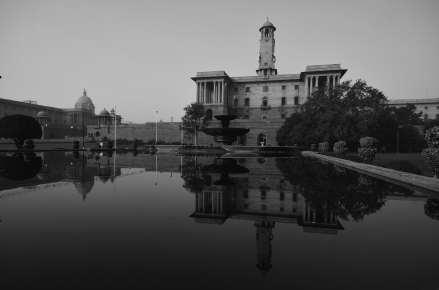
The Central Secretariat in New Delhi. |
Centuries later, in 1911, the aura of Delhi persuaded the British colonial government to shift their capital from Calcutta to Delhi, in part to legitimize their rule in the eyes of their subjects by linking themselves to the Mughals and all the previous dynasties who ruled parts of India from here.
D
elhi’s history of almost a thousand years of building has left a rich legacy of architectural heritage that few other cities in the world possess. Three monuments – Qutb Minar, Humayun’s Tomb and the Red Fort – have already been listed as World Heritage monuments by Unesco. Prima facie, therefore, there is compelling evidence to include Delhi itself as a World Heritage City. However, merely possessing such a cornucopia of architectural heritage is not sufficient for the city to qualify, because, according to Unesco guidelines, the heritage must also possess what it defines as ‘Outstanding Universal Value’ (OUV). The nomination exercise, therefore, sought to explicate the characteristics of the city’s universal cultural significance and how its multiple stakeholders are looking after it.It turned out to be a serendipitous exercise because there had been no earlier attempt to methodically catalogue the meaning of any of our society’s rich urban history. This void in our understanding of what constitutes heritage is evident in the fact that while Unesco has a list of over 220 World Heritage Cities, not one is Indian: India has never applied for that tag for any of its remarkable historic cities.
T
he Delhi nomination process offered us an opportunity to explore new ground: combining the cultural intimacy of the ‘user’ of cultural resources and the professional detachment of the ‘custodian’ of that resource. Such a combination of roles is seldom mobilized in defining the cultural significance of a single or group of monuments, but this combination enabled us to gain fresh insights into the nature of cultural resources in the Indian context, which were not commonly propagated by either the user or the custodian. Certain pet theories of how heritage should be protected by isolating it from society were nullified; while others about interweaving the imperatives of conservation and development were productively explored with a view to defining their parameters and possibilities in the Indian context. Seeing the development agenda through the lens of the diverse cultural landscapes of our country has led us to understand and advocate the positive role that heritage conservation can play in city management.In 1999, the Delhi Chapter of the Indian National Trust for Art and Cultural Heritage (INTACH) and Delhi Development Authority published a list of 1,208 heritage buildings and 27 heritage precincts in Delhi. This vastly expanded the list of 174 monuments that the ASI then protected in Delhi. The Master Plan of Delhi 2001-2021, includes this list along with six heritage precincts and three archaeological parks for protection. The proposal to nominate Delhi as a World Heritage City emanates from this mandate, but focuses on only two of the heritage precincts: Shahjahanabad and Imperial New Delhi, the so-called seventh and eighth cities of Delhi, because these made the strongest case for the ‘Outstanding Universal Value’ required for the Unesco tag.
OUV is a complex criterion to address, and in the case of Delhi, the final success of the exercise will hinge on convincing Unesco interlocutors, who might be unfamiliar with, and perhaps even unsympathetic to, the realities of Indian urbanism about the merits of our rationale. In sum, the nomination dossier argues that the urban layouts of both imperial cities of Delhi are unique examples of the city planning of their respective times, incorporating innovative planning ideas and ideologies. Both were built by the most important empires of their times, at the zenith of their power, as new, planned cities to make manifest their political authority. Remarkably, both continue to function as ‘living’ cities.
T
hough their contemporary appearance has been altered to some extent due to the exigencies of history and contemporary pressures of urbanization and development, the nomination dossier demonstrates that the technical attributes that define the OUV – overall form and design, material and substance, location and setting, and use and function – are authentic and still palpably present, and that the conservation mandate is backed by strong administrative rules and regulations.The walled city of Shahjahanabad, the Mughal Imperial City, and the entire extent of the British Imperial City, planned by Sir Edwin Lutyens as the capital of the British Empire in India, are fully contained within the boundary of the area proposed for nomination as ‘The Imperial Cities of Delhi’.
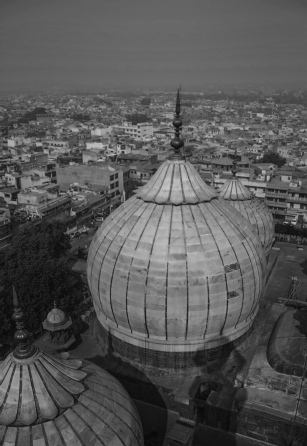
The urban morphology of Shahjahanabad (built between 1639 and 1649) has the characteristics of an Indian Islamic city – in this case, specifically Mughal – which evolved as a result of the intermingling of the cultures of India, Persia, Afghanistan and Turkey. The town plan was anchored by the ceremonial axis, Chandni Chowk, with streets radiating to the city gates, four of which still survive. Although the Mughal housing stock has been rebuilt over the years, with various layers of the late Mughal and colonial period seen on the houses, it retains the original footprint. Also extant are the imperial core – Chandni Chowk, the ceremonial access from the Red Fort to Fatehpuri mosque, Jama Masjid, the other principle thoroughfares and road network, and the traditional bazaars, kuchas, katras and mohallas.
A
lthough most of the encircling wall that delimited the Mughal city’s boundary from the rest of the geographical region of Delhi no longer exists, the location of the former wall still defines the form of Shahjahanabad and the nominated area is contained within it. In fact, the pre-1857 map of Shahjahanabad when compared to the present layout of the Mughal City, indicates very little change in its morphology. The traditional pattern of mohallas, kuchas and katras continues to this day.Shahjahanabad is the largest planned Mughal city. It is an example of the sovereign city model of pre-modern cities, conceived as axis mundi. It was distinguished from earlier Sultanate cities in both size, form and the communal syncretism that was Shahjahan’s political philosophy, which can still be seen in the proximate disposition of mosques, temples, gurdwaras and churches around the city.
The dossier also argues that the ‘integrity of composition’ of historic Shahjahanabad has been retained to a great degree: its geometric scale, size and layout survive to the present day. The mohallas of the city were homogenous units whose spatial system was made legible through a hierarchy of gates which defined the thanas and the smaller residential precincts sitting within each mohalla. The various mohallas, kuchas and katras may have changed in nomenclature in some instances, but the traditional urban hierarchy of spaces is largely retained. Many of the mohallahs are still identifiable. A few additional lanes and interconnecting streets are seen connecting adjoining kuchas and katras, but the overall ‘integrity of structure and its inter-relationship’ are largely maintained.
T
he imperial function of Shahjahanabad has, obviously, changed because it is no longer the capital of an empire. Nevertheless, the prime minister of India ritualistically addresses the nation from the ramparts of the Red Fort each Independence Day, retaining the symbolic significance of the imperial city that Shahjahan built. While the functional integrity of Shahjahanabad may have been compromised because it is no longer an imperial capital and commercial land use has replaced some of the original residential land use, it continues to be a pre-eminent trading town serving the region – as it was at the time of its founding – with most of the traditional bazaars continuing as wholesale markets just as before.
|
|
|
The Domes of Jama Masjid, Delhi. |
Inevitably, Shahjahanabad’s building fabric has changed with time, most significantly as a result of cataclysmic historical events like the sacking of the city by Nadir Shah in 1739 and the brutal British reprisals following the ‘uprising’ of 1857. The introduction of the railways by the colonial government in 1864 cut a broad swath through the city’s historic fabric; its important secondary purpose was also to control the city after the uprising. Further changes in Shahjanabad’s spatial character occurred when its northern part was occupied by the British administration and buildings like the Town Hall and St. James Church were constructed (in 1864 and 1836 respectively). Thus, over the last 200 years, the visual impact of the Mughal urban city fabric has been compromised in some places but, remarkably, a great deal still exists and has been identified for nomination.
As in any ‘living’ city, the houses were, from its founding, remodelled, renovated and rebuilt, but invariably on the same footprint. Thus, the built fabric has constantly been rejuvenated with new structures, but the original morphology of the city has remained intact and the building lines still maintain the rhythm of the historic urban landscape. Uninterrupted rows of buildings line the main streets and traverse in a similar manner along the narrower kuchas and galis. Much of the original fabric of intricate street facades and deep houses with courtyards for light and ventilation still survive.
A
n inventory of the built fabric of Shahjahanabd conducted in 2012 identified over 750 structures in the walled city that display a significant Mughal or late-Mughal architectural character. Some residential buildings have added colonial layers on the floors above. The nomination dossier argues that even though Shahjahanabad’s quotidian building fabric was not preserved in aspic, as in many other World Heritage Cities, it still possesses OUV because it has evolved keeping the significant characteristics of its heritage intact.However, there is no gainsaying the fact that the city is currently under severe threat of development. Soaring land prices have led to old structures being demolished and replaced with new construction. Anticipating this trend, the Master Plan of Delhi 2001-2021 identified this area as a ‘Heritage Zone’, and special byelaws are being framed to preserve what is left of the urban fabric of havelis, bazaars and street patterns. Many of the buildings notified as heritage structures by the government are in a good state of conservation, merely requiring routine maintenance in accordance with good conservation practices. Most of the institutional buildings like banks, hospital, and schools still survive and are in a good state of conservation. The survey undertaken in 2012 includes a State of Conservation assessment. The high number of ‘not at risk’ heritage buildings identified is evidence that the heritage assets of the nominated site are being properly cared for by their owners and custodians.
I
mperial New Delhi offers a study in contrast to Shahjahanabad: premod-ern/ modern; eastern/western; high density/low density; and visual heterogeniety/visual order. The contrast makes the joining of the two in a single nomination provocative, but such contrasts are, in fact, the hallmark of Delhi’s remarkable heritage.Imperial New Delhi’s town plan represents an unprecedented and unequalled synthesis of the two dominant town planning principles of the late 19th century in the West: the Garden City and City Beautiful. It too manifests the political ideology of the rulers who built it as a new town between the two World Wars. The Central Vista, the ceremonial axis, is the spine of the town plan and its geometric road network is the armature anchoring the city’s layout. This network and its unique avenue tree planting still exist, thus retaining the integrity of the original composition. The Central Public Works Department (CPWD), the authority responsible for maintaining this area, has a Maintenance Manual that lists the various alterations and additions that are permissible so that the integrity of the original design is maintained, while at the same time ensuring that the people living in bungalows and using the iconic administrative buildings have a safe and good quality of life.
Imperial New Delhi is also under severe pressure of development because of its very low density. The problem has been especially acute in the commercial district of Connaught Place where the absence of suitable building controls led to the original bungalows in its immediate vicinity being replaced with high-rise buildings in the 1970s. While this has compromised the ‘visual impact’ of the area, increased awareness about heritage conservation helped mediate further changes. Regulations have now been framed to address these issues.
T
he conservation of the vistas and verdure of Imperial New Delhi has been confirmed as the official urban policy in both the Master Plan of Delhi and the prevailing special regulations controlling the development of this heritage precinct. All view corridors are now being carefully maintained. For example, in 2005, when a large memorial for the police was being built in Chanakyapuri, it became apparent that the finished structure would block the view of the dome of Rashtrapati Bhavan along Shantipath. In response to a Public Interest Litigation, the Delhi High Court ordered that construction of the offending structure be stopped and the design changed to a less intrusive form. Thus, administrative mechanisms – both governmental and non-governmental – exist to protect the heritage character of the area. The nomination also provides for buffers in the direction of the key views and vistas to ensure continuity and connectivity to the nominated property.Although the origins of New Delhi were rooted, as in the case of Shahjahanabad, in its functioning as an Imperial capital, after the departure of the Raj in August 1947, the city was made the capital of independent India, thus continuing its original function, albeit as the capital of an independent, sovereign Republic. All the buildings continue to be used for the purpose they were designed, although with the modification that reflect the changed political reality. The Viceroy’s House is now Rashtrapati Bhavan, the residence of the President of the Republic of India; the Commander-in-Chief’s House served as the residence of India’s first Prime Minister Jawaharlal Nehru, and is now Teen Murti Bhawan, housing the Nehru Memorial Museum and Library; the administrative core of British New Delhi continues to function as the seat of independent India’s government; the bungalows that housed colonial officers are now residences for Indian government officials; and several of the original princely houses have now become venues for state functions, national art galleries, etc. Arguably, therefore, the functional integrity of the town plan has been fully retained.
T
he fact that there are no World Heritage Cities in India reflects the indifference with which our society treats its historic cities, and thus most are, unsurprisingly, reduced to slum-like conditions. One of the reasons for nominating Delhi as a World Heritage City was therefore to contest this default situation in the management of our historic cities and to demonstrate the benefits that accrue by conserving the rich urban heritage of our country, including, inter alia, transforming them into more liveable cities.Unfortunately, many resist this idea. The mandarins of the Ministry of Urban Development and civic administration, for example, view imperial New Delhi as valuable real estate to be exploited, and propagate its redevelopment solely in order to take advantage of its economic value; some cultural chauvinists cannot countenance the conservation of a colonial legacy (and others, for the same reasons, the Mughal legacy); critics pursuing a social and economic agenda join the critics of conservation by decrying what they perceive to be the inequity of maintaining low-density ‘elitist’ development in the centre of the city; and the Archaeological Survey of India, the official guardian of our country’s built heritage, does not even consider urban heritage as heritage at all, and therefore resists expanding the scope of its current mandate beyond the relatively miniscule number of monuments that are designated as ‘monuments of national importance’.
F
ortunately, the State Government of Delhi saw the merits of nominating the two precincts of the city as World Heritage Sites, and agreed to support the proposal. Such support was essential because the process of putting together the detailed dossier to be submitted to Unesco has taken over three years of work by several local, national and international professionals. It could not have been undertaken by following the business as usual model of city management or the narrowly construed, anti-conservation mindset of city managers. Hopefully, this initiative will catalyse other nominations of our country’s extraordinary historic cities – not necessarily to obtain the Unesco tag, but for the benefits that accrue from shifting the gaze of citizens and decision-makers towards the benefits of conserving cities.What are these benefits? To begin, consider some of the following developments that are already taking place in Delhi on account of it being nominated as a World Heritage City. Delhi is today an amorphous megalopolis. The Unesco nomination exercise expects to change this situation by giving the city a distinct identity. Town planners seldom consider this agenda as part of their task. The nomination not only celebrates Delhi’s heritage, but also proposes to use it as a tool to create a more experientially legible and liveable city.
A
s a follow-up of the nomination exercise, scores of lesser known monuments and neglected urban spaces have already been conserved and landscaped by the Delhi government and have now become valuable assets in the public domain. The area around the Gol Gumbad near the Lodhi Hotel on Lodhi Road, Bade Lao ka Gumbad in Vasant Vihar, Bijri Khan’s tomb in R.K. Puram, Dervesh Shah’s tomb in Gulmohar Park, and scores of others have already been conserved and developed as useable public spaces. Similar projects are in the pipeline. Tourist sites such as Purana Qila, Ferozeshah Kotla, Hauz Khas, the Mehrauli Archaeological Park and the bye-lanes of Shahjahanabad are slated for renewal, which should hopefully add new value and significance to our heritage sites. This will inevitably change the cognitive image of the city.About 20 heritage walks have been developed to enable residents to understand and experience the rich diversity of their cultural patrimony and, perhaps, encourage them – many first generation migrants – to take ownership of city spaces and thus ensure their better care. The Delhi Transport and Tourism Development Corporation, the nodal agency appointed by the Delhi government to oversee the preparation of the Unesco dossier, has initiated the Hop-on-Hop-off bus service to provide convenient access to heritage sites and is planning to include heritage havelis in its bed and breakfast scheme, thus translating the idea of heritage conservation into practical, economically beneficial projects.
All this is expected to boost tourism. Today, the tourist makes Delhi a transit stop to other destinations in the country. If, on account of it being declared a World Heritage City, tourists are encouraged to spend a longer time here – an obvious analogy is Rome – the city will benefit economically. Considering the scale of the city, such projects represent only a modest beginning, but the process of urban transformation and economic regeneration has been initiated and will yield rich dividends – materially and emotionally.
I
n a globalizing and frequently homogenizing environment, the identity of a nation, its cities and its people can easily be sacrificed in pursuit of rapid development. The fundamental objectives of conserving monuments are, therefore, not only to preserve memory in physical form, but also to create a distinctive identity by improving the environment in which it exists and in which society lives and operates. Preservation of the past should provide the groundwork for developing a future city rather than being dismissed as an inconvenient obstacle.It is important to emphasize this potential because the default assumption is that to be developed means to emulate ‘modern’ cities like Singapore or Shanghai. Heritage conservation is a process that contests this anomic approach. Seen in this light, conservation of historic legacy is not marginal or antithetical to the imperatives of development, but becomes its central axiom. This perspective needs to be woven into the management of the city so that city planning will shed its number-crunching and land use allocating obsessions and seek, instead, to create wholesome and liveable cities. But to achieve these results requires inter-departmental and inter-sectoral planning and coordination: the process of drafting the nomination dossier has shown that this can be done. This is the rationale behind nominating Delhi as a Unesco World Heritage City.