Fishing in troubled waters and the cusec-megawatt river
SONALI MITTRA and ROHAN D’SOUZA
MODERN river management, in the South Asian subcontinent, is often characterized as being defined by reductionist engineering and comprehensive water control. In technological terms this has meant the introduction of infrastructure such as weirs, barrages, canal systems and, inevitably, large dams.
1 The hydraulic principle underlying these varied structural interventions, however, has remained disarmingly simple: regulate flows either through diversion or impoundment in order to harness the volumes as cusecs or megawatts. That is, from its emergence in the nineteenth century, modern river management in the region has been overwhelmingly biased towards commandeering river flows for irrigation and hydroelectricity.The Ganga basin, cut through by a broad capacious main stem, is tangled by many fluvial arms and innumerable tributaries. In its deltaic portion, however, comprising some 41,000 sq miles stretched between the Meghna river in Bangladesh and the Hooghly river in the state of West Bengal, the Ganga’s main arm called the Padma folds into the Jamuna (the distributary of the Brahmaputra) before dropping into the Meghna, which then carries these combined waters into the Bay of Bengal. This Ganga basin in its entirety is densely packed with close to 448.3 million people
2 who are spread along its banks and ample floodplains.Prior to the consolidation of colonial rule in the region from the late eighteenth century onwards, the Ganga system served as a significant means of river navigation. In Jean Deloche’s two volume classic on transport in the Indian subcontinent before the railways, there is mention about a thriving trade along the numerous arteries of the Ganga through a varied collection of small and large boats.
3 Most of these sleek waterborne craft were manoeuvred, glided and moved along by catch currents, ebbs and pulses that coursed through the silt-laden muddy waters. The Ganga system, however, was also prone to violent mood swings; either becoming a wild raging torrential force during the precipitation soaked monsoon season or when sapped of its elemental energies in the dry months, the river almost dramatically acquired the sullen temperament of a sluggish python.
T
he quest for pursuing perennial irrigation in post-independence India has resulted in a systematic and big technology approach towards harnessing the Ganga waters. At present, in India there are more than 644 major and medium irrigation commands along the main stem and various tributaries of the system.4 Summed up differently, these hydraulic works refer to 12 major storage and diversion projects,5 with perennial irrigation provided to an area of 546,820 sq km, which constitutes nearly 56.6% of India’s net irrigated (including canals, tanks and wells) area.6 The official estimate also lists these 12 major diversion/storage projects in the Ganga basin as representing a total of between 2556.6 to 2581.8 m3/s of diverted flows and 6797 mcm of stored water annually.7Oddly enough, while surface irrigation has received much official attention in most of the five year plans, groundwater has been the more preferred form of irrigation for many cultivators in the region. According to the Central Groundwater Board (CGB), groundwater is most extensively used for irrigation with approximately 65% of the cultivable area being watered in such a manner.
8 Despite the claimed benefits of canal/intensive groundwater irrigation in the Ganga basin, there are several irreversible implications caused by diversions, over-extraction and storage structures.
C
ontinued irrigation over the years has contributed to building up salt and alkali levels in cultivated soils. In areas where drainage is poor, salinity level and alkali status in the soils has risen considerably. Some argue that this degradation from perennial irrigation has not been entirely captured in state-level numbers. In certain areas the soils have indeed been rendered infertile (usar) and alkali affected (reh), such as pockets of western Uttar Pradesh and Bihar.9 From these areas there is constant subsurface seepage and the flow of waste water here is charged with salts and alkalis, which eventually find their way to the Ganga river waters.With 1% of its major/medium irrigated command areas affected by excess salt levels, salinity represents a significant problem for the Ganga basin states. Once again, Bihar and Uttar Pradesh suffer the most salt degradation, with 2.64% and 1.21% of irrigation command areas affected, respectively; however, UP’s total salt affected area exceeds that of Bihar’s by a count of 2,831.4 sq km to 1,568.8 sq km, respectively.
10
C
omplementing the quest to create perennial irrigation on the Ganga system has been an equally troubled effort to generate megawatts (mw). The hydroelectric potential of the Ganga basin has been assessed at 10,715 mw, at 60% load factor.11 Out of the 142 identified schemes in the basin, 22 schemes with a total installed capacity of 2437 mw are currently in operation and a further 12 schemes, with an installed capacity of about 2716 mw, are in various stages of construction.12 To achieve the ambitious programme of hydro capacity addition in the 11th plan period (2007-2012), hydropower projects with a combined installed capacity of 58,573 mw were identified by the CEA (Central Electricity Authority) in the year 2006-07.13 It remains to be seen when and whether they will actually be completed. The environmental impact of hydroelectric power depends upon the size and type of the project.14 The World Wildlife Institute (Government of India), in one of its assessments, reported that dangerous impacts on aquatic and terrestrial ecosystems could result due to such dams.15The large-scale displacement of people and local ecological degradation are two other typical problems associated with hydropower projects. Displaced people invariably tend to be further marginalized and have limited capacity to withstand the ordeal of eviction.
16 However, even projects under construction and many proposed projects have now begun to face major delays due to social protest and disapprovals from the Ministry of Environment and Forests.17 The delays in projects have led to huge cost overruns, in many instances, challenging the viability of hydropower.18 Furthermore, the categorization of large dams under ‘renewable energy’ is being vociferously debated for its claims of being a source of green energy.19 For example, studies have shown that methane emitted from reservoirs could be more potent as greenhouse gases than carbon dioxide.20
I
n many ways, the debates about irrigation or hydroelectricity are about treating the river as a form of stock rather than as flow. That is, impoundment or diversion of river volumes essentially involves radical or substantial alterations in the river’s natural flow regime. Put differently, generating megawatts or commandeering volumes as cusecs is about trying to substitute the variable pulse regime of the river with a standardized flow. For fisheries, however, especially for wild fish runs, patterns in a variable flows regime are crucial.21
A
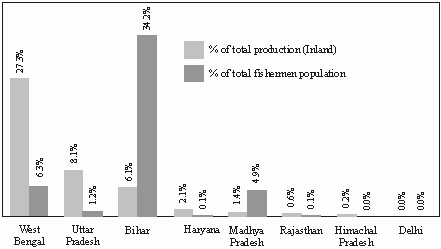
ccording to the Ministry of Agriculture, inland fish production reported in 2010-11 was 4.98 million tonnes, which is 60% of the total annual fish production in the country.22 Out of this, the Ganga basin produces 0.22 million tonnes,23 contributing 45.7% to the total inland fish production in India. The upland, middle reaches and estuaries of the Ganga basin have been colonized by diverse fish populations, which thus far have provided unmeasured contributions to rural diets. A recent paper reported the presence of 218 species in inland fresh waters24 in the Indian Ganga basin. While the presence and population of fish communities varies in different stretches of the Ganga river, major Indian carps such as the rohu (Labeorohita), catla (Cyprinuscatla; Gibelion) and the hilsa (Tenualosailisha) are commercially the most important.Interestingly enough, out of the total inland fishing based population in India, 46.9% is supposedly supported by the Ganga basin (seven states).
25 Within the basin, Bihar accounts for the largest share of these fisherfolks amounting to 73%, followed by West Bengal at 13.4% and Madhya Pradesh at 10.5%.26 It is interesting to note that in Bihar, despite having the largest number of fisherfolk, the fisheries production is comparatively low; West Bengal on the other hand presents a complete contrast (see figure). This disconnect, however, perhaps tellingly reveals that Bihar might have a larger subsistence based fisherfolk population, while in Bengal the orientation might be more commercial.
O
ver the years, a range of developmental activities, including irrigation projects and other types of river course modifications in the basin, have ecologically impaired much of the river system so that water quality is now considered quite degraded, and unsurprisingly as well, negative pressures have begun to play out on fisheries and aquatic biodiversity.27Amongst these, however, irrigation projects and flood control measures have been singled out as being amongst the most destructive on the flood plains, sloughs, inundation zones and oxbow lakes, all of which are the breeding and nursing grounds of these prized carp populations.
28 Though, paradoxically, while damaged fluvial habitats have led to a noticeable decline in the major carp populations, the numbers for minor carps and small catfishes have registered relatively positive increases.29 A study conducted by the Central Inland Fisheries Research Institute suggests that post-1960 the major carp yield suffered an almost 20% decline, especially in the upper stretches,30 within a decade. Another historical comparative research conducted by the Inland Fisheries Society of India showed that the contribution of major carps to fishery has greatly declined. At Allahabad, between 1958 and 1966, they contributed 43.5% of the catch; between 1972 and 1976 they amounted to 29% and in 1992 to 1993, only 13%.31
H
ilsa (Tenualosailisha) numbers, in particular, are also believed to have suffered damaging impacts. Their many migratory routes between the estuaries and the larger arms of the Ganga river system are now widely understood to have been irreversibly disrupted by the Farakka barrage. Despite the obstructions, however, one survey observed that hilsa could still be found upstream as far as Allahabad, although in small quantities during April and May.32 In a recent survey it was pointed out that hilsa contributed 40-60% of river catches in Bangladesh, 1% at Patna and 0.6% at Allahabad.33|
Fisheries Production and Fishermen Population in Ganga Basin |
|
|
|
Source : Handbook on Fisheries Statistics, Ministry of Agriculture, GOI, 2008. |
The launching of the Ganga Action Plan phase-1 by the central government in the mid-1980s for ‘cleaning’ the river has resulted, according to some reports, in the amelioration in water quality parameters (increased DO and decreased BOD); to the level of the 1960s in the riverine stretch (although not to the level aimed at).
34 According to De Graaf (in his study on floods, fish and fishermen), an increase in the number of prawn populations, for example, may even paradoxically enough indicate a loss of biodiversity in the Ganga.35 The general tenor of much of the existing assessments with regard to inland fisheries and fish population survival in the Ganga basin, in fact, remains overwhelmingly pessimistic.36
B
riefly, from the above, we point out that contemporary river development in the Ganga basin is being pursued in the familiar model of trying to generate cusecs and megawatts. However, the transaction costs that result from such structural efforts – shown from even a cursory look at some of the existing documentation – points to a trend adversely impacting both the riverine ecology and, in particular, traditional inland fisheries. Thus far, calibrating the delicate trade-offs between irrigation and electricity demands in the region have been carried out through various kinds of cost-benefit analysis (CBA) exercises. While, undoubtedly, these CBA exercises can provide fairly convincing inputs for resolving competing demands, they nevertheless fail to address the far more complex requirements for fisheries.Put differently, while benefits derived from cusecs and megawatts can be subjected to monetized calculations because they are stock, the same is not the case with fisheries as they are deeply embedded in ecosystem health and deal with ecological relationships rather than simply volumes. Furthermore, these riverine communities with their strong livelihood dependence on fisheries might value their ecosystems differently than those advocating projects for cusecs and megawatts. Most CBA accounting strategies, moreover, rarely take into account the value of long-term services such as seasonal inundation and drainage complexity.
Perhaps co-benefit sharing frameworks with a heightened understanding about basin interdependence might offer more compelling conceptual traction for exploring economic opportunities within the Ganga system, by recognizing it as an interconnected series of socio-ecological webs. In turn, such an environmentally and socially informed perspective might help reconcile the range of competing and tension ridden demands for megawatts, irrigation and fisheries in the basin. It bears reiteration that the continued disconnect between water policy, irrigation schemes, hydropower development plans and fisheries management will be disastrous for the Ganga basin and the millions that inhabit this region. Put differently, the recoil effects of environmental degradation
37 and decline in ecosystem services38 can, in the not too distant future, fatally unsettle the Ganga if it were to simply become a cusec-megawatt river.
Footnotes:
1. See Rohan D’Souza, ‘Water in British India: The Making of a "Colonial Hydrology",’ History Compass 4(4), 2006, pp. 621-8.
2. Status Paper on River Ganga. Ministry of Environment and Forests, National River Conservation Directorate. Alternate Hydro Energy Centre, Indian Institute of Technology, Roorkee, 2009, p. 8.
3. See Jean Deloche, Transport and Communications in India Prior to Steam Locomotion, Vol. I & II, Oxford University press: New Delhi, 1993 & 1994. Also see review by Rohan D’Souza, ‘Transport Before the Railways’, Economic and Political Weekly XXXII(17), 26 April 1997, pp. 884-885.
4. Environmental and Social Management Framework (ESMF), Vol I. The Energy Institute and Resources Institute, and Ministry of Environment and Forests, Government of India, 2011, p. 38.
5. Ibid.
6. Water and Related Statistics. Water Resources Information System Directorate, Central Water Commission, Government of India, New Delhi, 2010, pp. 115-123.
7. The Energy Institute and Resources Institute, op cit., 2011, pp. 38-39.
8. B.M. Jha, ‘Towards Better Management of Ground Water Resources in India.’ Central Groundwater Board, Government of India, New Delhi, 2010, p. 7.
9. ‘Country Report: Assessment of Water-logging and Salt and/or Alkaline Affected Soils in the Commands of all Major and Medium Irrigation Projects in the Country Using Satellite Remote Sensing Regional Remote Sensing Service Centre.’ Central Water Commission, Government of India, 2009, p. 15.
10. Ibid.
11. Water and Related Statistics: Report. Water Resources Information System Directorate, Central Water Commission, Government of India, New Delhi, 2010, p. 176.
12. Planning Commission of India 2008. Annual Plan Documents by the States and UT’s and Working Group Report on Water Resources for XI Plan. Databook for DCH, New Delhi, 2011, p. 92.
13. Report of the Working Group on 11th Five Year Plan. Planning Commission, GoI, New Delhi, 2011, pp. 463-467.
14. South Asia Network on Dams, Rivers and People (SANDRP). Comment on IMG (B.K. Chaturvedi) Committee Report on Upper Ganga Hydro and the River. Accessed 31 August 2013. Available at: http://sandrp.in/IMG_ report_on_Ganga_has_Pro_Hydro_ Bias_June 2013.pdf
15. Asha Rajvanshi, Roshni Arora, et al., ‘Assessment of Cumulative Impacts of Hydroelectric Projects on Aquatic and Terrestrial Biodiversity in Alaknanda and Bhagirathi Basins.’ Technical Report. Wildlife Institute of India, Uttarakhand, 2012, p. 203.
16. Rakesh Agarwal, ‘Hydropower Projects in Uttarakhand: Displacing People and Destroying Lives’, Economic and Political Weekly XLVIII(29), 2013, pp. 15-16.
17. K. Ramanathan and P. Abeygunawardena, Hydropower Development in India: A Sector Assessment. Asian Development Bank, The Philippines, 2007, pp.10-11.
18. Central Electricity Authority, Hydro Development Plan for 12th Five Year Plan. CEA, New Delhi, September 2008.
19. Alain Tremblay, Louis Varfalvy, Charlotte Roehm and Michelle Garneau, ‘The Issue of Greenhouse Gases From Hydroelectric Reservoirs: From Boreal to Tropical Regions’, in Proceedings of the United Nations Symposium on Hydropower and Sustainable Development. China, Beijing, 2004.
20. Ivan B.T. Lima, et al., ‘Methane Emissions from Large Dams as Renewable Energy Resources: A Developing Nation Perspective’, Mitigation and Adaptation Strategies for Global Change 13(2), 2008, pp. 193-206.
21. See the excellent research by the Tropical Rivers and Coastal Knowledge (TRaCK) initiative at the Charles Darwin University (Australia). The TRaCK project has carefully documented the complex connections between river flows, fisheries and fluvial food webs. For more on their project, see http://www.track.org.au/
22. Ministry of Agriculture, Handbook on Fisheries Statistics, 2011. Department of Animal Husbandry, Dairying and Fisheries, Government of India, 2012, p. 9.
23. Ibid.
24. K.K. Vass, S.K. Mondal, S. Samanta, V.R. Suresh, and P.K. Katiha, ‘The Environment and Fishery Status of the River Ganges’, Aquatic Ecosystem Health and Management 13(4), 2010, pp. 385-394.
25. Ministry of Agriculture, Handbook on Fisheries Statistics. Department of Animal Husbandry, Dairying and Fisheries, Government of India, 2008, p. 147.
26. Ibid.
27. David Dudgeon, ‘Large-Scale Hydrological Changes in Tropical Asia, Prospects for Riverine Biodiversity: The Construction of Large Dams Will Have an Impact on the Biodiversity of Tropical Asian Rivers and Their Associated Wetlands’, BioScience 50(9), 2000, pp. 793-806.
28. A.G. Jhingran and K.K. Ghosh, ‘The Fisheries of the Ganga River System in the Context of Indian Aquaculture’, Aquaculture 14(2), 1978, pp. 141-162.
29. C.G. Montana, S.K. Choudhary, S. Dey and K. O. Winemiller, ‘Compositional Trends of Fisheries in the River Ganges, India’, Fisheries Management and Ecology 18(4), 2011, pp. 282-296.
30. A.G. Jhingran and K.K. Ghosh, op cit., pp.141-162.
31. K.K. Vass and M. Sinha (eds.), Changing Perspectives in Inland Fisheries. Proceedings of the National Seminar, 16-17 March 1998. Inland Fisheries Society of India, Barrackpore, West Bengal, 1998, pp. 15-23.
32. S. Reuben, S.S. Dan, M.V. Somaraju, Philipose Varughese and T.V. Sathianandan, ‘The Resources of Hilsa Shad, Hilsailisha, Along the Northeast Coast of India’, Indian Journal of Fisheries 39(3-4),1992, pp. 169-181.
33. Ibid.
34. K.K. Vass, S.K. Mondal, S. Samanta, V.R. Suresh and P.K. Katiha, op cit., pp. 385-394.
35. G. De Graaf, B. Born, A.M. Kemal Uddin and F. Martin, Floods, Fish and Fishermen. The University Press, Dhaka, 2001, p. 110.
36. See Nachiket Kelkar, Fishing for Scrap: Sustaining River Fisheries and Biodiversity in the Face of Ecosystem Degradation and Poverty in the Gangetic Basin. Report submitted to Committee Officer, Committee of Agriculture branch, Lok Sabha Secretariat, Parliament Annexe, 2012.
37. Environmental and Social Management Framework (ESMF), Vol I. The Energy Institute and Resources Institute, and Ministry of Environment and Forests, Government of India, 2011, p. 45-57.
38. Ibid.