Regional cooperation on the Ganga basin: yet a mirage?
DWARIKA N. DHUNGEL
Take Me and Mine Into You Forever, O Mother Ganga.
Pandit Jagannath on Ganga Laharai during 1500 AD, (http://creative.sulekha.com)
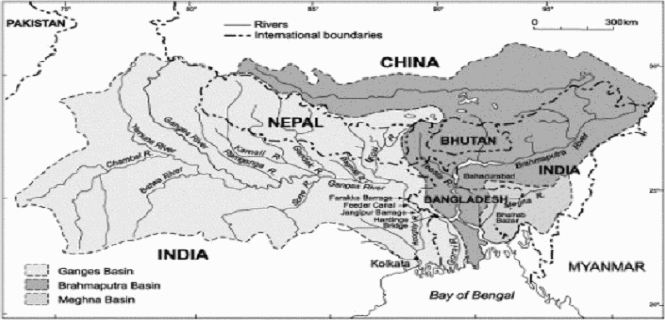
A trans-boundary river between India and Bangladesh, the Ganges is one of the most important rivers of South Asia. Along with a few Indian rivers, some originating in the Tibetan Autonomous Region of the People’s Republic of China and passing through and some originating within Nepal, serve as tributaries to this great river. Its basin covers a little more than one million sq km and spreads over four countries – China, Nepal, India and Bangladesh. Though cooperation among the countries of the basin, especially among Nepal, India and Bangladesh, for harnessing the water of the Ganges for the socio-economic betterment of the people, has long been a subject of discussion at the political and professional levels, yet it has remained a mirage.
Of the Ganga basin countries, India is the dominant user of the Ganges water and the major player in regional cooperation. To fulfil her water requirements it has pursued a policy of bilateralism with Nepal and Bangladesh in relation to the waters of this river and its tributaries for the last six decades. More recently, India seems to be rethinking its policy from bilateralism to regionalism in the context of the construction of dams on the Brahmaputra river by the People’s Republic of China and its inter-basin water transfer projects and India’s own growing water demands in her northern heartland.
In such a backdrop, this paper dwells on the efforts made so far for regional cooperation, possible reasons for it not happening, the latest developments and some personal reflections. Published public and other relevant documents, along with discussions with experts, form the basis of this paper. The first part of the paper dwells on the importance of the Ganges and efforts made towards regional cooperation; the second part looks at the current situation in the basin and other developments that could contribute to effective regional cooperation.
Originating from the Gangotari glacier at Gaumukh in the Indian Himalaya, the Ganges flows 2,500 km across the fertile northern Indian plains into Bangladesh before finally meeting the Bay of Bengal. En route it is joined by several major tributaries from Nepal and India.
1 The basin is among the most densely populated regions on earth, home to 655 million people, with an average density of over 551 persons per sq km, which in the delta goes up to 900 persons per sq km (www.panda.org).The Gangetic plains are the granary of northern India; its water is home to a variety of fish, the source of food for millions of people. The major North Indian industrial towns are also located on the banks of the Ganges, as a result of which the water is severely polluted. Its delta area, the Sunderbans, is home ‘to a host of rare and iconic species.’ The basin is also characterized by pervasive poverty with over 70% of the population living on less than US $2 per day (The World Bank 2012).
I
n addition to the availability of extensive groundwater resources, the estimated annual run-off from the rivers of Nepal is 220 billion cubic metres, with an average annual precipitation of 1530 mm (WECS, 2002). The Ganges is the natural drainage of all the rivers flowing from Nepal. The annual average contribution of the rivers of Nepal is 46% of its flow; it is as high as 75% during the lean season (March to May ) at the Farakka barrage.2Nepal, in addition to its vast water resources, has suitable sites for large storage projects capable of holding 77 billion cubic metres of water, constituting about 68% of the total monsoon flow.
3 After meeting its water demands, Nepal contributes to the downstream countries during the lean period to meet their water demands in different sectors. From 1977 onwards Nepal has proposed cooperating with her southern neighbours in the water resources sector at both the government and track II levels.The late King Birendra Bir Bikram Shah Dev, speaking at the 26th Colombo Plan consultative meeting in Kathmandu in 1977, ‘referred to abundant water resources of the country and expressed Nepal’s readiness to develop and share resources – like the waters from the snow-capped Himalayas – for the collective benefit of all the peoples of the region’ (quoted in Lohani 2013).
A
t the very first summit of Heads of States or Governments of the Association of South Asian Association for Regional Cooperation (SAARC) held in Dhaka in 1985, King Birendra emphasized the need for regional cooperation in the field of water resources: ‘From the side of Nepal with the high Himalayas as one of our assets and a vast reservoir of yet untapped water resource that can give to the millions of our people a means to fulfil their basic needs, I wish to draw attention to the fact that there exists this priceless resource waiting to be harnessed for the benefit of our people’ (IFA 2010).|
TABLE 1 Ganga Basin Area Distribution |
||
|
Country |
Basin Area km 2 |
Percentage of Total Area |
|
China |
33,520 |
3.08 |
|
Nepal |
147,480 |
13.56 |
|
India |
860,000 |
79.10 |
|
Bangladesh |
46,300 |
4.26 |
|
Total |
1,087,300 |
100 |
|
Source : Hari Man Shrestha and Lekh M. Singh, The Ganges-Brahmaputra System: A Nepalese Perspective in the Context of Regional Cooperation, Asian International Waters, 1996. (Quoted in Iswer R Onta, Harnessing the Himalayan Waters of Nepal: A Case for Partnership for the Ganges Basin: An Invited Paper for Ganges Forum, Sponsored by IWRA and UN University, Tokyo, 18-20 March 1998, Calcutta.) |
||
Note the response of the Prime Minister of India: ‘We have not sought to melt our bilateral relationship into a common regional identity, but rather to fit South Asian cooperation in our respective foreign policies as an additional dimension’ (quoted in Upadhyay 2013).
N
otably, Bangladesh supported Nepal’s offer and mentioned it as a positive move; this, however, was seen as ganging up by Nepal and Bangladesh against India.4 Despite India’s negative attitude towards regional cooperation, Nepal thought it worth pursuing the matter at SAARC and in other forums such as South Asia Growth Quadrangle (SAGQ)5 and the US-supported South Asia Regional Initiative for Energy (SARI/Energy).
V
arious research institutions based in Nepal, India and Bangladesh too have made a plea for such cooperation. The Water Resources Strategy of Nepal (2002) and the National Water Plan of Nepal 2005 stressed the importance of regional cooperation among the Ganga basin countries in the water resources sector. However, regional cooperation in the sector is yet to materialize. The answer lies in the mindset of the countries of the basin, especially that of India, crucial if regional cooperation is to be a success.Note the National Water Plan 2012
6 and 2010 recommendations of a New Delhi-based think tank, Institute for Defence Studies and Analyses (IDSA)7 in the water sector. Even in pursuance of the treaty provisions signed with Bangladesh (Treaty of 19778 and 19969), which seeks to cooperate with a third country for augmenting the flow of the Ganga at the Farakka barrage, India’s policy has remained one of bilateralism. For example, pursuant to Article IX of the Agreement on the Sharing of the Ganges Waters at Farakka 1977 (footnote 8), India and Bangladesh, in May 1979, ‘decided to approach Nepal for study/investigation of the projects in Nepal... indentify the specific areas where the cooperation of Nepal is necessary…’ (Dhungel and Pun 2008).‘Prior to the Nepal visit, there was clearly a major difference between India and Bangladesh on the manner of approaching Nepal… It was only on 29-31 October 1986 [after the establishment of SAARC] that the Joint Committee of Experts (JCE) from India and Bangladesh finally visited Nepal to seek information and data needed for a study of the possibility of augmenting the Ganges flow at Farakka through the construction of seven storage projects in Nepal…’ (ibid). When it became clear that the JCE had come to Nepal just to procure data from Nepal and was not willing to involve Nepal in the joint study, Nepal expressed its dissatisfaction to the Indo-Bangladesh JCE. It clearly stated that the sharing of data was not a problem, provided it was involved in the joint study from the very beginning so that its interests would also be covered by the study (ibid). The committee went back without any success as it had no mandate to accept the suggestion made by Nepal.
S
o why does India not favour regionalism? Drawing on talks during the track II exercises, it appears that her relations with Pakistan and the People’s Republic of China are the main stumbling blocks. Further, India thinks it is easier for her to deal with neighbouring countries in a bilateral manner rather than in a group, as she takes the position of a lower riparian country with Nepal and has always objected whenever Nepal sought foreign support to undertake storage reservoirs or inter-basin transfers for irrigation purposes in the medium rivers in her territory on the ground that the proposed projects would ‘cause adverse effects on the existing water use in the downstream riparian areas’ (Bhattarai 2009). But, in the case of Bangladesh, her stand is that of an upper riparian country. Evidently, India clearly realizes that opting for regional cooperation would be more complex to handle as compared to dealing with neighbours bilaterally.
S
ince the commissioning of the Farakka barrage in 1975, Bangladesh has sought continuity of the prevailing Ganges flows to meet her growing demands for different purposes through augmentation measures in the upper reaches. In addition, demand for water is increasing in each country of the Ganga basin. But the flow of the Ganges at the Farakka has decreased over the years, mainly due to withdrawal in the upper reaches. In this context, at the 37th meeting of the bilateral Joint Rivers Commission (JRC) between India and Bangladesh, held in New Delhi in 2010, Bangladesh proposed that Article VIII of the 1996 treaty could be ‘implemented by India, Bangladesh and Nepal, by jointly building a reservoir at a suitable location in Nepal, to benefit all the three countries.’
|
Map of the Ganges River and her Tributaries + Brahmaputra and Meghna Basin |
|
|
|
Source : www.sciencedirect.com |
The Ganga basin is also facing high climate variability, seen most dramatically in floods, droughts, and the uncertain timing of the onset of the monsoon. Large areas of the basin routinely suffer from both droughts and floods. Floods already take a significant toll on lives and livelihood in the Nepal lowlands known as the Terai, as well as in Bangladesh and the Indian states of Bihar and eastern Uttar Pradesh. Floods account for 90% of the economic cost of natural disasters in Nepal.
I
ndia also seems to be concerned about the basin water transfer undertaking of the People’s Republic of China, although when her own River Linking Project (RLP) was at the conceptual stage, Nepal and Bangladesh expressed concerns regarding the Indian proposal. It may be recalled that China has undertaken a South-North Water Transfer Project which, ‘eventually aims to pipe 45 cubic kilometers of water annually northward along three routes in eastern, central and western China… the eastern and central routes will be channelled under the Yellow River, while the western route entails pumping water over part of the Himalayan mountain range’ (Moore 2013). Furthermore, China has decided to go ahead with the three dams on the Brahmaputra river. This has caused concern in India who has raised the matter with China at the highest level.
T
he resultant effect of the developments in China seems to have prompted India to move from her current strategy of bilateralism to regionalism in the water sector with neighbouring countries. The signal of the policy shift was indicated by The Hindu in its 15 April 2013 issue: ‘Nepal, India and Bangladesh (NIB) have decided to join hands to cooperate and exploit the hydropower sector and use water resources management for mutual advantage’, including jointly developing and financing projects in the Ganga river basin. In this regard, a note has been prepared by the Ministries of Power, Water Resources and External Affairs of the Government of India (GoI) indicating the tremendous potential for development of water resources and hydropower in the Ganga basin and Ganga having a role ‘in the agriculture, hydropower, fisheries, navigation, and environmental sectors and in the economy of the co-basin countries… The joint initiative will contribute to poverty eradication and better socio-economic integration.’
T
he NIB initiative, as claimed, ‘has been envisaged as a strategy to explore technically and geographically feasible means in the basin for augmentation and equitable distribution of augmented supply of water and power.’ For this purpose, committees of water resources and power ministries of the NIB have been proposed as ‘the highest decision-making body, subject to the approval of the respective governments.’ In this regard, the Government of Nepal is yet to come up with a response.Similarly, the Hindu reports that, ‘In order to derive optimum benefits from the Brahmaputra basin, Bhutan, India and Bangladesh have agreed to work jointly towards cooperative development and management of water resources and hydropower in an integrated and holistic manner.’ The basic aim of these initiatives, ‘is to implement programmes in partnership with member states that will contribute to strengthening the cooperation mechanism and to long-term sustainable development, economic growth and sub-regional cooperation.’
According to knowledgeable professionals, however, the supposed U-turn from the current policy of bilateralism to regionalism will have to be watched carefully. They are unclear whether India is really interested in regional cooperation or has declared this policy just to secure the support of neighbours to pressurize China. Furthermore, they argue that even if the Indian efforts on the Brahmaputra river succeed, it is India that will gain the maximum benefit, not the other supporting country, as Bangladesh is downstream to India.
It is reported that Bangladesh wants to capitalize on the changed Indian attitude and hopes to entice Nepal in the regional initiative once again. And she wants Nepal to act quickly, expressing disappointment with its attitude.
Furthermore, ‘Despite Delhi’s nod, the sub-regional plan to augment the water flow of the Ganges river, on which more than 40% of Bangladeshis depend for agriculture, stumbles as the Nepalese government has sought further time before approving the regional initiative.’ In this regard, it may be mentioned that Nepal is in a state of transition; its current government is in no position to take any long-term decisions for the country and on its main natural resource, water.
F
rom the above discussion, it should be clear as to where regional cooperation for the Ganga basin stands. The countries of the basin have to traverse some distance to achieve the goal of regional cooperation in the Ganga basin, despite the advocacy of regionalism for this basin by scholars and studies undertaken by the research institutions of the three countries. According to Indian analyst Brahma Chellaney: ‘Indeed, Asia is one of only two continents, along with Africa, where regional integration has yet to take hold, largely because political and cultural diversity, together with historical animosities, have hindered institution-building. Strained political relations among most of Asia’s sub-regions make a region-wide security structure or more effective resource cooperation difficult to achieve’ (The Kathmandu Post, 8 April 2013). He goes on, ‘This could have significant implications for Asia’s ostensibly unstoppable rise – and thus for the West’s supposedly inevitable decline. After all, Asian economics cannot sustain their impressive economic growth without addressing their resource, environmental, and security challenges, and no single country can do it alone.’The World Bank study of 2012 also called for ‘significantly enhanced regional cooperation in water, weather and climatic information, modelling and warning systems which are essential for the sustainable management of the basin and the safety and prosperity of the people.’
N
epal is aware that even after meeting all her current water demands and safeguarding the interests of the future generation in the wake of her geographical location, the amount of irrigable land (1.8 million hectares) she has and the huge hydropower potential in her 28 large dam sites, places her in a position to cooperate with India and Bangladesh to obtain optimum benefits from her estimated run-off of more than 200 billion cubic metres of waters. Similarly, her neighbours would benefit immensely if this resource were harnessed in a way such that the cooperating countries could be in a win-win situation. In other words, if the rivers flowing from Nepal are properly harnessed, they will make a substantial contribution to the socio-economic development of not only the people of Nepal but also millions of people living in the Ganges belt of South Asia, i.e. India and Bangladesh’ (Dhungel and Pun 2009).The only difference of opinion among the Nepalese stakeholders is on the terms of cooperation with other countries of the region in the water resources sector. Some argue that Nepal should go for large hydropower projects, sell the energy to India and deploy the resources generated for development. Others are concerned about the adverse impact of large hydropower projects on the environment of the country.
The World Bank study (2012) has suggested that Nepal should tap her hydropower potential, which could meet domestic demand and the ensuing surplus used for trading in the region. It, however, cautions that the water stored in the dams would not significantly contribute to flood control and irrigation in the downstream areas. Equally, there is concern that large dam construction would cause the inundation of large tracts of land, displacement of thousands of people and loss of sites of historical importance, for which the country needed to be compensated on the basis of a cost-benefit analysis.
M
any knowledgeable professionals from within the region are of the opinion that India’s wide irrigation network in the Gangatic basin areas is currently not operating at full capacity due to the shortage of water. In such a context, they are surprised by the 2012 World Bank study’s conclusion that large dams in the Himalayas would not have a significant impact on flood control and irrigation. Also, the stored waters may help Nepal to get access to the sea through the Ganges.10 Therefore, Nepal needs to seriously compute the benefits and costs of large dams, transparently and after discussion with all stakeholders, before deciding whether or not to go in for large dams.There are other recommendations of the World Bank study which Nepal could pursue to promote regional cooperation on the Ganges. One such area could be sharing of water related data and information by setting up an institutional mechanism for this purpose. There are, however, those who question the need for data and information sharing at the government level given the technology available to collect data from satellites. Further, as water related data is considered secret by some countries, mainly India, it would help if arrangements to collect and exchange data are also made at the non-government level among the countries of the region.
B
ecause of the historical legacy of treaties and understandings reached on water resources with neighbouring countries, water remains a very sensitive issue in Nepal. The same might be the case with other countries too. It would thus be advisable to inform the stakeholders about what has transpired so far in terms of success and failure with regard to cooperation among the Ganga basin countries and sensitizing them to the importance of regional cooperation. In the process, total transparency must be maintained. Also, countries that have signed bilateral treaties and understandings should honour the commitments made through such arrangements as confidence building measures.For initiating dialogues to help build trust among the countries of the basin – mainly Nepal, India and Bangladesh – and to contribute to regional cooperation among the Ganga basin countries in a sustained manner, professionals and institutions working in the field should come together and form a group, which might be called G-power along the lines of M-power in the Mekong basin.
So far China has not been invited to the Ganga basin discussions. It is my contention that when India herself has raised concerns about developments regarding the Brahmaputra river and China’s basin transfer schemes, there is no reason to be coy about involving China in the Ganga basin regional cooperation exercise. Also, in the context of climate change related issues, i.e. change in ‘water’s time-space distribution and increase risks on floods and drought…’ (XA 2010), it is time to bring China on board in all regional cooperation efforts for the Ganga basin.
I
n addition to initiating a series of dialogues to help the Ganga basin nations develop mutual trust in the field of water resources, G-power could also take a lead in an effort to arrange for data sharing and coordinating studies and research. The proposed forum could work out an institutional framework for cooperation in the Ganga basin in the water sector, discussed openly by the concerned stakeholders and then act as an advocacy group to lobby with the governments for adoption of the framework.It may be mentioned that a cooperation framework for the Mekong river was developed for a totally trans-boundary river. Its total replication, however, may not be possible for the countries of the Ganga basin in designing its own institutional framework for the obvious reasons. Nevertheless, the experience of the Mekong institutional framework could be instructive in designing a framework for the Ganges.
* Corrected by the author after the issue was printed.
Footnotes:
1. The Nepalese rivers are the four large (the Kosi, Gandak, Karnali and Mahakali) and five medium (Kankai, Kamala, Bagmati, West Rapti and Babai) rivers. Indian rivers are the Bhagirathi, Yamuna and Ramganga.
2. Pun (2004) writes that ‘Nepal’s four large and medium rivers contribute a total of 5,675 cubic meters per second to the Ganga, or an annual volume of 179,000 million cubic metres. Based on an annual discharge of 382,000 million cubic metres at Farakka, Nepal’s medium and large rivers alone contribute an astounding 47 per cent of the Ganga’s annual flow at Farakka. Even through Nepal represents just 13 per cent of the Ganga’s total basin area, during the three lean months between March and May, the volume of water flowing through Nepal represents an incredible 75 per cent of the flow reaching Farakka.
3. As per the World Bank study of 2012, the number of large dams sites identified in Nepal was 23 and the aggregate water storage on the river system would be … about 130-145 million cubic meters. But according to the secretariat of the Water and Energy Commission of Nepal, there are 28 dam sites in the country, WECS Bulletin 7(1), December 1995, whose estimated water storage capacity is 77 billion cubic metres (bcm). (Poudel 2009)
4. In this regard the former foreign secretary of Government of India, Maharaj Rasgotra, wrote: There actually was a gang up of sorts on the part of Nepal and Bangladesh on the question of Ganga waters and the construction of reservoirs in Nepal to ensure greater flows into Bangladesh and both countries were unjustifiably accusing India of an obstruction attitude. They wanted tripartite negotiations on water related problems, with Nepal occasionally suggesting China’s participation as well. These were politically motivated moves, primarily on Nepal’s part to extort concessions or simply to pressure or embarrass India. For good reason, we took the view that the issues between India and Nepal on the one hand and between India and Bangladesh on the other were bilateral and unrelated to one another and that China, at any rate, had no role in either case (ORF 2004).
5. Aware of the difficulty in taking up the issues of trans-boundary rivers through SAARC because of its charter, which does not allow member countries taking up bilateral matters/issues in its formal discussions, SAGQ, with Nepal, Bhutan, Bangladesh and India was started in 1996, but it too failed to make headway, mainly due to the lukewarm attitude and mindset of member countries to opt for sub-regional cooperation.
6. The Indian National Water Plan of 2012 also clearly indicates the country’s preference to deal with her neighbours in a bilateral framework. According to that plan, India would pursue the following polices:
‘Even while accepting the principle of basin as a unit of development, on the basis of practicability and easy implementability, efforts should be made to enter into international agreements with neighbouring countries on bilateral basis for exchange of hydrological data of international rivers on near real time basis.
‘Negotiations about sharing and management of water of international rivers should be done on bilateral basis in consultative association with riparian states keeping paramount the national interests. Adequate institutional arrangements at the Centre should be set up to implement international agreements.’
7. The Institute for Defence Studies and Analyses (IDSA), in its study entitled Water Security for India: The External Dynamics, suggests that, in relation to Nepal, ‘the efficacy of the bilateral cooperation needs to be increased by improving the working of the existing bilateral mechanism, including the Joint Committee on Water Resources.’ However, the study alerts the GoI to the growing water stress in the country by 2025 and scarcity by 2050. The IDSA in its report writes that the: ‘salience of water in India’s relations with its neighbours will increase in the coming years. Whether water turns out to be a source of conflict or cooperation will depend upon the policy choices made by India and its neighbours. If South Asia remains in turmoil, cooperation will become difficult. The challenge before India in the coming years will be two-dimensional: to manage its water resources better; and simultaneously to manage its riparian relations with its neighbours.’
The existing bilateral mechanism referred to by the IDSA in relation to Nepal is a high-level committee headed by the water resources secretaries of the two countries constituted to provide guidance and solve the issues faced by other committees.
8. Article IX of the Agreement on the Sharing of the Ganges waters at Farakka 1977 stipulated that the two countries shall: ‘carry out investigation and study of the schemes relating to the augmentation of the dry season flows of the Ganges, proposed or to be proposed by either Government with a view to finding a solution which is economical and feasible. It shall submit its recommendations to the two Governments within a period of three years.’
9. Article VIII of the 1996 Treaty reads: ‘the two Governments recognize the need to cooperate with each other in finding a solution to the long-term problem of augmenting the flows of the Ganga/Ganges during the dry season.’
10. The National Water Highway no. 1 of India intends to connect Patna with Allahabad through the navigation in the Ganges. This waterway could provide Nepal access to the sea through her rivers, Kosi, Gandak and Karnali, all of which flows to the Ganges. The Kosi treaty signed between the two governments, Nepal and India has a provision on navigation, although not solely for providing Nepal with access to the sea. Similarly the Gandak barrage built on the Gandak as per the treaty signed by two governments, Nepal and India, has navigational locks. Some officials of the then Ministry of Water Resources (MoWR), now Ministry of Energy (MoE), of the GoN had told this contributor that the study on the navigation possibility on the Kosi River would be undertaken as part of the study of the Multipurpose Kosi High Dam and Sun Kosi Diversion Scheme, but did not know if the Gandak and Karnali rivers would also be studied along with the study of the Kosi river.
References:
Agreement on the Sharing of the Ganges Waters at Farakka 1977 Between the People’s Republic Bangladesh and Republic of India.
Damodar Bhattarai, ‘Multi-purpose Projects’, in Dwarika N. Dhungel and Santa B. Pun (eds.), The Nepal-India Water Resources Relationship: Challenges. Springer Science+ Business Media B.V., United Kingdom, 2009.
Brahma Chellaney, ‘Asian Century: Asia’s Resource Scramble’, The Kathmandu Post, 8 April 2013.
Dwarika N. Dhungel and Santa B. Pun (eds.), The Nepal-India Water Resources Relationship: Challenges. Springer Science+Business Media B.V., United Kingdom, 2009.
Dwarika N. Dhungel and Santa B. Pun, ‘Impact of the Interlinking of Rivers on Nepal: A Critical Analysis’, in Monirul Q. Mirza, Ahsan Uddin Ahmed and Qazi Kholiquzzaman Ahmad (eds.), Interlinking of Rivers in India: Issues and Concerns. Taylor and Francis Group, London, 2008.
Institute for Defence Studies and Analyses, Water Security for India: The External Dynamics. IDSA, New Delhi, 2010.
Institute for Foreign Affairs (IFA), Statements and Declarations of SAARC Summits of the Heads of State or Government (1985-2010), Institute of Foreign Affairs, Kathmandu, Nepal, 2010.
Government of India, National Water Plan 2012. GoI, New Delhi, 2012.
Mohan Lohani, ‘Harnessing Nepal’s Water Resources in National Interest: A Book Review’, Journal of the Nepal Council of World Affairs, 2013, Kathmandu.
Monirul Q. Mirza and Qazi K. Ahmad, Interlinking of Rives in India: Issues and Concerns in M.M. Quder Mirza, Ahsan Uddin Ahmed and Qazi Kholiquzzaman Ahmad (eds.), op cit., 2008.
Scott Moore, ‘China’s Massive Water Problem’, The New York Times, 28 March 2013.
Iswer R. Onta, ‘Harnessing the Himalayan Waters of Nepal: A Case for Partnership for the Ganges Basin.’ Paper submitted at the Gages Forum, Calcutta, 18-20 March 1998, Sponsored by IWRA and United Nations University, Tokyo.
Som N. Poudel, ‘Water Resources Utilization: Irrigation’, in Dwarika N. Dhungel and Santa B. Pun (eds.), The Nepal-India Water Resources Relationship: Challenges, op cit., 2009.
Santa Bahadur Pun, ‘Overview: Conflicts Over the Ganga?’ in, Disputes Over The Ganga: A Look at Potential Water-Related Conflicts in South Asia. Panos Institute South Asia, Kathmandu, Nepal, 2004.
Maharaj Rasgotra, India-Nepal Relations: The Challenge Ahead, Rupa/Observer Research Foundation (ORF), New Delhi, 2004.
Hari M. Shrestha, ‘River-Linking Concept of India Viewed from the Nepalese Perspective’, in Dwarika N. Dhungel and Santa B. Pun, op cit., 2009.
Hari M. Shrestha and Lekh M. Singh, ‘The Ganges-Brahmaputra System: A Nepalese Perspective in the Context of Regional Cooperation.’ Asian International Waters, 1996.
Strategic Foresight Group, Challenges of Water Stress and Climate Change in the Himalayan River Basins. Kathmandu, 6-7 August 2009.
Strategic Foresight Group, Second International Workshop, Himalayan Sub-Regional Cooperation: Water Security. Dhaka, 2010.
Strategic Foresight Group, The Himalayan Challenge: Water Security in Emerging Asia. Mumbai, India, 2010.
Strategic Foresight Group, Singapore Suggestions: International Workshop Report, Benefits of Cooperation in the Himalayan River Basin Countries. 2-3 December 2010, Singapore.
Strategic Foresight Group, Himalayan Solutions: Cooperation and Security in River Basins. Mumbai, India, 2011.
Treaty Between the Government of the Peoples’ Republic of Bangladesh and the Government of the Republic of India on Sharing of the Ganga/Ganges Water at Farakka, 1996.
WECS, Water and Energy Commission Secretariat Bulletin, Volume 7:1, December 1995. His Majesty’s Government of Nepal, Water and Energy Commission Secretariat, Kathmandu.
WECS, Water Resources Strategy Nepal. His Majesty’s Government of Nepal, Water and Energy Commission Secretariat, Kathmandu, 2002.
WECS, National Water Plan. His Majesty’s Government of Nepal, Water and Energy Commission Secretariat, Kathmandu, 2005.
The World Bank, Ganges Strategic Basin Assessment: A Discussion of Regional Opportunities and Risks, The World Bank, 2012.
Surya N. Upadhyay, International Water Course Law and a Perspective on Nepal-India Cooperation. EKTA Books, Kathmandu, Nepal, 2013.
Jun XA, ‘Benefits of Cooperation in the Himalayan River Basin Countries of Bangladesh, China, India and Nepal: Substance of Cooperation – Specific Proposals and Trade-offs. Paper presented at the International Workshop Report, Benefits of Cooperation in the Himalayan River Basin Countries, Singapore, 2-3 December 2010.