Promiscuity rather than purity
RITA DATTA
IT’S one of those capricious paradoxes of History. A fringe region in the East of the subcontinent, with only a fringe role in politics and culture for over two millennia, had leadership thrust upon it in the modern age. But its very drawback – no overwhelming past to anchor its psyche, no portentous traditions to guard against outside contamination – ensured just the lightness of being for promiscuous mingling with a foreign people. They’d come in from Bengal’s sea coast – nowhere as thriving as the western India ports – and quietly set up house without causing alarm to any of the political players who mattered in the 18th century, generating new social forces, new thought and new creativity. And it’s in their hub, the socio-cultural crucible of Calcutta, that the story of modern Indian art begins.
With, it is usually said, the Bengal School. Because, by positing an alternative to western academicism, Abanindranath Tagore and his followers both retrieved a space for an indigenous vision and stimulated a critical debate on how the knotty issue of identity could be addressed in the context of colonialism. The question may appear irrelevant where continuity runs through change. But for a conglomerate of communities in different stages of development merging into a tentative nation whose contours were yet to be defined, such a debate was inescapable.
O
n the other hand, some scholars would begin with the Bauhaus show of December 1922 held in Calcutta, when avant-garde European art exposed Victorian naturalism as effete and dated.However, if a shift towards incipient modernity has to be mapped, the beginnings must be pushed back by more than a hundred years, to the late 18th-early 19th century, when anonymous artists, under the influence of European practitioners passing through the English East India Company capital, began to use western material: oil and canvas. Migrating from declining native courts, they found new patrons among both the foreign settlers and their Hindu collaborators and, through the years, acquired greater control over perspective and modelling in depicting mythical-religious themes in Renaissance settings. Though this fascinating hybridism lacked the exclusive individual signature distinctive of modern art, its explorations of a new grammar anticipated the way western canon would come to overturn Indian conventions.
|
|
|
Line drawing on Picasso (The Song of the Night of Lost Sleep series), 2008 by Jogen Chowdhury. Courtesy CIMA. |
And bhadralok tastes, too. This was demonstrated by their resistance to the Orientalism of E.B. Havell, who arrived in Calcutta in 1896. Renaissance illusionism, officially promoted by the Company government and disseminated through the Calcutta School of Art (established 1854), had set off a trend that Havell tried to reverse. But under the next Principal, Percy Brown, academic naturalism returned. Interestingly, the official position may have encouraged the revival of the genre in the 1920s through talented artists like Hemendranath Majumdar, Atul Bose and sculptor Debiprosad Roy Chowdhury. In fact, it had never retired, but proved to be, with cunning variations, stubbornly seductive for more than a century and still mesmerizes buyers.
A
nother set of circumstances initiated, around the Kalighat temple in the second half of the 19th century, a linear stylization harnessed in making images both sacred and urbanely profane. However, new technology – the printing press – soon threatened this low-brow art because Battala and its neighbouring localities in the North of Calcutta could churn out garish images on cheap paper that marked ‘the rise of an urban sub-culture’, according to Partha Mitter in his Art and Nationalism in Colonial India. All these new trends, a barometer to calibrate innovations in Bengal’s art, would leave their imprint on later directions.
T
he Bengal School evolved around some very talented artists. Nandalal Bose, Asit Haldar, Chugtai, Sunayani Devi – possibly one of the two earliest Indian women in art, the other being Ravi Varma’s sister, Mangalbai Tampuratti – Kshitindranath Majumdar and others. Three more artists influenced by the Bengal School were Bose’s student Benode Behari Mukherjee, and the Delhi-based Bhabesh Sanyal and Sailoz Mukherjee. And Ramkinkar Baij, though schooled in Shantiniketan, was an example of rugged individualism. If Rabindranath Tagore envisaged a new architecture in symbiotic harmony with the environment, drawing on the regional idiom, Baij pioneered site specific sculpture with unusual material (cement-concrete mixed with coarse laterite earth) that was, in form and texture, as local as it was universal.Inevitably, however, modern Indian art soon outgrew its nationalist agenda. Even before the Calcutta Group (1943) of Prodosh Das Gupta, Nirode Majumdar, Gopal Ghosh, Paritosh Sen, and others rebelled against its assumptions, subversion was afoot: brother Gaganendranath – criticized by W.G. Archer for the ‘un-Indian’ look of his art – and uncle Rabindranath had sensed, even before the Bauhaus show, the irrepressible life force in European trends that were both organic and immensely hungry for inputs from everywhere, whether Tahiti, Japan or Africa. Highlighting the centrality of a dialogue with western art stressed the need for Indian expressions of autonomous worth outside of socio-political parameters.
B
ut another trend soon emerged, promising an indigenous essence which bypassed mainstream traditions such as Ajanta and Mughal miniatures. Though Jamini Roy has been criticized for the patua practice of replicating images, he asserted that the marginal heritage of rural and tribal communities hadn’t atrophied despite the colonial intervention. Startlingly modern in their abbreviated syntax, their idioms meant a return to roots without the baggage of revivalist romanticism. Maturing from a ‘half-hearted orientalist to a robust primitivist, as Partha Mitter puts it in his Triumph of Modernism, Roy’s art displayed ‘structured affinities with the avant-garde in the West who engaged in challenging the teleological certainty of modernity...’ Not surprisingly, he predicted similar quests in later artists.|
|
|
By Dhrupadi Ghosh. Courtesy the artist. |
The Calcutta Group, certainly the first such in Bengal, believed that progress couldn’t be made by clinging to the past. But, wisely, it wasn’t indifferent to regional legacy. Sculptor Das Gupta, for example, who merged Mathura durability with the minimalist elegance of Arp, rued Havell’s failure to ‘revive... the spirit of temple sculpture’ in spite of the ‘…luxuriant crop of terra-cotta temples...’ in Bengal.
B
ut then, the lowly terracotta wasn’t the favoured medium of Das Gupta and his contemporaries, Sankho Chaudhuri and Chintamoni Kar; nor did it quite catch on among later sculptors like Uma Siddhanta, Niranjan Pradhan and Sarbari Roy Chowdhury either, who preferred stone and metal. In fact, though each of these established artists had found his/her own voice, a distilled reticence was common to them: evidently, the spell of western masters like Henry Moore and Brancusi apart from Arp, continued to besiege their imagination. The two major names that were outside this broad trend were Baij and a sculptor of the next generation, Meera Mukherjee. The latter’s startling blend of Ellora classicism with the Bastar dialect promised a refreshed gaze at marginal traditions. Meanwhile, the emphasis of the 1940s had indeed shifted from classical to quotidian, quite in order for the generation that, labelled by Jaya Appaswamy as ‘artists of the transition’, was stepping out of colonial rule into a new democracy.
S
imultaneously, another trend was taking shape. The Bengal Famine unleashed, as World War II thundered on, a nightmare of epic suffering. This was followed by land protests (Tebhaga), riots, Partition, Independence. Three young artists, inspired by Communism and moved by the agony of the affected, devoted their talents to the cause. But what might have degenerated into strident pamphleteering was redeemed by the visceral power of the stark forms that Chittaprasad, Zainul Abedin and Somnath Hore evoked.|
|
|
Cry, 2010 by Kingshik Sarkar. Courtesy CIMA. |
Though their subaltern perspective seems virtually indistinguishable, one from the other, there are subtle differences which reflect the nuances of the Bengali temperament. Chittaprasad’s sturdy, stylized forms and caustic political allegories came from the kind of fierce humanism of an avowed rebel that has only a marginal space for animals and nature. Abedin’s socio-political commitment was, on the other hand, leavened by a sensuous lyricism. Not surprisingly, unlike Chittaprasad, he became part of the art establishment after Independence, in East Pakistan and then Bangladesh. And, as he grew older, Hore moved beyond facile millennial prescriptions. His experience of life came to be crystallized into a meditative anguish over ‘wounds’ in his bronzes and prints alike. ‘Wounds’ thus became a philosophic rather than political metaphor in his work.
The emotional allegiance of these three artists, predicated on socio-economic concerns that usually tilted Left at least till the 1970s, was echoed in the next generation that inherited the IPTA (Indian People’s Theatre Association) legacy. With time, however, these broadened, became more humanist than ideological, and continued to spur creativity in Bengal not just in art but in literature, theatre and cinema as well for about three more decades, and acquired, in the best examples, multilayered suggestions as sensibilities ripened. The skewed illusionism of Bikash Bhattacharjee, which spawned a whole gharana, the arch badinage of Jogen Chowdhury, which spawned another, the wry tableaux of Dharmanarayan Das Gupta, the stricken beasts of Sunil Das, the squinting eroticism of Prakash Karmakar, the weathered tribals of Rabin Mandal, the gender accents of Veena Bhargava, the urchins in Shyamal Dutta Ray and Shuvaprasanna, affirmed implicit social/ humanist sympathies.
I
n a way, therefore, they sometimes acted as the conscience keepers of the ruling elite, choosing to be, as Geeta Kapur succinctly puts it in her Secular Artist, Citizen Artist, ‘both inside the nation and outside the state in their interpretative rendering of the political.’ The Naxalite unrest of the 1970s had, indeed, troubled an artist like Bikash Bhattacharjee. That was when the Congress was in power. Years later, anger over state brutality in Singur and Nandigram (2006/2007) would sear the imagery of Jogen Chowdhury and Shuvaprasanna. This time the CPM was in power. However, despite these examples, it must be said that art hasn’t really grown into a powerful tool of concerted and sustained protest in Bengal.
B
ut protest politics or any kind of anthropocentrism isn’t crucial to a few others. The haunting aches in Ganesh Pyne and the anxious romanticism of Ganesh Haloi largely surfaced from deep within themselves, while Nature was the Muse in Suhas Roys’s landscapes. Both the above trends resonate in the Bengali mind where commitment to public causes resides in an uneasy truce with romantic introversion. Then there’s that maverick teacher, designer, artist and critic, K.G. Subramanyan, whose enquiry into the language strategies of art and the crafts is informed by a quizzical, degage wit. Another artist to be mentioned is Partha Pratim Deb who has wrested a niche for chance and play in his art.
T
he 1960s and 1970s – when many of these artists matured into selfhood – stimulated an exciting engagement with styles. Indigenous legacies and global trends could be raided at will in their search for consciously individual signatures that wouldn’t abdicate regional identity either. Most of this art was, expectedly, representational, with the thematic focus on human and animal forms. Landscapes remained marginal; abstraction more so. Which makes Haloi, the collage artist B.R. Panesar and the younger Badhan Das, who matured in the late 1980s, a minority. With them must be included Lalu Shaw who also produced virile abstractions. However, abstract and semi-abstract expressions survived in the 1990s through such young artists as Shamindranath Majumdar and Arindam Chatterjee.Artists’ groups – like the Society of Contemporary Artists and Calcutta Painters to which a number of them belonged at some time or the other – were an important feature at a time when consolidation was the keynote. Exhibition logistics, not uniformity of concerns, had brought diverse talents together. Though groups still formed, the 1980s and 1990s moved away from this trend. Ramlal Dhar, Paresh Maity, Chitravanu Majumdar, Jaya Ganguly, Jayashree Chakravarty, Jayashree Burman and Samir Aich acquired visibility through shows that didn’t flaunt group banners. Recently, artists’ collectives are being formed once again but with an agenda of common interests. If this hints at changing conditions, it must be remembered that the late-1980s buzz about a boom had soon dissipated.
Yet the 1990s inaugurated dramatic calisthenics in language, demolishing entrenched notions, adopting colloquial idioms and street argot, replacing empathy with irony and argument. Presaged by MTV visuals of dissonant fragments and mercurial jump cuts, of new cartoons and bizarre animation, the digital age has been embraced by young artists in ferment over the postmodern discourse; the camera promises post-production sport; and the internet brings art news and views to the fingertips of freshers. The classic modernism of pre-World War II vocabulary that had dominated the earlier generations is thus being dethroned by pop, fluxus, site-specific activity, installation, conceptual and performance art.
T
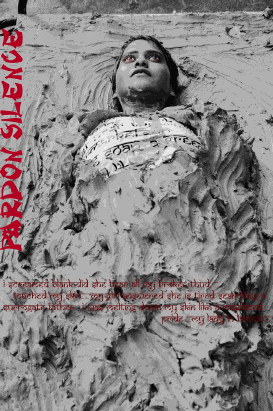
he young have also learned to look beyond the western masters to such rising stars as Shirin Neshat (Iran) and Ai Weiwei (China). Unlikely material has entered art practice. Shreyoshi Chatterjee, Manjari Chakravarty, Paula Sen Gupta, Adip Dutta, Sougata Das and Tapati Chowdhury have experimented with cloth, paper pulp, everyday objects, wire, aluminium foil, nails, sponge and so forth as the incredible Shakila takes her collages from simple depiction to saucy comments to subtle protest. Even paintings appear in a new avatar. Kingshuk and Reshmi Bagchi Sarkar have opted for the Japanese Nihonga technique, with its texture and sheen, while Sumitro Basak’s visual coup lies in his unique narrative manner.Some have sought to locate their art outside the institutional space slyly critiquing the establishment. Refusing the commodification of art, Sanchayan Ghosh of Shantiniketan, inspired by Badal Sarkar’s repudiation of proscenium theatre, initiates interactive happenings with the community. Manas Acharya and Taufik Riaz, both also engaged in video installation, incorporate texts and music in their performance art. Text, computer graphics and commercial signage have been put to subversive use by Anirban Ghosh and Sayak Mitra, while photographs worked upon by Chhatrapati Dutta and Dhrupadi Ghosh acquire teasing suggestions. And this is only the tip of a growing list.
E
ven as this urban art activity questions inherited paradigms, a new and growing interest in folk/tribal expressions has drawn village artists/artisans into the magnetic field of exhibitions and markets. While this trend infuses fresh life into the marginal heritage, changes are quietly induced in their themes, medium and manners. This can be seen in the Midnapore patachitra which is, in fact, something of a multi-media performance art. Artists such as Swarna, Khadu, Madhu and Hazra Chitrakar who, like the bauls and fakirs of West Bengal and Bangladesh, are rooted in a vibrant syncretism that merges Hindu lore and rituals with Islamic faith. They have been inserting images and themes alien to their received iconography. Like the Howrah Bridge, for example. Or the land protest in Singur. More alarming, though perhaps inevitable, is the shift from vegetable to chemical colours and an alteration in form, too. Exposure to urban art nudges them to attempt naturalism. Similarly with the dokra artisans of Birbhum and Bankura, who now do commissioned work matching the buyer’s taste.But these changes, still very fluid, mark a troubled transition. However, since promiscuity rather than purism promises good health to the arts, this corruption of traditional practice may yet yield a broadening of creative horizons. In Bengal as elsewhere.