Kolkata – an archive of cityscapes
PRAMOD KUMAR KG
I have nothing to say, only to show.
– Walter Benjamin
I on the contrary have nothing to show, but to say – about visions of a city, both real and imagined, through the lens of the camera. Kolkata (formerly Calcutta) begins its existence in archival records as a fishing village on the east bank of the river Hooghly. The village was to become the seat of a fledgling trading house – the British East India Company in early 17th century, culminating with the establishment of Fort William in 1701. The Company was subsequently to relinquish control of Kolkata and much of India to the British Crown following the first war of Indian Independence in 1857.
Less than a century later, Kolkata lost its status as the seat of power of the Raj when New Delhi was established as the capital of India in 1911. While historical records document this transition of the fate of the city, another chronicle of this evolution exists in visuals and as images on paper through paintbrushes and photomechanical processes ending with the photographic camera.
Visions of Kolkata in its several stages of existence have existed in various formats and sizes across mediums. While pen and paper, watercolours, etchings, aquatints and oils among other genres simultaneously coexisted till 1840, the arrival of photography in the Indian subcontinent was to change the scene forever. Susan Sontag had famously observed that, ‘a society becomes modern when one of its chief activities is producing and consuming images’, and Kolkata as a subject, capital of the erstwhile British Raj, has been up for grabs ever since. The onset of the age of mechanical reproduction was to consequently alter the manner in which images were being produced, distributed and consumed with the photographic camera offering numerous permutations and combinations of views and frames of visualizing the city by its intrepid photographers – mostly foreign but some native.
Here I focus on the work of a contemporary photographer Nemai Ghosh, whose archives (held by the Delhi Art Gallery) have been akin to the presence of an interlocutor helping us cross-reference various other images of Kolkata through prints, chromolithography, theatre, film, paintings, calendar art and so on. The local and the particular were hugely important in Kolkata and constantly exerted pressure on the global world of images and ideas that the colonial encounter brought to its shores. Technology was constantly adopted and tweaked to suit the local aesthetic with a distinctly local modernity seen coming to the fore in various archives of ephemera that survive and populate our visual narratives of the city. Photography is the last manifestation of this trend.
The realm of archives in India in the traditional understanding of the word has largely meant manuscripts, dusty books and papers from the past. In the last decade or so, the definition has begun to add another medium in its wide-ranging scope, that of the photograph. In the archive fever that seems to have enveloped the country, photographic images have been the most successful expression of the potential of the archive to reach out to audiences at multiple levels, invariably charged with the responsibility of the hermeneutics of the visible. The importance of the archive as a storehouse of a nation’s cultural quotient has meant that efforts are constantly being instigated to harness its largely ephemeral potential.
W
hile a study of ephemera is important to understand constructs of visual practice in India, what perhaps gathers more gravitas is the attempt by contemporary photographers to document even the archives itself, as seen in the works of the pioneering photographer Dayanita Singh in ‘The Great Indian Archive’. Today photographic exhibitions, books and projects of the ‘visual’ abound. The lead was largely established by collectors of 19th century photography and by collections held in India’s cultural institutions. Others emerged from the works of photographers like Kulwant Roy and Homai Vyarawalla who chronicled the country in transition. Several others like the work of photographer Sunil Jannah are yet to fully emerge and give us a view of the rich holdings.|
Satyaki Ghosh |
|
|
|
Nemai Ghosh. |
The first documented photography studio in India was established in Kolkata in 1840, just under a year after its invention was announced to the world. Major Indian photographers like Raja Deen Dayal who took extensive photographs of the city were to continue the work of pioneering European photographers like Felice Beato and Samuel Bourne amongst a host of other names. This trend was to continue with several contemporary Indian photographers like Raghu Rai and the late Raghubir Singh’s rich oeuvre of work showcasing some of the most arresting visuals of Kolkata and the life of its people.
|
Nemai Ghosh / Delhi Art Gallery |
|
|
|
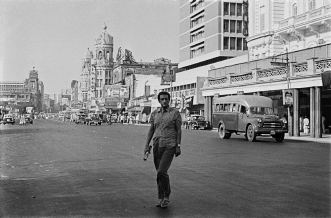
Satyajit Ray in front of the Grand Hotel In Kolkata’s Chowringhee, scouting for location for Seemabaddha (Company Limited), 1971. |
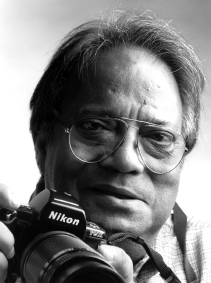
The photographic works of Nemai Ghosh at the Delhi Art Gallery are largely a chronicle of the history of Bengali and Indian cinema of the last quarter of the 20th century. This archive of 1,20,000 images is the only example of a photographic record of cinema in 100 years of its presence in India. Crucially, the archive also holds an extensive range of photographs of the city of Kolkata taken by Ghosh over forty years of his working life in the city. Nemai Ghosh began his practice of photography in 1968 in Satyajit Ray’s Kolkata. The noted Bengali film director was his muse and the sets of his films were Ghosh’s classroom. A self-taught photographer, Ghosh’s motivation began from his first day with Ray when the latter acknowledged that he had captured his very frames. From then on till Ray’s death in 1992, Ghosh was influenced by his own admission, by the tenacity, dedication and discipline of the auteur.
T
hough today best known for his iconic images of Ray, Nemai Ghosh’s career in photography spanned the cultural universe of the latter half of the 20th century. One could be forgiven for assuming it was exclusively about Ray – after all, by his own admission, Ghosh was both fascinated and inspired by his charisma and energy. It was an artistic partnership – for Ray almost certainly used Ghosh’s images although it is unclear how much he directly influenced their framing and composition – that lasted throughout Nemai Ghosh’s career (and indeed, extended to cover Ray’s son Sandip’s early collaborations with his father).However, Ghosh also covered much more in his lifetime. An engagement with performance predominates: he photographed a number of other directors at work (including Roland Joffe, Goutam Ghose, M.S. Sathyu and Girish Karnad among others) with their actors; prominent dancers including Pandit Birju Maharaj, the late Guru Kelucharan Mohapatra and Sonal Mansingh (amongst others); and international dance and mime troupes. And he never forgot his first love, theatre, regularly photographing experimental theatre groups in Kolkata, of which there are over 12,000 images in the Delhi Art Gallery archives. ‘At no point did I lose touch with theatre and its progress,’ says Nemai. ‘I was no longer a part of it, but I watched from a distance through the lens of my camera. It was as if the camera was an extension of myself that built an invisible bridge between me and the stage.’
G
hosh captures people both at work, and in formal portraits, underscoring the interplay between his role as both a documenter and an artist. This process was to extend to his photographs of Kolkata in its various moods, through the year, in various settings and locales, amongst the rich and the poorer parts of the city, indoors and outdoors, amongst its great edifices and within the intimacy of its theatres and movie sets. Actors Utpal Dutt and Sombhu Mitra and Tapas Sen, the master of theatrical lighting, inspired the techniques and staging of his photographs. ‘Shooting with no flash and at slow shutter speeds to capture those dramatic moments has always been thrilling,’ says Ghosh.
T
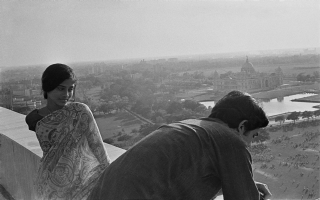
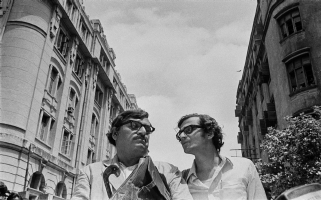
he first images of Kolkata by Ghosh were largely shot while Ray was scouting for suitable locations for his Calcutta trilogy of films – Pratidwandi (The Adversary), 1970, Seemabhaddha (Company Limited), 1971 and Jana Aranya (The Middleman) in 1975. The three movies explored the pressures of urban living in a metropolis on young educated men. Kolkata with its colonial architecture is seen in the movies just barely recovering from the multiple effects of war, famine, loss of the Bengali heartland to East Pakistan, influx of refugees and the collapse of the city as a port and industrial town. These first images of Kolkata depict the city looming large over its protagonists and the shadows and darkness in Ghosh’s images replicate this vital detail of Kolkata in almost every frame.Ghosh’s great reluctance to avoid using a flash or artificial light meant that he invariably captured the moment as he saw it. The urge to introduce an artificial source of light would have meant that the captured moment was not true or real. This fidelity towards authenticity is what marks Ghosh’s work from several others who photographed the city of Kolkata.
|
Nemai Ghosh / Delhi Art Gallery |
Nemai Ghosh / Delhi Art Gallery |
|
|
|
|
|
|
Dhritiman Chatterjee and Joyshree Roy in a scene from Pratidwandi (The Adversary), 1970. |
Utpal Dutt and Pradip Mukherjee in Jana Aranya (The Middleman), 1975. |
Ghosh’s images reveal his ability to become an unseen, unremarked presence, capturing images, moods, sets and scenes like frames in the mind of the director. Working in inhospitable conditions with difficult light, sometimes too dim to capture the cityscape and at other times too harsh to avoid, Ghosh invariably managed extraordinary compositions of his hometown. Much of his work as seen in the archives is moderated by the prevailing technologies of the time, and his learning ‘on the job’. The perspectives and views as seen in his photographs inform us today of his personal vision of the city that were unfolding in front of him at the sets, which were usually the streets of Kolkata.
I
t was with a Canonet QL 17 camera that Ghosh started his working career. He then moved on to the Cannon FTb semi-professional SLR camera with a 50 mm f/1.4 lens and a 135mm f/2.8 telephoto lens. From 1975, he moved to using a Nikon FM2 and its later iterations, concluding with the Nikon F100 that he currently uses with the 50mm f/1.4, 85mm f/1.4 and the wide lens 28mm f/1.4 and 35mm f/2 that allows him to capture Kolkata in all its glory. Ghosh candidly admits that he could never afford the more upper end, state of the art gadgets, but in his eventual choice of equipment he never allowed his artistic vision to be compromised. The quality of the negatives in the archive shows the variety of film available in India at the time and tell us a great deal about the various companies producing film and the great lengths he went to find film that would be suitable for what he set out to capture.
V
iewing Ghosh’s photographs of Kolkata during his stint as a unit stills photographer to a large movie making set-up and otherwise during his own watch of the city, what is strikingly apparent is the absolute cohesion in his vision of looking at the city in a real human scale. One of the proclivities of 19th and early 20th century photographers was to capture the expanse of the city to take in the wide expanse of the maidan and other Raj markers like the Victoria Memorial or the ordered chaos of carriages outside Writer’s Building. Unlike them, rarely does Ghosh allow his views of the city to dominate its citizens.Forty years of documenting the city has not quelled his passion and Ghosh is still seeking the new Kolkata emerging from the changing reality of his past. His enthusiasm to climb the 35th floor of a new city high-rise to see how his beloved Kolkata looks from up there is an excitement that keeps him going nowadays. After much prodding he admits that his photographs of the city were a reaction sometimes to all those who came and shot it from the outside and why he thinks his view of the city is an insider’s take.
Images of Kolkata or a visualization of the city begins possibly in the late 18th century when English and Scottish missionaries in Kolkata made use of local patuas or scroll painters for setting up presses and typesetting the newly standardized Bengali script. While some of the earliest mechanically replicated images were woodblock engravings, mechanically reproduced prints were produced by the middle of the 19th century along with the arrival of photography in the city. The different mediums though continued to coexist for several decades together, well into the early years of the 20th century when the ascendance of photography was remarkable as against the production of bazaar prints, chromolithographs and other visual aids in colonial India.
O
ne of the significant differences of the visual image being created was that of the landscape of the city. While photographs by Europeans working for the colonial establishment went about capturing views of buildings, vistas, monuments and parks in the city, these urban landscapes rarely permeated the world of ephemeral images that were widely being circulated. It was only much later, in the 1970 and ’80s, that the inner city with its streets, buildings, graffiti walls, windows and doors and the lived reality of its inhabitants was found suitable as a subject for the work of several Indian and foreign photographers.|
Nemai Ghosh / Delhi Art Gallery |
|
|
|
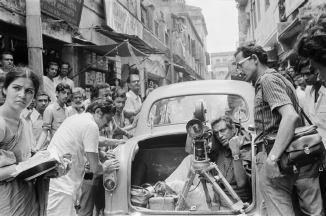
Satyajit Ray behind the camera with crew on location on Kolkata’s streets shooting for Jan Aranya (The Middleman), 1975. |
Ghosh’s work in several ways provides a counterpoint from photographers of the past and how they see the city. He makes his position as an insider very clear with his choice of settings and moods that only a resident with years of recee and familiarity would stumble on. The sheer number of images in the archive is a testimony of his love for the city and his willingness to capture another nuance of the same on a different day. People’s perception of a city are usually coloured by the lived reality of several others. Today, with the explosion of visual aids in the form of photographs plastered across almost every space from news channels to advertisements and on the cricket field, an original image almost ceases to register in this surfeit of imagery. That then is the value of this enormous archive of photographs by Nemai Ghosh. They provide us with an original chronicle of a city as seen by its best biographer, photographed over four decades with all the human drama that animates every major city of the world.
F
or an archivist, the perfect image amongst Ghosh’s thousands is one that perhaps does not immediately bare its secrets to the beholder. For Ghosh’s images come with a visual codicil of several dozen other photographs of the same landscape; some precede and others follow this moment. A careful pouring over the series allows one to delight in the wonderment of each frame, their differences and similarities allowing every viewer to take their pick. These were the moments that Nemai was privileged to capture and is the reason why his images are unique, imbued with a comprehensive quality, hitherto unrecognized.
* Pramod Kumar KG is the Managing Director of Eka Archiving Services, India’s only museum consulting company. He established the Anokhi Museum of Hand Printing, directed the Jaipur Virasat Foundation and instituted the Jaipur Literature Festival. He has worked extensively with textile and photographic collections, and is the Consulting Editor from India for the Textiles Asia Journal. He is the author of Posing for Posterity – Royal Indian Portraits (2012, Roli Books) and curated a seminal exhibition on Nemai Ghosh in January 2013.