Sanskara
P.D. SINGH and SANJAY KUMAR
CASTE based prejudice and discriminatory practice against children from marginalized communities, especially from Dalit and other lower castes, in our government schools has been commonplace. Though manifest in different forms in different times and contexts, this has been an important factor affecting the school participation of these children. There are many studies and reports which have documented and narrated the painful experiences of these children in classrooms and in schools.
1 The various forms of discrimination, humiliation and physical violence that children from lower caste, especially Dalit communities, have been subjected to in the schools have been vividly described in the autobiographical writings of many Dalit writers when recollecting their own childhood experiences in government schools.2These narratives suggest that many teachers, in their relationship with Dalit and lower caste children, tend to reproduce the discriminatory attitudes and practices which underlie caste hierarchies and relations in the larger society in the school. However, during the last decade the social composition of children in government primary schools has significantly changed. Data indicate that the number of children enrolled in elementary education increased by 57 million to 192 million between 2003 and 2009, and the number of out of school children declined from 25 million to 8.1 million during the same period.
3 A large part of this increase in enrolment is from the historically marginalized and excluded communities such as Dalits and other lower castes. The social composition of children in government primary schools now largely reflects the social composition of the populations that the schools serve.
T
hus, it can be said that a process of inclusion of Dalit and other lower caste children, at least in terms of access to school, has been taking place in government schools during the last one decade. But, does this mean that this changing reality has also had a significant impact on the working of caste based prejudices and discrimination in the schools? In order to address this critical question of the role of caste based prejudices in shaping the relationship between teachers and children from marginalized communities, a pilot study was conducted in two government primary schools in Bihar, which reveals that parallel to the inclusive processes mentioned above, caste based exclusionary processes are still working in the schools, though more in subtle than direct forms.4The study was conducted in two government primary schools in Wazirganj block of Gaya district in Bihar.
5 It was based primarily on in-depth interviews and informal interactions with teachers, and classroom and school observations. One of the schools was situated in a village inhabited primarily by the most marginalized Musahar6 community, while the other was situated in a multi-caste village, socially and economically dominated by upper caste Rajputs. Children from all communities in the villages were enrolled in the schools. The caste-wise break-up of children enrolled largely corresponded to the caste-wise break-up of the communities in the villages served by the schools (Tables 1 and 2).|
TABLE 1 Social Category of Children Enrolled in Schools |
|||||||||||
|
Social Category |
Number and Percentage of Children |
||||||||||
|
School 1 |
School 2 |
Total |
|||||||||
|
No. |
Per cent |
No. |
Per cent |
No. |
Per cent |
||||||
|
Upper Caste |
35 |
11.04 |
4 |
2.12 |
39 |
7.71 |
|||||
|
Other Backward Castes (OBCs) |
4 |
1.26 |
79 |
41.80 |
83 |
16.40 |
|||||
|
Extremely Backward Castes (EBCs) |
18 |
5.68 |
46 |
24.34 |
64 |
12.65 |
|||||
|
SC (excluding Musahar) |
78 |
24.61 |
5 |
2.65 |
83 |
16.40 |
|||||
|
Musahar |
182 |
57.41 |
55 |
29.10 |
237 |
46.84 |
|||||
|
Total |
317 |
100.00 |
189 |
100.00 |
506 |
100.00 |
|||||
|
TABLE 2 Social Category of the Total Households in the Villages Served by Schools |
||
|
Social Category |
Households No. |
Per cent |
|
Upper Castes |
21 |
8.4 |
|
Other Backward Castes (OBCs) |
42 |
16.8 |
|
Extremely Backward Castes (EBCs) |
32 |
12.8 |
|
SCs (excluding Musahar) |
38 |
15.2 |
|
Musahar |
117 |
46.8 |
|
Total |
250 |
100.0 |
T
he majority of the children (63.24 per cent) were from Dalit communities. Children from the Musahar community alone constituted 46.84 per cent of the total children enrolled; only 7.71 per cent children belonged to upper castes. In case of 41.11 per cent children, their fathers had never been to a school, while the mothers of 81.03 per cent children had never been to school. If we add to this category those who had been enrolled in a school but had dropped out before reaching class V, these percentages rise to 49.61 and 87.35 respectively. Thus, around half of the children were first generation learners.Further, 62.65 per cent children were from landless households. Another 16.80 per cent were from near-landless households owning less than one bigha land (local unit of measurement of land). Only 3.16 per cent children belonged to households which owned more than five bighas of land. In terms of occupation of the father, 43.48 per cent children belonged to a category where the father was a casual labourer, involved mainly in agricultural, brick kiln, local construction work, etc. In the case of another 30.24 per cent children, the fathers were engaged in cultivation. But, not all of them were owner cultivators. A large number of them were small tenant cultivators whose economic status could not be said to be significantly better than casual labourers.
I
n our study, the deep-rooted caste based prejudices were found to be working through a belief among teachers in the notion of sanskara. Based on this notion, teachers considered children from Dalit and lower castes as hereditarily ‘uneducable’. When asked about the reasons behind the failure of children from the marginalized communities, particularly from the Musahar community, a majority of them said that sanskara of these children and their parents was responsible for it. A common response was, ‘How can these children study; they do not have sanskara.’ As a school teacher put it: ‘Sanskara is responsible for the educational failure of the children from the Musahar community because parents’ sanskara gets reflected in the children also and children begin to view themselves in the image of their parents.’When asked to further explain how sanskara played a role in education of these children, the teachers used various connotations, such as lack of education among parents, poverty, home environment, lack of cleanliness, etc. to describe it. The following responses from teachers are illustrative:
Children of Musahar community are not able to succeed in education because their parents are illiterate. Even when these parents want to educate to their children, they are not able to do so due to poverty. The sanskara of these parents is such that instead of sending their children to school, they send them to work.
Due to lack of sanskara, parents from Musahar community do not take care to educate to their children. Due to lack of education, unclean living habits and poverty, the parents themselves do not have sanskara conducive to education.
These attitudes and beliefs were common not only among teachers from non-marginalized communities but among a number of teachers from marginalized communities too. One of the Dalit teachers said, ‘Due to their sanskara, parents from the marginalized communities do not take interest in their children’s education. Their sanskara is also reflected in this attitude. Lack of education among these parents is related to their sanskara from the beginning.’
N
oteworthy in the responses of the teachers was that while explaining the reasons for educational failure of children from the marginalized communities, they pointed out various factors such as poverty, lack of education among parents, and lack of a conducive home environment. But, instead of relating these factors directly to educational failure, the teachers related these factors with sanskara which was not conducive to education and learning, arguing that lack of sanskara was responsible for the educational failure of these children. It would perhaps have been less problematic if sanskara was taken to mean ‘cultural’ or ‘social capital’ related directly to socio-economic conditions. Then it could be argued that marginalized communities, due to their poverty and illiteracy, lacked the requisite cultural capital which is necessary for their children to succeed in the current schooling system.The belief in the notion of sanskara becomes problematic when teachers begin to view it in terms of ascribed or hereditary attributes of communities. When asked to further elaborate, one teacher asserted that sanskara was a hereditary disposition, while another explained it as related to ‘blood’ of an individual, meaning sanskara to be a genetic attribute. When the question of how a person’s sanskara was formed was posed to the teachers, their belief in its hereditary character became clearer. The responses given below typically represent the teachers’ belief in this regard.
A child’s sanskara begins to be formed in the womb of his/her mother. After birth, it is formed by parents’ sanskara, lifestyle and environment of his/her community and society.
Children receive sanskara from their parents. If the parents’ sanskara is good, children’s sanskara will also be good.
S
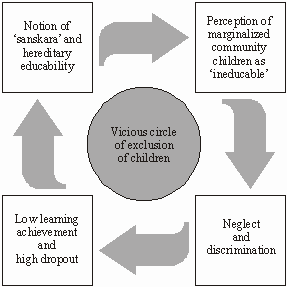
anskara was thus considered by a majority of teachers as a hereditary attribute which is transferred from parents to children from generation to generation. Further, teachers related good sanskara with the learning ability and interest of children, and advanced a cyclical argument in this regard: ‘Good sanskara comes from education and education is not possible without good sanskara.’ Because parents from marginalized communities are illiterate, they do not have good sanskara. Since they themselves do not have good sanskara, they cannot inculcate the same in their children. As a result, their children too do not have good sanskara and, therefore, these children cannot study and learn. Finally, because sanskara is hereditary, these children are hereditarily ‘uneducable’. Through these cyclical arguments, the teachers were found to construct their perception of children from the marginalized communities as being ‘learning deficient’ or ‘uneducable’.Though this view was dominant, it was not an uncontested perception. Some of the teachers, particularly from the marginalized communities, confidently rejected this dominant perception, and argued that school based factors such as quality of teaching were responsible for the educational failure of these children. A Dalit teacher identified three factors – uninteresting teaching and learning, lack of professional skill among teachers, and fear-based teaching methods. Another teacher said: ‘Parents’ sanskara is not responsible for the educational failure of children from Musahar community. It is found that children of parents without having the so-called sanskara have also become great scholars and thinkers. Poverty and the related constraints have kept these children away from education. Today, everyone from the Musahar community is aware that their children too need to get educated.’
I
t seems that because of the growing awareness and assertion among the marginalized communities with regard to their children’s education, even the dominant belief among a majority of teachers in the notion of heredity-based ‘educability’ is not expressed explicitly in terms of caste. Rather, the expressions are camouflaged with the help of cyclical arguments about relationship between education and sanskara. However, the caste based principle of purity and impurity underpinning the notion of sanskara comes to the surface when teachers begin to relate sanskara to the traditional occupations of the marginalized communities.For instance, a majority of teachers believed that although pig rearing was a ‘polluting’ occupation, and a sign of ‘bad’ sanskara, the Musahar community continued to rear pigs because of its inherent sanskara. A few examples of responses from teachers in this regard given below are quite revealing: The sanskara of Musahars is such that they consider pig rearing as good... Their sanskara itself is such that they eat pig-meat... and do not consider it as polluting. Due to pig rearing, children and parents of Musahar community can never develop good sanskara.
T
he Musahar community is considered ‘unclean’ by a majority of the teachers; their traditional occupation of pig rearing is considered ‘polluting’; and the ‘unclean’ Musahar community is considered to be engaged in this ‘polluting’ occupation because of its hereditary sanskara. This reminds us of the basic structural principles of ‘purity and pollution’ underlying the caste system as explained by various scholars7 whereby the traditional occupations of ‘pure’ higher castes are also considered ‘pure’ and that of the ‘impure’ lower castes ‘impure’. Thus, the basic principle underlying the notion of sanskara is the same as that of the traditional caste system. In the traditional caste system, the lower castes were considered to be ‘unfit’ for learning and education, because learning and education were considered to be a ‘pure’ vocation. Similarly, teachers today believe that children from Dalit or Musahar communities do not have a sanskara conducive to learning and education.One of the teachers in our study schools even went on to explicitly state that, ‘One cannot even dream of the mental development of those who are engaged in pig rearing.’ Thus, although caste was not directly referred to by the teachers while explaining the reasons behind educational failure of children from marginalized communities, it was primarily caste based attitudes and perceptions on which their belief in the sanskara was based. The teachers, however, were generally found to be reluctant to directly discuss the role of caste factor in schools. They asserted that caste identity of the children did not matter in the school and that every child was treated equally. This assertion was, however, belied by the fact that the Bal Panjika (Children’s Register) maintained by schools, contained a column which explicitly described the caste identity of each child of the village. Thus, the matter of caste identity of the children in the school was explicit, and the official school records described it openly, and saw it as important.
T
he belief in the notion of sanskara and inherent ‘uneducability’ of children from marginalized communities adversely affects the nature of teacher-student relationship as well as the overall school ethos and environment. In our study schools it was found that teachers generally did not indulge in any overt acts of discrimination or violence against children from marginalized communities. The discriminatory behaviour by teachers, such as unnecessary and excessive beating/corporal punishment to marginalized community children, engaging them specially in performing such tasks as sweeping the school, back-row seating arrangement for them in the classroom etc., which have been reported by other studies on school education, were not being practiced in our study schools. Instead, teachers were found to have developed an attitude of sheer neglect towards children from marginalized communities and had very low or no expectations of learning achievement from these children.Neglect by teachers in classrooms and schools severely affects the self-worth of these children and further alienates them from and pushes them out of the schools. This whole phenomenon takes the shape of a vicious circle as shown in the accompanying diagram.
T
he teachers’ attitude of neglect has a severe impact on retention as well as learning achievement of children, especially from marginalized communities. Class wise enrolment data from our two study schools (Table 3) shows high dropout rates in both the schools. The data indicate that while there is a consistent decline in the number of students between classes I and V, the decline is very sharp after class I and class IV.|
TABLE 3 Class-wise Enrolment of Children |
||||||
|
Class |
Number and Percentage of Children |
|||||
|
School 1 |
School 2 |
Total |
||||
|
No. |
Per cent |
No. |
Per cent |
No. |
Per cent |
|
|
Class I |
153 |
48.26 |
69 |
36.51 |
222 |
43.87 |
|
Class II |
52 |
16.40 |
43 |
22.75 |
95 |
18.77 |
|
Class III |
46 |
14.51 |
40 |
21.16 |
86 |
17.00 |
|
Class IV |
46 |
14.51 |
23 |
12.17 |
69 |
13.64 |
|
Class V |
20 |
6.31 |
14 |
7.41 |
34 |
6.72 |
|
Total |
317 |
100.00 |
189 |
100.00 |
506 |
100.00 |
There is a lack of socially disaggregated data on learning achievement. However, data available from a few studies indicate very low levels of learning among children from marginalized communities. A study based on NSSO data shows that the percentage of children between 6-14 years who can read and write widely varies between SC children (58.2 per cent) and children from other castes (72 per cent).
8 Another study of selected primary schools in West Bengal during 2001-2002 also observes a wide difference in learning outcome of children from disadvantaged social categories such as the SCs, STs and Muslims. About 13 per cent of SC children, 25 per cent of Muslim children and 29 per cent of ST children in standard III and IV could not read. For the rest of the population, this proportion was merely eight per cent. Similarly, compared to the eight per cent of children in standard III and IV belonging to the ‘others’ categories who could not write, 13 per cent of SC children, 27 per cent of Muslim children and 43 per cent of ST children could not write.9
|
Vicious Circle of Exclusion of Children From Marginalized Communities |
|
|
Though the notion of sanskara and the attitude of neglect prevalent among teachers have an adverse impact on learning experience and outcome of children from all communities, their impact on children from marginalized communities is particularly severe. To understand this differential impact, it needs to be kept in mind, first, that children from marginalized communities constitute the majority in government schools. Second, the current teaching methods in the mainstream government schools are mainly based on the practice of ‘home work’ which requires children to get adequate academic support from parents and resources at home in order to be able to perform reasonably in schools. Since children from marginalized communities are mostly first generation learners from poor and illiterate wage labour families, they cannot get the requisite academic support at home. For these children the classrooms and the schools, instead of home, have to be the main learning places. To make the classrooms and the schools relevant and joyful learning places for children from marginalized communities, and to enhance their school participation, retention and learning outcomes, it is necessary that the issue of prevalence of caste based notions of hereditary educability of children is adequately recognized, and strategies are evolved to address it properly.
* In traditional Hindu society the various life cycle rites and rituals were called ‘sanskara’ – ‘naamkaran sanskara’ (naming a child), ‘vivaha sanskara’ (marriage), ‘yagyopavita sanskara’ (sacred thread ceremony), ‘daaha sanskara’ (death ceremony), etc. Each caste group in the hierarchical structure of the Hindu social order had a specific set of ‘sanskara’. Castes placed higher in the hierarchy were considered purer and their sanskara was also considered purer and higher in status. The lower castes did not have the right to adopt and perform the sanskara of the higher castes. As the caste system was based on birth, a person’s right to a particular sanskara depended on the fact of his birth in a particular caste. In recent times, the term ‘sanskara’ is used by common people to describe the socio-cultural attributes of a person which he/she has inherited by being a member of a particular caste. Caste is considered to be based on birth and, therefore, a person’s sanskara is also considered to be based on his birth in a particular caste and cannot be changed.
Footnotes:
1. PROBE Report. OUP, New Delhi, 1999; Geetha B. Nambissan, ‘Social Diversity and Regional Disparities in Schooling: A Study of Rural Rajsthan’, in A. Vidyanathan and P.R. Gopinathan Nair (eds.), Elementary Education in Rural India: A Grassroots View. Sage Publication, New Delhi, 2001; R. Govinda, (ed.), India Education Report. OUP, New Delhi, 2002; Jean Dreze and Harish Gazdar, ‘Uttar Pradesh: The Burden of Intertia’, in Jean Dreze and Amartya Sen (eds.), Indian Development. OUP, New Delhi, 1996; Lal Bahadur Ojha (ed.), Dalit, Adivasi and School. Samavesh, Bhopal, 2003; M. Murali Krishna, ‘Pedagogic Practice and the Violence Against Dalits in Schooling’, in Christine Sleeter, et al. (eds.), School Education, Pluralism and Marginality: Comparative Perspectives. Orient BlackSwan, Delhi, 2012.
2. Dadasaheb More, Deradangar. Radhakrishna Prakashan, Delhi, 2001; S.K. Limbawale, Nar-Vanar. Radhakrishna Prakashan, Delhi, 2003; Daya Pawar, Achhut. Radhakrishna Prakashan, Delhi, 2003; Om Prakash Balmiki, Joothan. Rajkamal Prakashan, Delhi, 2003.
3. The World Bank, Press Release No: 2010/304/SAR. The World Bank,Washington, DC, 2010.
4. The study was conducted during 2009. We are grateful to DFID India, New Delhi for providing financial support for the study.
5. Names of the schools and the teacher respondents have not been revealed in order to protect their identity and confidentiality.
6. The origin of Musahars, who are known by different names in Bihar and its adjoining states, still remains debatable. In colonial ethnographic works, they have been related to different tribes both within and outside the region. While Nesfield (1888) linked their origin to the Kol and Cheru tribes of Chotanagpur based on legendary myths of ‘Deosi’, Risley’s (1891) hypothesis based on the etymological explanation of the word Musahar (rat-eater or rat-catcher) traces their origin to the Dravidian Bhuiyas of southern Chotanagpur. Indian ethnologist S.C. Roy (1935a, 1935b) links their origin to the independent section of the old ‘Desh Bhuiyas’ or ‘Pauri Bhuiyas’ in the tributary state of Orissa. For a detailed discussion on this, see Gyan Prakash (1990).
7. Louis Dumont, Homo Hierarchicus. Vikas Publication, Delhi, 1971; G.S. Ghurye, Caste and Race in India. Popular Prakashan, Bombay, 2005 (1932).
8. E. Barr, et al. (eds.), Dalits in India and Nepal: Policy Options for Improving Social Inclusion in Education. Division of Policy and Planning Working Papers, UNICEF, New York, 2007.
9. Pratichi India Trust, The Pratichi Education Report II: Primary Education in West Bengal: Changes and Challenges. The Pratichi India Trust, Delhi, 2009, pp. 11-16.
References:
Gyan Prakash, Bonded Histories: Genealogies of Labour Servitude in Colonial India. Cambridge University Press, Cambridge, 1990.
H.H. Risley, Tribes and Castes of Bengal, 2 vols. Bengal Secretariat Press, Calcutta, 1891.
John C. Nesfield, ‘The Musheras of Central and Upper India’, The Calcutta Review (171), 1888.
S.C. Roy, ‘Report of Anthropological Work in 1930-31: Chotanagpur, the Chutias and Bhuiyas’, Journal of the Bihar and Orissa Society (18), 1935.
S.C. Roy, Hill Bhuiyas of Orissa. Man in India Office, Ranchi, 1935.