Freedom through education?
SHUSHMITA CHATTERJI DUTT
A high proportion of out of school children today either live in remote areas or urban slums without appropriate primary education facilities. Many of these habitations are likely to be inhabited by economically disadvantaged communities that are predominantly Scheduled Caste (SC), Scheduled Tribe (ST), Other Backward Classes (OBC), or Muslim groups. The opportunity cost for a child to attend school is high, and girls are specially disadvantaged. The majority of out of school children (OOSC) in India today are adolescent girls. The list of reasons for depriving girls of education sounds like a litany, repeated ever so often in many research documents. Many families may choose not to send their daughters to school, but there are others who may not have the appropriate facilities easily available. The table below indicates the community-wise status of out of school children. It is expected that a substantial proportion of the total SC, ST and Muslim OOSC would be girls.
|
Communities |
SC |
ST |
Muslim |
|
2005 |
8.1% |
9.5% |
10% |
|
2009 |
5.9% |
5.2% |
7.7% |
|
Source : Joint Review Mission, SSA, June 2010. |
|||
The number of ‘out of school’ children is steadily declining. The SSA Project Monitoring System report for the 15th SSA Joint Review Mission 2012 indicates that in 2011, 3.2 million children were not enrolled in school; down from 5.2 million in 2010. The Annual Status of Education Report (ASER 2011) has found that 11-14 year old girls are the hardest to keep in school, though concerted efforts have brought down the numbers of such out of school girls from 10.3% in 2006 to 5.2% in 2011.
In recent years, a number of programmes have been initiated for educating adolescent out of school girls between the ages of 9-18 years. These girls have dropped out before completing their primary cycle or have never enrolled and are already playing adult roles, especially in poor rural households. The term ‘Alternate Learning Systems (ALS)’ is mainly used for education programmes for those who have been ‘left out’ of the education net due to supply side inadequacies or specific unmet needs from the demand side. There now exist many ALS models with varying levels of impact and outreach. However, it would be correct to say that most ALS designs try to ensure that adolescent girls rejoin regular mainstream schools and complete elementary education. The programmes also aim to expand the public space for girls, increase their awareness and confidence levels.
1This paper examines the needs of adolescent girls who have been left out of the primary education cycle within the Capability Approach frame-work. The Capability Approach (CA) is a theoretical model developed by Amartya Sen and Martha Nussbaum to interpret human well-being. CA understands poverty as capability-privation and human well-being as the freedom to function as individuals may desire.
2 CA also points out that an individual’s understanding of desire fulfillment is often influenced by existing social structures.3
U
nterhalter argues that education enhances one’s claim to a good quality life ‘entailed in the concept of capabilities’.4 The Capability Approach draws upon education to ensure social justice, just as feminist pedagogy draws on ‘conscientization’ for awakening the individual’s understanding of society. This paper finds that education by itself is a necessary but insufficient input for individuals to take charge of their life choices. It would require policy and programmatic support as well as wide-ranging social transformation (not catalyzed exclusively by education) in order to build capabilities.
T
he Capability Approach helps to highlight how conditions in the environment can limit individual freedoms or capabilities. Unterhalter explains, ‘For example, inefficient distribution of resources for schooling – not only lack of money, buildings or equipment, but also lack of understanding regarding how to teach in gender equitable ways that are sensitive to class or race or regional differences might result in… a failure of capabilities… Similarly placing an extra burden of domestic work on girls in families, restricting the amount of food they eat, prohibiting women from participating in decision making or discriminating against women at work… limit the intrinsic good of education for women and men.’5Robeyns argues that, ‘Functioning includes working, resting, being literate, being healthy, being part of a community, being respected and so forth. What is ultimately important is that people have the freedoms or valuable opportunities (Capabilities) to lead the kind of lives they want to lead.’
6It is the responsibility of the state to enhance capacity and human capital to widen social, economic and political opportunities. The factors that should be addressed are (i) Individual capabilities such as ones’ health, educational competencies and skills etc. (ii) Socio-structural and cultural factors such as social and gender norms, power relations, discriminatory practices. (iii) Systemic factors such as health and educational arrangements, governance provisions, among others.
7These factors specially affect adolescent girls who have been left out of the primary cycle. There exist multiple disadvantages – gender, low literacy, poverty and, in majority of the cases, social marginalization. Thus, while education provides the framework of opportunities for these girls, it remains insufficient to support the achievement of all round well-being or effective freedom for them.
T
he Capability Approach shows the requirement for policies, services and resources that support improvement in lifestyles.8 This has been elaborated by Nussbaum explaining the CA as: Life – Normal length of human life without experiencing discrimination or indignity. Health – Bodily health (including reproductive health) and adequate nutrition etc. Bodily integrity – Protection against bodily abuse and exploitation (including sexual exploitation). Senses/Thought – Ideas that are informed and nurtured by education, freedom of expression. Emotions – Attachments of one’s choice; express empathy and sympathy with others as desired. Control over one’s environment – Material, social and political environment of one’s life.If it is accepted that improvement of lifestyle should encompass all of the above, then girls’ well-being cannot spring exclusively from their being educated till the primary or even the elementary level. The girls would require support from an enabling policy environment, supportive social attitudes of the community and family, effective governance structures, and an inclusive economic environment.
9
A
residential education camp called Pehchan10 for girls who either did not complete primary education or were never enrolled was initiated in Tonk district, Rajasthan. The baseline survey found that families regarded the girls as unpaid working hands and did not consider their educational needs as important. Unflagging and intensive efforts by NGO facilitators convinced the families of the benefits of education and persuaded them to send their daughters to the camp. The security of adolescent girls was an important issue among the local communities and proved a serious impediment to starting the camp. The camp was, therefore, organized in a well-secured hostel built for pilgrims that was occupied only during special festival periods. The selected teachers were provided a 40-day residential training along with a week long acclimatization stay at the neighbouring villages.11
E
xperiential and Participatory Learning (E&PL) methods with a re-conceptualization of the student-teacher relationship were introduced in the camp. This intervention with its flexibility, single sex classrooms and wider, life-related curriculum provided avenues for adolescent girls to resume and continue their education. A key feature was that the girls reside and study at a place removed from their homes so that they are not distracted by family demands to participate in household work or paid employment. Pehchan provided for high teacher-taught contact time and practical orientation on negotiating local systems.
|
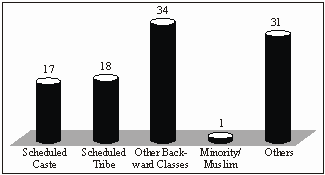
Figure I Social Profile of Girls |
|
|
|
Source : Manisha Jani.12 Total number of girls 101. |
A critical input to the Pehchan experience was strong and continued community, family and organizer interaction. Parents were encouraged to visit the girls and occasionally stay overnight. The curriculum for girls was linked to life related requirements. Initially, there were a number of girls who dropped out of the camp because they were homesick or could not adjust to camp life. Initially, when one girl left the camp, all others from her village would follow her. Gradually the girls began to mingle with each other, learn new lessons and share with one another. However, the total number of girls present at the camp at any one time tended to vary as they travelled back and forth from their homes for festivals, illnesses and other reasons.
The learning levels of the girls were assessed and learning groups were formed accordingly. The girls played and attended class together, shared rooms, books, food and water. They also prepared a roster for sharing other responsibilities like cleaning the premises, organizing games and activities for the camp, serving meals. The girls loved to dance and sing their local songs and camp activities were regularly interspersed with dance and song sessions.
E
xperiential and Participatory Learning (EP&L) methodology which includes discussion, discourse and debate was used. The participatory methods of teaching and individualized attention to students were key tools employed at the residential camp. There was no corporal or other forms of punishment. The organizers arranged for the girls to visit the local post office, primary health centre and banks. The local officers at each institution provided the girls a guided tour to help them understand how the institution functioned. The girls went on bus rides and even a train ride to the nearest station. They were encouraged to form groups and plan each step of their journeys.After the girls were oriented on nutrition and food preparation, groups were formed to take charge of the planning of meals, purchase and storage of kitchen stocks. The girls soon began to keep the accounts of expenditure being incurred at the camp. But it is clear that these girls need additional economic and social resources if they are to (i) complete at least secondary education, pick up additional skills (for income generation and otherwise); (ii) influence their life choices regarding marriage, child bearing, place of residence; and (iii) enrich their quality of life (e.g. better health, expanded economic opportunities).
T
he Chetna Satra or Awakening Session introduced the concept of equality before law and individual freedom along with ideas about rights and responsibilities of individuals in society. Exposure to Experiential and Participatory Learning (EP&L) built critical thinking among the girls. Relevant local and other events and incidents associated with caste, economic, social and political power would be discussed and girls encouraged to share their own experiences. The Chetna Satra was the platform for introducing sensitive topics like early marriage, dowry, dowry deaths and atrocities committed on women. These methods helped the girls to understand the position and situation of women and girls in society.
|
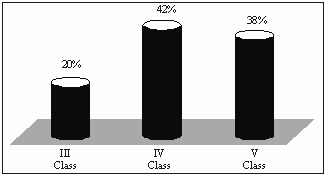
Figure II Pass Percentage of All Girls With Level 13 |
|
|
The girls learnt about human anatomy and bodily functions. Charts and visuals were used to explain the human reproductive system. The girls’ right to bodily security formed an essential strand of discussion. The results of the academic assessment carried out indicated that the residential camp had brought some encouraging results.
B
efore the camp drew to a close, Balika Manches or Girls’ Clubs were formed. These would continue in the villages after the girls returned home. These clubs were meant to help the girls’ network remain alive. This was also one way to fight learning loss among girls returning to largely non-literate environment. This continued contact helped keep alive many of the new attitudes and thoughts that had been introduced at the camp. Girls who had not been to the camp were also encouraged to become members and interact with camp graduates.However, the camp and the girls’ education made no changes in the core attitude of the parents and guardians about the restrictive social mores that surrounded the girls. It was clear from discussions with the parents that these would not be relaxed. It was also found that while the girls had begun to assert their independence in small ways, the short stay at the camp had not sufficiently empowered the girls to challenge the core social mores, or influence change in the fundamental behaviour patterns of the larger community.
14
R
esearch suggests that investing in adolescents helps break the inter-generational cycle of low literacy, morbidity and poverty. The Pehchan experience suggests that education may help these adolescent girls build a better future for themselves, but it is not known how long these changes in the girls’ own behaviour and thinking will last in an unsupportive environment. It is thought that more intensive and wider inputs are required if even the small changes experienced by the girls is to become more permanent. These inputs will include quality primary education with high transition to secondary education, attention to adolescent girls’ health and nutrition, protection from violence, exploitation and abuse, and building girls’ essential economic and social assets and skills.
|
Capabilities |
Essential Level |
Effective Level |
|
|
1. |
Awareness of self, voice. |
Girls value themselves and are valued by their family. |
Girls have a secure and valued place in the larger community. They provide direction for and influence community action and thought. |
|
2. |
Decision making, applying choice. |
Girls can and do make informed choices about education, freedom of movement. |
Girls make informed choices about issues that affect their life, e.g. marriage, child bearing, work. |
|
3. |
Accessing information and knowledge resources. |
Girls have access to skills, health and nutrition, education. Girls have knowledge of key government and private sector programmes designed for their benefit. |
Girls participate in available social and economic development programmes. They influence policy for women’s effective equality. |
|
4. |
Creating social and economic space. |
Girls have the knowledge and understanding to adopt liberal social attitudes. |
Girls initiate social change in the larger society, address economic vulnerability. Girls use resources and skills for income generation. |
|
5. |
Claiming political rights. |
Girls understand political systems and their own rights and responsibilities within these systems. |
Girls negotiate the political system to claim their rights; join the system to discharge their political duties at local panchayati raj, state and national political levels. |
Thus, girls’ would require space in the economic arena for their capabilities to be turned into effective gains, and for accessing basic nutrition, better health care and education. They would need to engage with early marriage norms, restrictions on girls’ socialization and political participation. Robeyns
15 has succinctly listed all that girls may require: ‘…resources (income), non-monetary products (care, domestic work, voluntary work), public goods and services, e.g. child care facilities, high quality education, social; institutions, e.g. fair and efficient legal system, liberal community culture, e.g. attitudes towards working mothers, part-time working fathers…’The above framework separates the functional levels into essential and effective. The socio-economic environment must be more inclusive if the changes indicated are to become reality.
N
ussbaum16 has argued that political responsibility of a society is to enhance individual capabilities. This is also the objective of education for adolescent girls. The gap between the rights on paper and the individual’s ability to enjoy them are largely due to the lack of an enabling environment that makes rights available, accessible and effective. Access to socio-economic resources plays an important role in shaping the educational and social outcomes achieved by girls and women. The differing priorities, agenda and power of other individuals in the system influence the capabilities finally experienced by these girls. The final input to secure the girls’ future should be a review of the economic environment to ensure that the adolescent girl uses her knowledge and skills to benefit from available opportunities.
T
he framework outlined above indicates the direction of what is possible. A more detailed operational plan is needed before effective action can emerge. An indicative road map of action could include:* A common understanding and resolution for action towards girls’ freedom.
* Stakeholder analysis and partnerships.
* Plan for priority areas of action.
* Identifying resource requirements.
* Planning capacity building requirements.
A great deal has already been done and progress along the road map has begun. A concerted push and determined resolution should help to achieve comprehensive freedom for girls.
Footnotes:
1. Shushmita Dutt, ‘Choosing a Better Tomorrow: The Status of Women and Girls in Rajgar’, Korea: Asian Journal of Women’s Studies 6(2), 2000, pp. 2-5.
2. David A. Clark, The Capability Approach: Its Development, Critiques and Recent Advances. GPRW-WPS-032, Economic and Social Research Council, 2006, p 3. ‘Functioning – A function is an achievement of a person: what he or she manages to do or be. Achieving a functioning (e.g. being adequately nourished) with a given bundle of commodities (e.g. bread or rice) depends on a range of personal and social factors (e.g. metabolic rates, body size, age, gender, activity levels, health, access to medical services, nutritional knowledge and education, climatic conditions, etc). Sen emphasizes that capabilities reflect a person’s real opportunities or positive freedom of choice.
A. Sen, Commodities and Capabilities. Elsevier Science, Oxford, 1985; A. Sen, ‘Capability and Well-being’, in Martha C. Nussbaum and Amartya K. Sen (eds.), The Quality of Life. Clarendon Press, Oxford, 1993, pp. 30-53; and A. Sen, Development as Freedom. Oxford University Press, Oxford, 1999.
3. A. Sen, ibid., 1985, pp. 82-83. There is Sen’s well-known example of a health survey of women in India where the women’s own perceptions were influenced by societal norms and differed radically from the researchers observations. The women felt they ate enough, though researchers found nutritional deficiency.
4. E. Unterhalter, Education, Capabilities and Social Justice. efareport@unesco.org, 2003, p. 6.
5. Ibid., p. 9.
6. Ingrid Robeyns, The Capability Approach and Welfare Politics. Paper presented at the Conference on Gender Auditing and Gender Budgeting. University of Amsterdam, 2005, p. 3.
7. Sabine Andersen, H-U. Otto and H. Ziegler, Education and Welfare: A Pedagogical Perspective on the Capability Approach. Paper prepared for 2006 International Conference on HDCA, Dept. of Education, University of Bielefeld, 2006, p. 23.
8. Benedetta Giovanola, Capability, Freedom and Equality: Possible Connection. Unpublished paper submitted to Human Development and Capability Association, 2006, p. 56.
9. Shushmita Dutt, ‘Mahashakti – A Study of Women’s Empowerment in Bhopal’, Korea: Asian Journal of Women’s Studies 8(1), 2002, p. 4, 5.
10. Pehchan was managed by CULP, a local NGO working in the education sector.
11. N.P. Stromquist, ‘Gender, Education and the Possibility of Transformative Knowledge’, Compare 36(2), 2006, pp. 145-161 (Routledge, UK). Stromquist has identified teacher training as a key element of transformational education for girls.
12. Manisha Jani , Girls’Residential Camp, India. UNICEF, unpublished report, 2006.
13. Ibid.
14. Anabay Sullivan, Nitika Tolani and Malini Trivedi, Educating ‘Out-of-School Girls’: An Assessment of the Pehchan Project in Rajasthan. Unpublished report, Unicef, India, 2005.
15. Ingrid Robeyns, op cit., 2005, p. 5.
16. Martha Nussbaum, Women and Human Development: The Capabilities Approach. Cambridge University Press, Cambridge, 2000.