Entrepreneurship and industry
SUNIL MANI
THE industrial sector in India has been at the forefront of economic liberalization. In fact, the very first formal policy document on the new economic reforms was the New Industrial Policy Statement of 1991, which sought to reduce barriers to entry by delicensing virtually the entire industrial sector. Consequently, there has been a surge in industrial entrepreneurship in India in the form of a large number of new company formations.
1A number of new technology based industries have sprung up over the last twenty years or so: the larger information and communications technology industry, the biotechnology and the renewed automotive industry are cases in point. Although the industrial investment intentions have increased significantly since 1991, their regional spread remains very uneven. States like Kerala are at the bottom of the table: during the period August 1991 through March 2012, the state managed to attract only 639 proposals involving Rs 17750 crore.
2 This figure is only 0.19 per cent of what has been forcast for the rest of India.The fact that Kerala is not industrialized has baffled policy makers and scholars alike. This is because the state has been one of the fastest growing in the country. With a large chunk of remittances being received from Keralite workers in the Middle East, the state also ranks number one in monthly per capita consumption expenditure. Further, the state has a highly literate work force. The high rate of labour migration from Kerala, both internal and international, would have made it easier for Keralites to gain access to new ideas about industrial ventures and organizational forms. Nevertheless, the degree of entrepreneurship from the state remains at a low level and has continued to be so for a long time. This is despite the fact that some of the most successful companies in India have been established and run by Keralites but, of course, located outside the state.
Many returnees from the Gulf region have set up small and not-so-small industrial ventures just across the Kerala border, such as in the Coimbatore, Erode, Salem and Kanyakumari districts of Tamil Nadu, and Mangalore and Mysore districts of Karnataka, besides the capital cities of Chennai and Bangalore. The state also does not have any significant value adding activities even when it is endowed with such locally available raw materials as natural rubber. Even for those economic activities with a long-standing tradition of factory production such as coir products and tiles, technological upgradation and product innovation have been slow to catch up with the emerging opportunities in demand, both domestic and external.
S
everal reasons have been adduced for this state of affairs. The ranking of these so-called constraints have varied over time. The constraints are land, labour, quality of bureaucracy and the attitude of civil society towards the negative externalities of industrial production such as air and water pollution, deleterious consequences for the water table, and so on. It is worth examining these constraints in some detail, as their resolution is a necessary condition for more entrepreneurship to flourish. This might also help us understand as to why only entrepreneurship based on services has flourished in the state.At the top of the list is availability of land. Although Kerala is fast approaching a stable population, its density (859 km
2 as per 2011 Census) is almost two and half times that of the all India average. Further, given the fertility of the soil and the productivity of cash crop cultivation, the opportunity cost of land in Kerala is, relatively speaking, very high. Both these factors combine to increase the pressure on land to such an extent that there are severe shortages of land coupled with high prices, if and when it is available. A manifestation of this pressure on land is the recent controversy over the ‘smart city project’ which has suffered a time overrun of nearly four years as the acquisition of land, its price and other conditions attached to its lease, has become a major bone of contention between the parties involved. In fact, the lack of availability of suitable land and its price has now become a major constraint, especially for establishing large sized manufacturing firms. To overcome the problem of land availability, an earlier industrial policy had recommended the creation of a land bank, but hitherto this has remained a mere proposal.
T
he second constraint, which earlier ranked very high, is labour. While Kerala labour is skilled and relatively speaking better educated, it is known for being more conscious of its rights than responsibilities. The result is that it can resort to strikes and other forms of unrest even over the simplest of issues. Historically speaking, labour has acquired a bad image as recalcitrant – thanks to the party-political nature of trade unionism and its fragmentation leading to inter-union rivalries. Many analysts now dispute this proposition by pointing to the lower number of strikes and lockouts in the state compared to her neighbours, although the interpretation of these numbers is usually on total than on a density basis.Even though militancy among labourers has decreased over time, the bad image about past behaviour continues to exert a negative perception and a sort of psychological fear among prospective entrepreneurs. Successive state governments have sought to dispel this negative image about labour through massive public relations exercises. Nevertheless, an aspect that remains worrying is the attitude of casual labourers who are typically employed for loading and unloading operations. Despite the existence of legislations governing their employment, like the Kerala Head Load Workers Act of 1978, their erratic behaviour continues to concern entrepreneurs. Even as late as in 2009, according to an Assocham study,
3 Kerala continued to be the fifth top ranking state in terms of the number of man-days lost due to strikes and lockouts. So the negative label on labour has stuck, with no change or improvement with the passage of time.
T
he third constraint relates to the bureaucracy in Kerala which, given its limited exposure to ways of doing business with industrialists, drags its feet on taking decisions. Even as the state claims to have introduced a single window clearance system, in actuality it is a very large single window! Further, there are many instances of corrupt practices and hence the perception that despite paying bribes in Kerala, the task remains unfulfilled. The bureaucracy with its limited exposure and experience is rarely proactive and this too puts off potential entrepreneurs. In short, we face a vicious circle – limited exposure leading to limited experience resulting in limited investment. Despite the recent Industrial and Commercial Policy 2011,4 which seeks to ‘create an effective single window clearance mechanism for speedy approval and statutory clearances to new enterprises’, there is no empirical evidence to suggest that an effective clearance mechanism has been put in place.The fourth factor that has a bearing on the level of entrepreneurship is a heightened sense of environmental consciousness among civil society members. The ‘Plachimada issue’ involving the MNC, Coca-Cola, is a case in point. While in this specific case the evidence seems to have been overwhelmingly against the bottling plant in terms of the deleterious consequences on the water table, scientific opinion remains divided. There are many other less publicized incidents where local people have effectively managed to close down so-called polluting factories,
5 and more often than not these closures have been a result of violent outbursts. This environmental consciousness has also the consequence of local vigilantism serving as an effective antidote to erring industrialists more than the legal instruments instituted by the state.
A
part from these constraints, the quantity and quality of physical infrastructure also acts as an impediment. Of the various factors, electricity and the quality of roads stand out as requiring improvement. The state has been dependent, by and large, on a single source of power, namely hydroelectric (almost 70 per cent). The state has a total installed capacity of 2857.59 mw, but the transmission and distribution loss is a high 16 per cent. Given the rather excessive reliance on hydroelectric sources, and erratic monsoons, the state no longer enjoys the luxury of requisite electricity generation to satisfy power hungry industry.
T
he poor maintenance of the 23,000 kms of road length under the Public Works Department (PWD) implies that much of it is not navigable for easy movement of large container trucks. Worse, the accident rate,6 with its unfortunate and near exponential increase, has made matters worse. Although successive governments have attempted to address these concerns, the poor state of affairs on both electricity and roads continue, although some remedial action as far as quality of roads is underway. Finally, one must also flag the obnoxious practice of political parties declaring a general strike as a way of protesting against national policies like raising prices of petrol. Not only are a number of working days lost, it adversely affects activities such as tourism, which is a major industry in Kerala.The result of these shortcomings is that Kerala has remained, industrially speaking, stultified. The state has, as noted earlier, attracted little industrial investment since the onset of economic liberalization (see Table 1). Worse, there has been no major investment in the state since 2010. Effectively, the number of working factories in the state has remained virtually constant at around 18000 or so.
|
TABLE 1Distribution of Industrial Projects Implemented 1, 1992-2012(Investment figures in Rs Crore at current prices1992-2012) |
|||
|
No |
Investment |
Percentage share |
|
|
Gujarat |
1,618 |
88,450 |
26.01 |
|
Maharashtra |
1,665 |
43,313 |
12.74 |
|
West Bengal |
755 |
32302 |
9.50 |
|
Andhra Pradesh |
1,011 |
29,709 |
8.74 |
|
Haryana |
467 |
17,850 |
5.25 |
|
Tamil Nadu |
587 |
15450 |
4.54 |
|
Karnataka |
275 |
13,070 |
3.84 |
|
Chhattisgarh |
81 |
3,126 |
0.92 |
|
Orissa |
86 |
2110 |
0.62 |
|
Kerala |
81 |
1,019 |
0.30 |
|
Other States and UTs |
3,029 |
||
|
Total |
9,685 |
340,085 |
100 |
|
Notes : 1. This is based on the number of Industrial Entrepreneur Memorandums (IEMs) actually implemented; 2. Data for 2012 is as on 31 March 2012. Source: Computed from SIA Statistics April 2012, Department of Industrial Policy and Performance, Secretariat of Industrial Assistance, Government of India, http://dipp.nic.in/English/Publications/SIA_Statistics/2012/apr2012/index.htm (last accessed on 21 June 2012). |
|||
Foreign companies too have shied away from the state and, according to recent data from the Secretariat of Industrial Assistance (in its April 2002 edition of Fact Sheet on FDI Statistics), Kerala has attracted only about one per cent of FDI (cumulatively from April 2000 through April 2012) which has come to India. Given this state of affairs, the only industrial ventures that Kerala can attract are those from the services sector, which do not require much land/labour, are compliant with the environmental standards that civil society imposes, and for which various incentives are available from the state.
There is, however, a silver lining: Kerala’s record in implementing its industrial proposals is better than the national average. During the period 1992 through 2012, Kerala managed to implement 13 per cent of its proposals while the national average was 11 per cent. A similar figure for Andhra Pradesh is 15 per cent while that for Tamil Nadu it is eight per cent, and for Karnataka, a mere seven per cent. It is, of course, disheartening that a large number of proposals fail to reach their logical conclusion.
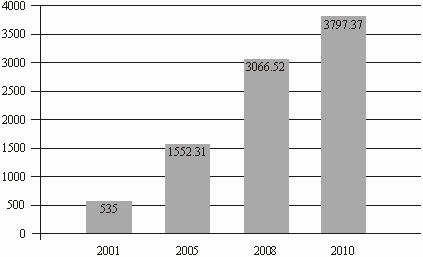
The greatest success comes in retail trade, tourism and hotels and information technology (IT) services – all emerging industries in Kerala, which attract most new entrepreneurs. Of the three, tourism and retail trade have been around for some time, and a number of new ventures and entrepreneurs have emerged in these sectors. Among the two, tourism has received strong support from the state. The Kerala Tourism Development Corporation has been at the forefront in branding and selling tourism services, both in India and abroad. Several new innovative products have emerged, apart from the traditional ones: houseboats and home-stays being two such new products which offer plenty of scope for entrepreneurs. The arrival of package tourists from the West has led to the emergence of a number of tour operators. Tourism is now one of the most dynamic sectors in the state: foreign exchange earnings from tourists have grown at a compound annual rate of 25 per cent (Figure 1). But for the global financial crisis induced negative growth rate in 2008-09, the figure would have been much higher.
|
FIGURE 1 Foreign Exchange Earnings From Tourist Arrivals in Kerala (in Rs Crore) |
|
|
|
Source : Kerala Tourist Statistics. http://www.keralatourism.org/tourismstatistics/Kerala_ Tourism_Statistics_2010_Report.pdf (last accessed on 21 June 2012). |
A
complimentary activity to tourism is retail trade. In fact, the sectoral category trade, hotels and restaurants is the largest contributor, accounting for as much as 21 per cent of the Gross State Domestic Product (GSDP) of Kerala. Projects like the Grand Kerala Shopping Festival, held during December-January, have now become an annual feature. Within retail trade, two areas account for much of the visible growth in this sector, namely textiles and gold jewellery shops, with a number of new entrepreneurs setting up chain stores. In fact, it may not be incorrect to say that Kerala based entrepreneurs now occupy an important position in the gold jewellery trade in South India. However, there are constant complaints about this industry falling short on value added tax (VAT) collections, the main source of revenue for the state. Textile shops of various hues have mushroomed even in smaller towns, most of them dealing in ready-made garments. The recent permission to FDI in single brand retail has led to the emergence of a number of shops dealing with well-known foreign brands. Since such shops are in the franchise mode, this has given yet another opportunity to Kerala based entrepreneurs to express themselves.In recent times, the ICT industry has come to occupy a central place in the government’s industrial promotional efforts. Six reasons or factors can be identified for the emergence of this industry. First, the opportunities provided by the ICT industry itself, as it is one of the fastest growing industries in India. The growth of the outsourcing market, especially with its ‘double-digit’ growth rates over a long period of time, has created plenty of room for new entrepreneurs. Second, the traditional hubs of IT services in India like Mumbai, Bangalore, Hyderabad and Chennai have more or less reached saturation point; hence the industry has started migrating or expanding to second tier cities like Trivandrum and Cochin.
T
hird, from the early 1990s, the state had identified IT services as a potential growth area and invested heavily in the creation of two major clusters of IT service production – the Techno-park at Trivandrum and subsequently, the Infopark at Cochin. These government created clusters are a natural response of the state to overcome the six constraints discussed earlier. Everything is provided under controlled conditions; the parks represent a government solution to government failures in not being able to provide the right type of environment for industry to flourish. The state has also formulated explicit policies for the development of this industry; hitherto three such policies were enunciated in 1998, 2001 and 2007. Further, a draft policy was announced in 2011 making available a number of fiscal incentives. In addition the state has directly tried to promote entrepreneurship in IT by establishing Akshya Centres, promoting e-governance initiatives and starting technology incubators in the Technopark.
F
ourth, is the increasing availability of engineers from Kerala based engineering colleges. This coincided with the liberalization of technical education in the state. A recent study shows that even though the number of seats in engineering colleges increased from 3000 or so in 1991 to about 45,000 in 2011, the out-turn rates have been steadily falling.7 Nevertheless, the system churns out about 12 000 engineers or so annually. Further, even those who fail to graduate can find employment in the lower end of the outsourcing industry such as call centres and data entry operations. This increased supply of engineers has been another important contributing factor, although questions are often raised about their quality which can be a hurdle when the industry attempts to climb up the value chain towards knowledge-process outsourcing.Fifth, Kerala has one of the best communication infrastructures in the country. The overall teledensity of the state stood at 106 telephones per 100 people (as on 31 March 2012) as against the national average of 78. The sixth and final reason is the lowering of entry barriers to the IT industry with a faster diffusion of free and open source software. This has given a major boost to entrepreneurship in IT services. Young engineers now have an opportunity to give commercial expression to their ideas without overly worrying about violating any Intellectual Property Rights (IPRs). In fact, the recent establishment of the International Centre for Free and Open Source Software (ICFOSS) at Trivandrum by the state government is likely to give a fillip to the emergence of a number of new ventures using free and open source software (FOSS) as promotion of entrepreneurship is one of the avowed objectives of this centre.
F
inally, the recent Smart City project, if and when it fructifies, is also expected to jump-start entrepreneurship. But to promote the ICT industry, the state had not only to invest considerable sums of money on the physical infrastructure, but also had to offer fiscal incentives in the form of capital subsidy. This incentive induced industrialization strategy has mixed welfare consequences, since to promote a footloose industry such as ICT, the state has to resort to taxing citizens and pass on the benefits to a group of industrialists in the hope that this will promote employment and generate a multiplier effect. Theoretically speaking, it is difficult to find fault with this argument but, in actuality, we have little information on these multiplier effects, even on the immediate local economy. We need fresh studies on this aspect as the state government is extending this incentive induced way of promoting the IT services industry to second and third tier town within the state.It will also be instructive to analyze Kerala’s record on IT services production. While production data is not easily available, export data is and since exports account for nearly 100 per cent of domestic production, it may be a good proxy. Kerala’s share in total IT exports from the country has remained virtually constant at about one per cent. Further, Kerala ranks ninth (out of a possible 18) among states and union territories rendering IT services in the country.
D
espite its growing importance, the database on the IT sector in Kerala is weak. This is surprising as there are a number of institutions supporting its growth and thus the government’s ability to monitor the effectiveness of its own policy instruments should not be so flimsy. Nevertheless, there are no firm estimates of the number of entrepreneurs involved. A reasonable guess, based on the number of firms in the two parks and including other firms which are located outside the parks, is about 100 entrepreneurs.The background of these entrepreneurs is diverse, but two broad groups can be discerned. The first and smaller group constitutes an experienced and older one with considerable experience either in India or abroad in the IT field.
8 Some of the largest Kerala based IT firms are founded by these entrepreneurs. The second group consists of younger engineers trained in the engineering colleges in Kerala. Numerically this is the larger of the two categories. Some of the members of the latter group have gone on to establishing innovative IT companies which are worth watching.9 Returning entrepreneurs from Silicon Valley have started a few companies, as have erstwhile employees of public sector enterprises such as Keltron. IT services with growing opportunities are likely to be an important segment in the industrial landscape of the state.There are three other emerging areas which are important in Kerala. These are Ayurveda (both manufacturing of Ayurvedic drugs and related services), real estate and running of professional colleges of various sorts, but predominantly in engineering education. However, all the three areas are replete with, relatively speaking, a larger proportion of fraudulent pretenders and very often their activities have brought a bad name to the rest in each of the three industries. Government regulation of their conduct has also been rather superficial and tardy and the guilty have often got away lightly.
Finally, although Kerala has the potential to be an industrial haven, at least for small and medium type of enterprises, its ability to attract investment from the rest of India and abroad, including from non-resident Keralites, remains doubtful. There is little in the state’s industrial policy to iron out the constraints discussed earlier. Instead, the policy makers have resorted to massive public relations exercises to wipe out the ‘bad image’. The forthcoming ‘Emerging Kerala Investors Meet’ in September 2012 is a step in that direction.
Fortunately, there a few success stories where entrepreneurs have struggled against odds and created a number of successful companies. A study of these cases is more likely to encourage entrepreneurship in the state. Kerala will also have to seriously consider promoting small and medium enterprisesin the manufacturing sector. This is because no state or country can grow and develop by merely focusing on the service sector.
Footnotes:
1. See Sunil Mani, ‘Promoting Knowledge-intensive Entrepreneurship in India’, in Eddy Szirmai, Wim Naudé and Micheline Goedhuys (eds.), Entrepreneurship and Innovation in Developing Countries. Oxford University Press, Oxford, 2011, pp. 194-227.
2. See, SIA Statistics April 2012. SIA, Department of Industrial Policy and Performance. See, http://dipp.nic.in/English/Publications/SIA_Statistics/2012/apr2012/index.htm (last accessed on 22 June 2012)
3. See Ravish Jaggi, States Industrial Disputes and Labour Laws. Assocham Research Bureau, (last accessed on 23 June 2012).
4. See http://www.kerala.gov.in/docs/policies/draftic_policy11.pdf (last accessed 20 June 2012).
5. See Staff Reporter, ‘Mob Vandalizes Clay Company’, The Hindu, 17 November 2008. http://www.hindu.com/2008/11/17/stories/2008111757710300.htm (last accessed 21 June 2012).
6. According to Kerala Police, the number of fatalities in road accidents increased from 2710 in 2000 to 4145 in 2011. See http://www. keralapolice.org/newsite/pdfs/Road/2010/comparative/death_in_road_accidents_ 2011pdf (last accessed on 22 June 2012).
7. See Sunil Mani and M Arun, ‘Liberalisation of Technical Education in Kerala: Has Higher Enrolment Led to Larger Supply of Engineers?’, Economic and Political Weekly 47(21), 2012, pp. 63-73.
8. Prominent examples of these are the founders of IT firms like IBS, SunTec and Nest Technologies.
9. Companies like MobMe wireless, which emerged as a winner in the NASSCOM Emerge 50 Innovation 2011 or QBurst, are examples of this category.