Annus horribilis
JAHANGIR AZIZ and OMKAR GOSWAMI
BY the afternoon of 16 May 2009, many were over the moon. Most psephologists, political commentators and TV pundits had said that the Indian National Congress would be lucky to win more than 150 seats out of 543 in the general election for the 15th Lok Sabha. Yet, with a favourable vote swing of over two per cent points, the Congress ended up bagging 206 seats – 61 more than in 2004. Its allies, too, performed well: Trinamool Congress won 19 seats compared to just two in 2004; and the DMK secured 18 seats.
And so, the Congress-led United Progressive Alliance (UPA) won a total of 262 seats, gaining 80 more than the 14th Lok Sabha – just 10 short of cornering 50% of the lower house. It was beyond anybody’s expectations barring, it must be said, the publisher of this magazine, who was shouting 260 from the rooftop at least a fortnight before the counting.
For many, an even more agreeable outcome was the decimation of the left parties. From 43 seats in 2004, the CPI(M) won only 16 in 2009; the CPI’s tally fell from 10 to 4; and the total number of Lok Sabha seats of the left plummeted from 59 in 2004 to 24 in 2009.
W
e believed, therefore, that after five years of doing very little – often hamstrung by the unyielding left – the Congress-led UPA-2 had got the mandate to return to reforms. Not just the stuff that would warm the cockles of corporate India’s collective heart, but more importantly in areas of physical infrastructure, social sector reforms and improvements in governance practices that were holding up better opportunities and higher growth across the land.That hasn’t happened. To be fair, the UPA-2 began its second term in difficult conditions not of its making. The global economy was reeling from the impact of the post-Lehman financial crisis and activity in India was threatening to slow down precipitously.
Since then, however, two and a half years have passed and the UPA-2 government has largely disappointed on almost every policy front. Apart from some partial reform to petroleum pricing, the government has had little to show for itself. What we see is a tragic potpourri of an honest but tired prime minister who is unable to lead his cabinet colleagues; of the government’s two senior-most and highly competent ministers scrapping across Raisina Hill; of one nasty bit of corruption after another tumbling out of the woodwork; of reforms coming to a grinding halt in an atmosphere that is utterly devoid of positive, bipartisan lawmaking; and a pervasive sense of a government that, having lost its ability to govern and deliver, is just marking time.
Is this a fair description? A failed UPA-1 followed by an even worse UPA-2? To get a fix on it, we need the split the question in two periods: the five years of UPA-1, and two and a half of UPA-2. Looked this way, the story has greater colour and context.
Here is the summary. Whatever the constraints of politics and governance with the left as bedfellows, India did well for herself in terms of economics and business during UPA-1. No doubt, there was serious governance neglect; but that was over-compensated by the best period of economic growth of the nation which spread across much of the land.
In contrast, despite being liberated of the left and the obduracy of some other allies, the UPA-2 has been a disaster, both in terms of economics and politics. Arguably, some of the economics is not of its making, coming as it has in the most volatile era that the world has seen since the Great Depression. But disastrous politics, the lack of any purpose worth the name and a comprehensive breakdown of decision-making have made matters far worse. And 2011 certainly qualifies as India’s annus horribilis.
T
he politics was pretty bad during the period 2003-2008: the last years of the Vajpayee government hadn’t delivered major reforms; that was followed by the UPA-1. Even so, India produced excellent GDP growth, which some commentators have described as the country’s ‘recent golden years’. Here are the numbers: in 2003-04 real GDP growth clocked 8.5%. That was followed by 7.6% in 2004-05. Then came three spectacular years: 9.5% in 2005-06; 9.6% in 2006-07; and finally 9.3% in 2007-08. The average GDP growth for the period was 8.9% – the highest that India has seen in any five year period since recorded economic history.How did this come about? The most important factor was the phenomenal entrepreneurial drive across the land. Liberated from the high interest regime of the second half of the 1990s, and operating in a milieu of relatively low inflation, Indian entrepreneurship came to bear like never before. We are not talking only about the corporate icons of new India such as TCS, Infosys, Airtel, ICICI Bank, HDFC and HDFC Bank, Axis Bank, and other high growth enterprises in the services sector. We are talking about major investments and growth in manufacturing as well as in exports.
P
eople forget that 2003-08 was the era that saw significant rise of the auto-mobile industry. Tata Motors made its mark with the now ubiquitous Indica V2 followed by the Indigo; Mahindra and Mahindra introduced the Scorpio; Maruti-Suzuki expanded its range significantly beyond the old 800 cc, the Zen and the Esteem; trucks and buses were selling better than ever before; Hero Honda became the world’s largest selling motorcycle company and Bajaj Auto introduced the Discover followed by the Pulsar; there was locomotion everywhere. But that was not all. Manufacturing grew across the board: in textiles; forgings; foundries; transformers and switchgears; boilers; clinker and cement; steel; fast moving consumer goods; and construction activities.To understand this, it is useful to look at the share of corporate investment in the national economy. In 2003-04, it was a modest 6.8% of GDP. By 2003-04 it had risen to 10.3%; then to 13.7% in 2005-6; followed by 14.9% in 2006-07; and then 18.1% of GDP in 2008-09. Roughly three-fourths of this was investment in equipment to set up capacities for meeting greater demand.
The other factor was a rapid growth in exports. Despite poor infrastructure, Indian exports increased substantially over the period. In 1999-2000, exports accounted for 12.3% of GDP. By 2003-04, it had already risen to 16.3%. The share continued to rise till it peaked at 23.3% of GDP in 2008-09. Thus, 2003-2008 saw high GDP growth driven by hitherto unobserved levels of entrepreneurial breadth and energy – with considerable focus on manufacturing and construction, additional investments in plant and machinery and rising share of exports.
G
rowth was not driven by deficit financing. This is a point worth stressing, especially in today’s context where some ill-read latter day Keynesians believe that real growth and success at the polls in India largely depend upon ever-increasing handouts financed by apparently costless fiscal deficits. The central government’s fiscal deficit in 2003-04 was relatively high at 4.6% of GDP. P. Chidambaram, the finance minister for almost all of UPA-1 steadily brought it down to 3.1% of GDP by 2007-08, despite it including the expenditure on account of fertilizer and oil subsidy bonds. More importantly, gross borrowings of the central government were reduced from 4.9% of GDP in 2003-04 to a little over 3% by 2007-08.How did this virtuous cycle – higher growth, more manufacturing and construction, greater investments, larger share of exports, and reduced dependence on deficits and borrowing – come about despite the UPA-1 government’s policy inactivity? Our hypothesis is that in the five years leading up to the Lehman crisis, the world, especially Asia, saw outstanding growth. India was no exception. Indeed, along with China, India was the cynosure of the world – the fast growing democratic darling of the West, which was set to double its real income once every eight years. The water levels were high; there was consistent tailwind; and all vessels could set sail at high speed without the need to seek huge dollops of assistance from the master helmsmen in government. 2003-08 saw governance inactivity. But it did not witness consistently negative and often dysfunctional governance. That came later.
P
ost-Lehman and UPA-2: In 2007-08, India’s GDP growth was 9.3%. But there was a slowdown in the offing. During January-March 2008, the last quarter of that fiscal year, growth had fallen to 8.5%, after nine successive quarters of over 9%. The slide continued in Q1, 2008-09 (April-June 2008) with 7.8%; and in Q2, 2008-09 (July-September 2008) with 7.5%. Then we were hit by the tsunami of the global crash triggered by the collapse of Lehman Brothers. In Q3, 2008-09 (October-December 2008) GDP growth fell to 6.1%; that was followed by 5.8% for Q4 (January-March 2009). In 2008-09, therefore, GDP growth fell to 6.8% – a far cry from the 9% plus growth that India had witnessed in the previous three years. Shortly thereafter came the national elections, and with it the much strengthened UPA-2.|
|
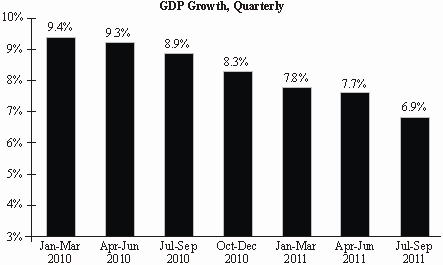
In all fairness, the first year of Manmohan Singh’s second innings as the prime minister saw a recovery. 2009-10 saw GDP growth rising to 8%, thanks to a big spike in the last quarter of the year, when it recorded 9.4%. This high growth momentum continued for the first two quarters of 2010-11: 9.3% in April-June 2010, followed by 8.9% in July-September. Then the next down-slide began, as the chart below shows.
T
o be sure, some of this slide is on account of global factors. One cannot expect buoyant growth in a horribly uncertain environment: the US economy will be lucky to grow by 1.5% in 2011; the euro zone and Japan are likely to slip into recession, and the fate of the euro is hanging off a precipice. Yet, despite facing the same global scenario, China grew by 9.1% in July-September 2011, and is expected to close the year with an annual growth of over 9%.We believe that the slowdown in growth – especially the most recent slump of two percentage points from 8.9% in July-September 2010 to 6.9% a year later – is mostly of our own making. And it has to do with economic and political governance.
Tomorrow’s growth comes out of today’s productive investments. Unlike 2003-08, investment growth has declined dramatically, especially corporate investment which reflects what Keynes called ‘the animal spirit’ of entrepreneurship. One of us sits on the boards of some major manufacturing companies and an institution that specializes in financing infrastructure investments. From this ringside view, he has been seeing one investment proposal after the other being put on the back-burner thanks to economic and political uncertainties and lack of structural reforms. The overwhelming sentiment is to hold on to the free cash, not get into leveraged capital expenditure and, if deemed seriously necessary, to explore investment opportunities abroad.
T
his overarching investment hesitation is now showing up in the data. For the quarter of April-June 2011, gross fixed capital formation (GFCF) grew by a measly 7.9% over the same period in the previous year. For July-September 2011, it has de-grown by 0.6%. GFCF, as a share of GDP, has fallen from almost 35% to just a tad over 30%. Simply put, despite a serious build-up of capacity constraints across most industries, those who ought to be investing are deciding to give it a miss.Why so? The answer is a combination of several factors: inflation; rising interest rates; declining availability of longer term funds thanks to increased deficit financing and government borrowings; huge policy uncertainties; lack of any significant foreign direct investment (FDI); and the seemingly complete absence of governance at the Centre and across several states.
Let us look at inflation. The virtuous cycle of 2003-08 had kept India on a high growth low inflation path over much of that period. However, by the end of 2007 inflationary pressures started to surface. The reluctance of the Reserve Bank of India (RBI) to take pre-emptive steps combined with a rise in global commodity prices pushed inflation from 3.6% in October-December 2007 to 11% by July-September 2008.
A
lthough inflation declined in the immediate aftermath of the Lehman crisis, loose monetary and fiscal policies during 2009-10 fanned its re-emergence, worsened by the drought of 2009. By October-December 2009 inflation had climbed to 9.6%. Since then it has consistently hovered between 9% and 10%.Again the government and the RBI reacted hesitantly, first unsure about the underlying drivers of inflation – was it due to the supply side or on account of demand pressures – and then concerned whether raising interest rates could trip up growth. This heightened macroeconomic uncertainty. Questions about when and at what rate might inflation peak and growth trough, and therefore how interest rates might evolve, began to take centre stage. Not surprisingly, with rising uncertainties, companies shied away from committing to any substantial investment.
There is no doubt that the RBI came in late, and was behind the ‘inflation curve’ for quite a while. Then it woke up, and in its desire to be ahead of the curve, committed to 13 consecutive interest rate hikes – some of which were half a percentage point at a time. The sudden, almost frenzied, approach of the RBI also spooked investments. Now the questions were: What would the next rate hike be? And when would it end?
Simultaneously, the exchequer went out of control. The budget deficit of the central government had been brought down to 3.1% of GDP in 2007-08. It took off thereafter – not only to spend one’s way out of the global shock but also to finance large number of social welfare programmes, including giving Rs 120 per day for 100 days to those below the poverty line under the Mahatma Gandhi National Rural Employment Guarantee Act.
In 2007-08, the fiscal deficit of the central government was at 3.1% of GDP. A year later, it had jumped to 7.8%. In 2009-10, it slowed modestly to 6.5%. And although it was brought down to 4.7% in 2010-11, it still remained elevated. But 2010-11 was an aberration as it contained an unprecedented 1.5% of GDP from the sale of 3G spectrum; without it, the deficit would have been closer to 6.2% of GDP. As it stands, without some obvious sleight of hand, it is unlikely that the government will meet its fiscal deficit target of 4.6% of GDP for 2011-12.
T
he rise in fiscal deficit was naturally accompanied by a huge borrowing programme of the central government. In 2007-08, it was at 3.3% of GDP. This increased to 6.2% in 2008-09; 7.8% in 2009-10; and 5.3% in 2010-11. For 2011-12, with Rs 40,000 crore of revenues from divestment going for a toss, and tax revenues not growing as these should, it is fairly certain that we will continue witnessing elevated levels of government borrowings.This has led to a marked lack of availability of investible funds – much of the money being sucked out by the government to meet its own requirements. Moreover, since the bulk of government expenditure is in the nature of consumption and not productive, short-gestation investments, it has not led to higher government investment-led growth. The stage, therefore, has been set – indeed being played out – for a classic ‘crowding out’, where ever-increasing demand by the government for investible funds is choking off fund availability for the rest of the economy.
W
hat we are seeing, therefore, is a rapid economic transition from the virtuous cycle of 2003-08 to a vicious cycle – inflation, high interest rates, policy uncertainties, high fiscal deficit, increasing government borrowing for consumption purposes, dramatic slowdown of private sector investment – all leading to lower growth, quarter on quarter.Nothing illustrates this uncertainty more than the recent precipitous decline in the exchange rate of the rupee. On 9 June 2011, the rupee stood at Rs 44.64 per US dollar. By 22 November 2011, it was down to Rs 52.49 – a depreciation of almost 15% in four and a half months. Despite huge global uncertainties, the RBI has opted for a virtually hands-off approach towards the rupee. This peculiar stance has given speculators the go-ahead to merrily short the rupee. In a seriously uncertain global economic environment, with a significant current account deficit and very volatile capital inflows and outflows, the clear statement that the central bank will not intervene has made shorting the rupee a lucrative one-way bet.
Would the People’s Bank of China have made such a statement? The answer is ‘no’, even if it had only $310 billion as reserves. Indeed, other central banks haven’t done so. The central banks of Korea and Indonesia have intervened substantially, and these have played an important part in preventing a free fall of the won and the rupiah.
Add to this horrible stew the poisoned garnish of corruption. Till recently, the jails were full of all manner of characters, mostly linked to the 2G telecom scam. Telecom alone accounted for a cabinet minister, a Rajya Sabha MP, a central government secretary and other bureaucrats, as well as senior executives of telecom and real estate companies.
That was not all. The illegal iron ore mining scandal in Karnataka came to the fore and eventually led to the arrest of an ostentatiously powerful Bellary mining lord and his associate. Then there were others such as a member of parliament and erstwhile head of the Commonwealth Games organizing committee; and a well known politician for an earlier ‘cash-for-votes’ scandal.
Suddenly, corruption has become the order of the day. As a friend of ours remarked, it involved businesses relating to ‘aasman key upar’ (spectrum) and ‘zamin key neeche’ (mining). It also involved almost anything in which either the state or central government had a say – be it in terms of licenses and permits, or in terms of funding, such as the Commonwealth Games.
T
his has led to four things. First, the judiciary has taken the centre-stage. It has gone full steam ahead to incarcerate any suspicious person and, till very recently, deny them bail even in cases that were clearly bailable offences.Second, it has created fertile ground for people such as Kisan Baburao (Anna) Hazare and his followers to launch an anti-corruption movement – punctuated by hunger strikes, supported largely by the urban middle class, and covered extensively by the media. One can understand the urban middle class angst: rising inflation has increasingly shrunk their purchasing power; uncertain asset prices have raised serious questions about their future incomes; and they feel let down by the UPA-2 government. It can hardly be doubted that corruption is a serious problem. But to believe that an independent ombudsman under the Jan Lokpal Bill will be a silver bullet to end corruption is at best far-fetched.
As this article is being written, a parliamentary panel has submitted its report on the Lokpal Bill. It has already become contentious: there have been 16 notes of dissent from a 30-member committee; and Anna Hazare has threatened further action if the bill does not meet his team’s full approval. It is quite likely that fireworks are in the offing.
T
hird, there is the making of a comatose bureaucracy. Under normal circumstances, the critical decision-maker in any central administrative ministry is the joint secretary. If she or he approves, the matter is routinely ratified by the additional secretary and the secretary – and also the minister, in case the file escalates to his level. Today, the fear of the CBI, the CVC, the CAG and the judiciary has reached such a level that no joint secretary is willing to approve any significant matter, lest it come back to persecute him.So, for anything of importance to the nation, the decision-making now runs thus: the joint secretary will note in the files, ‘Addl. Secy. may please see’. The additional secretary will note, ‘Secy. may please see’. The secretary will note, ‘Minister may please decide’. The minister will ask the secretary to draft a note that pushes the matter to the Cabinet Committee on Economic Affairs (CCEA). The CCEA, when it has the time to look into this matter, will suggest that it is best decided by a Group of Ministers (GoM), or for even more important matters, an Empowered Group of Ministers (EGoM).
He who today chairs the seemingly endless number of GoMs and EGoMs is none other than finance minister Pranab Mukherjee. From morning to night, the ‘Rabbit of Raisina Hill’ hops from one meeting to another, and occasionally in and out of GoMs and EGoMs, trying to clear as many files as he can, only to find that these have mounted even higher at the end of the day.
Fourth, the legislature is witnessing one of the worst period of bellicosity and mistrust between the treasury benches and the opposition – and indeed between the Congress and at least two of its main allies, the Trinamool Congress and the DMK. Nothing illustrates this better than three recent instances.
C
onsider the government’s proposal to permit 51% FDI in multi-brand retail. Given the antipathy of the opposition to UPA-2, the timing was absurd – coming as it did during the winter session of Parliament. Even more inexplicable was the government not taking into account the views of the Trinamool Congress and the DMK, resulting in it having to suffer the ignominy of being publicly castigated by its two key allies. There were serious divisions even within the Congress. Moreover, despite having once endorsed 100% FDI in retail, the BJP chose to bare its fangs. Predictably, the Parliament effectively shut down, and no business could be conducted. The government capitulated in 13 days, apparently to prevent a crisis resulting in mid-term elections.Then there has been the bi-partisan Parliamentary Standing Committee on Finance under ex-finance minister Yashwant Sinha throwing out the government’s proposal to hike FDI in insurance from 26% to 49%. The committee has insisted that 26% be maintained, and that there be no loopholes to allow foreign partners to increase their equity in any form whatsoever. This occurred despite several attempts by Pranab Mukherjee to meet the chairman and members of the committee, and requesting them to raise the cap.
Finally, there was yet another blow from the same Parliamentary Standing Committee, which rejected the need to give statutory clout to the Unique Identification Authority of India (UIDAI) headed by Nandan Nilekani and, therefore, questioned the very basis of the Aadhar scheme designed to provide an identity card to all Indians. Here, the Standing Committee leveraged the stance taken by the Finance and the Home ministries, neither of which has been positive towards this initiative, being executed by a fellow cabinet minister with the backing of the prime minister. The result: either no decisions, or hugely delayed compromise decisions. That has been the leitmotif of 2011, our annus horribilis.
I
s there hope? Before the government’s backing down on FDI in retail, we would have said ‘yes’. Today, we are not all certain. We considered the introduction of FDI in multi-brand retail as a signal by government to break the shackles and end its policy paralysis. That the initiative had to be withdrawn in less than two weeks suggests that other reforms which are politically sensitive such as land acquisition and pension reform, or those that require a broader political consensus like the Goods and Services Tax are unlikely to see the light of day in the immediate future. We think all significant economic reforms are off the table – at least until the elections in Uttar Pradesh and the Punjab.Therefore, our annus horribilis may continue, because the government is now repeatedly demonstrating that it has lost its gumption to rule – for growth.
* The views expressed by the authors are strictly personal.