Accessing archives
PRAMOD KAPOOR
DESPITE India being a 5000 year old civilization, we have not cared to keep this evidence properly archived. Some of the best and most important Indian archival material is found overseas. Britain, with its long shared history with us, houses some of the most important images and documents relating to its people and places. The most common excuse given by the those responsible for archiving in India is that the British took most of the material with them when they left India in 1947. This is only partially true. The British always believed in making copies (why do you think our government still believes in filling forms in triplicate!) and did leave copies behind, evidence of which can still be found in India.
In my opinion there were two major reasons for a lack of archiving in India. First, perhaps after independence, politicians and administrators were too busy building the nation, creating dams, steel plants, and so on which was a priority and as a result bothered little with archiving. Second, we were then a socialistic republic and not a true capitalist society. Socialistic leanings, perhaps, prevented us from sharing information of the past and present in the way as other democracies had done. In a true democracy, one is supposed to be open and answerable to the people. While we practice democratic principles when it comes to elections, parliament, judiciary and the media, there were areas that were neglected – sharing of political and administrative information, past and present, being one such. The right to information is, after all, only a recent phenomena.
M
y affair with vintage material started in the late ’90s while researching for a book, still work in progress, called the ‘Indian Century’. I was looking for visual material, pictures, paintings, letters, news clippings, or any piece of paper that could be used as illustrations to showcase India from 1900 to 2000. Indian institutions were the obvious starting point. It was not easy. Most doors were securely closed. There were more questions asked than I could even answer. Was I an academic? What was the reason for me to come to the institution? What would I do there if I was allowed? Where would I use the material? Do I have a recommendation? After pulling a few strings I was allowed to fill a form – in triplicate of course – and asked to come the following week. My prayers were finally answered. I was allowed to look at the material but was warned, ‘Be specific, you can’t be allowed to fish in the water.’ The water was indeed deep but muddy. There was endless material, disorganized and there was no guidance of any kind.With this background, I decided to test the waters in London. With much hope, I wrote to various institutions and to my surprise each one responded enthusiastically, giving me a stipulated time with detailed instructions on how to acquire a reader’s pass and the do’s and don’ts of using the collection. They even offered to sift through their collection and keep a pile ready for me to peruse upon my arrival. Only Windsor Castle asked for a copy of the passport as a security procedure, but ensured that I got entry permission before my date of departure from Delhi.
A
mong the many institutions in Britian which I decided to visit, the Queens Collection at Windsor Castle interested me the most. Upon arrival, my wife Kiran and I were received by the elegant curator, Frances Dimond, who took us to our ‘research room’, gave us each a pair of gloves to wear to avoid any damage to the material, and brought a trolley full of albums. There were indeed very rare images of the durbars, the Prince of Wales’ visit to India, the royal family with visiting maharajas, and of all the Queen’s connection with India. One album, particularly one picture in the album, which had photographs of the Queen’s visit to Banaras in 1959, took me back to my schooldays when as young boys we were taken to the ghats on the river Ganga to greet the visiting Queen who was sailing with the Maharaja of Banaras in a ‘MorPankhi’, a boat that the Maharaja took out only when an important dignitary visited the city. And here in Windsor, I was staring at a picture of that same moment frozen in time.We looked at some thirty odd albums till we reached a section where gifts to the Queen from India were documented. Halfway through that section, we saw an unusual image of a shawl that was hand-woven by Mahatma Gandhi for the Queen and presented to her when he visited London for the Round Table Conference (1931). Later, after the tea break, we were taken to the museum where we saw the shawl and, of course, the famous all-ivory throne of Travancore ‘gifted’ to the Queen by the Maharaja.
My romance with vintage material began with that trip to Windsor. Enthused, I was fired up to visit the British Library, my next destination. It is said that you need more than a lifetime to explore the British Library. I now go there at least twice a year and always come back richer with ideas – a lot of them still unfulfilled. I remember my first visit to the British Library in the early eighties when one could walk up to the shelves and open the boxes with bare hands and read and feel the paper on which leaders whom one grew up idealizing had put their pen. It was a moving experience to ‘touch’ the paper on which Bapu himself had written Letters of Dissent.
The library has now grown very substantially in its new location on Euston Road. You can no longer touch important papers; you need to wear gloves and papers have moved from original to photocopies to digital. It has certainly helped to speed up research but has somewhat robbed the romance that comes with ‘touch and feel’!
I
stumbled upon the idea of a book on New Delhi while looking for visuals for the ‘Indian Century’, sometime in the late 1990s. That book still remains a ‘work in progress’ but in the interim I have directly or indirectly contributed to three books on Delhi and New Delhi published by us at Roli Books. It was at the Royal Institute for British Architects (RIBA) that I chanced upon some glass plate negatives of aerial images of Delhi when the city was still under construction. There were no active websites in those days. One had to physically go to the collection, order the boxes, and you would not be given more than two at a time. It took days to look through the collection, but in the end I found images that sowed the seeds of a big idea resulting in a very important book – New Delhi: Making of a Capital (authored by Malvika Singh and Rudrangshu Mukherjee). The discovery at RIBA led me to the Centre for South Asian Studies, University of Cambridge, the Victoria & Albert Museum, London, the Bibliotheque Nationale, Paris, the Getty ‘warehouse’ London, British Pathe, British Library, the newspaper Collection at Collingdale and the very charming Mary Evans Picture Library in the UK. Each offered a unique and memorable experience. Illustrating the article are some of my favourite images used in the New Delhi book.
K
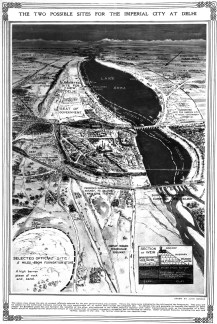
iran and I went to Mary Evans looking for old issues of the now defunct Illustrated London News which was probably the only illustrated periodical of its kind. In the last century, the old issues were not digitized and we were presented with about thirty shelves, very properly organized to look for the relevant months. Buried among the thousands of pages was this unique image which caught our imagination and remains very important to the book.|
|
|
A map published in the Sphere on 8 February 1913 showing the two locations under discussion for the building of the new capital. |
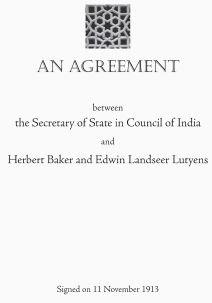
Found in a private collection, we thought it to be so important that we produced a facsimile of the complete document and pasted it inside the New Delhi book. It bears the original signatures of Baker and Lutyens.
|
|
|
A copy of the agreement between the secretary, His Majesty’s Government, and the chief architects, Edwin Landseer Lutyens and Herbert Baker, drawn on 11 November 1913. As per the agreement, the architects were to be paid a fee of 5 per cent of the total cost. The Imperial Delhi Committee was set up to collaborate with the architects and it was to appoint a chief engineer to work out the architects’ plans. The Royal Institute of British Architects (RIBA) was appointed as arbitrator. Baker was located in South Africa while Lutyens worked from his office in London. Both the architects were supposed to visit Delhi at least once a year for the duration deemed necessary by the committee. Their subsistence allowance was fixed at thirty shillings as well as five guineas per day for their absence from home. The conversion rate at the time was fifteen rupees to the pound. The total cost of the project, of the making of New Delhi, was approximately Rs 9 crore, later revised to Rs 13 crore. |
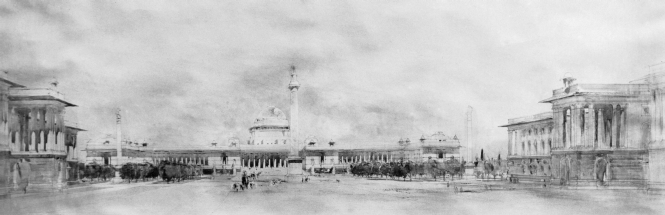
We first saw the photographs of these charcoal drawings with a private dealer (see pg. 38, top) and bought them for our collection. They were photographs taken in the 1930s of what then appeared to be charcoal. It was only last year, while researching for our new project, Delhi: Red Fort to Raisina, that that I discovered they were black and white images of watercolours made by William Walcott, the finest architectural perspectivist who worked closely with Lutyens, who was so impressed that he asked him to produce perspectives of New Delhi. Walcott made sixteen of them. A few of these outstanding watercolours have mysteriously disappeared from their original collections. Three surfaced in a Sotheby’s auction around the turn of the century. The reserve price for each was between £8000 to £12000.
|
|
|
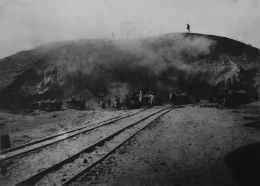
The hillocks were flattened by blasting around Raisina Hill. This barren wilderness is where the capital of the world’s largest democracy, New Delhi, stands today. |
I found this in a box containing several documents. This picture was perhaps never seen by anyone who used the library. Even today, it has not been put on the official website of the British Library.
T
he decision to shift India’s capital from Kolkata to Delhi was announced by King George V at 2 p.m. on Tuesday, 12 December 1911 at the Durbar organized in Delhi. Lord Curzon, who was a Viceroy (1899 to 1905), and who himself had organized an impressive Durbar in 1903, reacted adversely to the news. He called Delhi ‘a mass of deserted ruins and graves.’ ‘I venture to say that the less you say about the history of Delhi the better, and His Majesty’s Government will be on much surer ground if instead of saying anything about the dead capital of the past, they try to create a living capital in the future,’ he declared in the House of Lords.
|
|
|
Impression of the forecourt in front of Government House, flanked by the two secretariat blocks. Notice the in-scale elephants in the secretariat buildings that fused arcadia with modernity in the imperial imagination. |
|
|
|
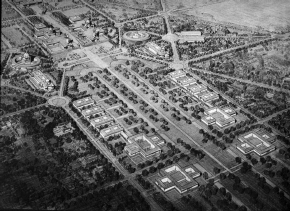
A drawing of an ‘aerial perspective of the proposal’ and Lutyens hexagonal plan for the new capital. Originally, a church (can be seen at the left, behind what was to be South Block) had been planned to create symmetry with the Council House (now the Parliament building) but the plan was subsequently aborted. |
|
|
|
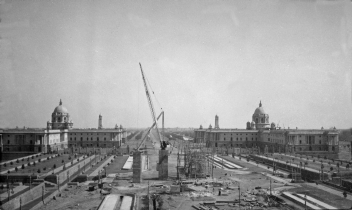
A view of the North and South Block buildings taken from the Government House. The base of the Jaipur Column in the forecourt is wrapped in scaffolding. Despite the apparent mess, the vista along Kingsway (now Rajpath) is clearly visible. |
F
rom being a critic, Curzon thereafter actively participated in the debate on the design of the new capital. Edwin Lutyens and Herbert Baker, the two main architects in charge of designing New Delhi, agreed that the ‘best of Indian styles should be the basis of the design for the new city.’ An article published in The Times of London in October 1912 said: ‘What (Moghul Emperor) Akbar sought as an individual, we have sought as a race – the union of new principles with what is best in the old. Let us leave, like him, an architecture that truly embodies that ideal.’We found this image (above right) in Centre for South Asian Studies, University of Cambridge which has some very rare and interesting material on New Delhi. The A.G. Shorsmith album is one among many important collections.
The columns were unveiled on Feb. 10, 1931 at a ceremony that celebrated the completion of the secretariat buildings and the formal inauguration of New Delhi. The Times of London at the time reported that, ‘It would be idle to pretend that the ceremony had any popular support. All the approaches to New Delhi were plastered with armed forces, and little encouragement was given to anyone who desired to offer a demonstration, friendly or otherwise.’
|
|
|
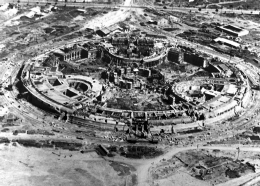
The Council House, which now houses the Indian Parliament, in the early stages of construction. A railway track runs around the entire length of the circular structure to convey material. |
A piece written by architect Herbert Baker for The Times of London in February 1930, reads like a victory speech: ‘Few will now question the wisdom of the commission of 1912… The largest mass of rock was chosen as the focus of the city… In the winter of 1913 the writer was sitting with the present Prime Minister on this rock and wondering how a beautiful city could arise from what Lord Curzon described as "the deserted cities of dreary disconsolate tombs" when the sun setting beneath the rain clouds formed a complete rainbow arching the destined central vista. The Good Omen then acclaimed has been triumphantly fulfilled, as the building of city proceeded – despite evil prophecies.’
|
|
|
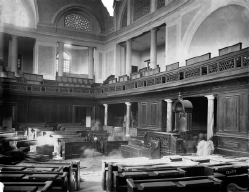
A picture of the Legislative Assembly giving a clear view of the grand speaker’s chair. Note the combination of jaali work on the railings and the pillars in the visitors’ galleries and on the ground floor. |
One particular prophecy had impressed the British: that of the last Sikh guru. In an article published in the Times of London in 1931, Baker recalled how ‘when sentenced to death by Emperor Aurangzeb, (he) went to it with a prophecy on his lips that a great white race would come from the West to destroy the empire of his executioner.’
|
|
|
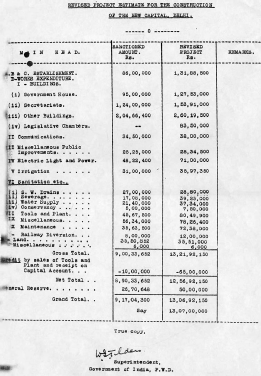
Rising expenditures due to the Great War and diminished values due to falling exchange rates led to a significant reappraisal of the costs of building New Delhi in September 1922. This document shows figures of the original and the revised costs. |
The British took special care of a shrine dedicated to the guru, Baker writes: ‘All living temples and shrines are enclosed (in the new city) with walled gardens. Among them the famous Sikh shrine has a specially honoured enclosure near Viceroy’s House.’ The shrine is called Gurdwara Rakabganj and is very close to Rashtrapati Bhavan.
Sixteen years after the inauguration of New Delhi the sun finally set on the empire and paved the way for a free India. Perhaps the British did not have the benefit of a prophecy.