Theoretical perspectives
SHAILAJA FENNELL
THE provision of schooling at the end of the 20th century is not yet universal and the difficulties in accessing and benefiting from primary and secondary education have become areas of concern. The challenges facing the state with regard to the universal provision of education are evident in a number of areas. First, the failure of state schools to provide adequate schooling has driven parents to seek alternative providers. Second, variation in the quality of education provided by non-state providers of education indicates an urgent need for regulating the sector. Finally, there is a growing commercial interest in the educational sector, with an increase in new providers who are changing the terrain of the education sector. These difficulties have begun to exercise the academic and policy worlds and are now the focus of new thinking on the way forward in the provision of education.
The new thinking in policy relates to the emergence of a paradigm of New Public Management in Western Europe that regards the introduction of the ethos of profit-making into the state sector as a beneficial feature to ensure better and more efficient production of services. Improvements in the public sector are also envisaged through a sharing of personnel between the private and public sector providers, thereby bringing about a shared set of incentives and a common culture. There has consequently been a move from a single provider approach to considering the advantages of a multi-provider approach. The presence of both public and private providers, often jointly producing education, has led to the formulation of public-private partnerships in the provision of education.
The introduction of public-private partnerships (PPPs) in education in Western Europe and the United States began in the 1990s. The expansion of this new form of provision has paved the way for recommendations that developing countries might embark on these ventures to improve educational access and quality in their school sector (Patrinos 2005). However, there is concern that the ready offering of this new model of education provision might be hasty at best and wrong at worst. For a start there is inadequate evaluation of the public-private partnerships that have been established in Europe and North America (Osborne 2000). It seems that political ideology and social policy played a significant role in fashioning partnerships and the weight of economic and educational arguments in these models might be questionable (Common 2001). Any prescription for advancing the case of public-private partnerships to developing countries thus requires careful consideration of the economics and politics that underlie this form of provision of education.
T
here was a rise of partnerships in the provision of health and education during the 1990s in western economies. The rationale for these partnerships was that bringing in the management practices of the private sector into the public sector would improve competitiveness and increase efficiency. The expectation was that this would make public expenditure more effective and, in some cases, also attract financial investment from the private sector.Partnerships in education have been driven both by the need for more finances to run the ailing school system as also to improve the quality of provision through raising management standards in schools. Equally important is the strong element of parental choice pushing for these new forms of school provision. The desire of parents to select the best school for their children in a state schooling system where admission criteria are based on the distance between home and the school have generated a new set of pressures on the schooling system. The rise of parental choice within the educational system in the United Kingdom has also been associated with a global rise of a neoliberal agenda in the international economic arena that emphasizes an expansion of the market and the simultaneous rolling back of state provision in national economies (Ball 2007).
A
key driver for public-private partnerships (PPPs) in the United Kingdom was the Private Finance Initiative Bill (PFI) that was introduced by the government in 1997. The PFI was regarded as an instrument to bring in finance from the private sector and to improve the financial management of schools. The emphasis was on the ‘value for money’ (VfM) dimension of educational provision. The thinking behind the PFI was that the private sector was more efficient in terms of delivery than the public sector, and that the introduction of private sector principles into the state education sector would improve its efficiency and performance.This improvement was to be measured through a specific indicator constructed for this purpose, the Public Sector Comparator (PSC) (HM Treasury 2001). The PSC was to evaluate whether the contribution of the private provider had indeed improved the financial performance of the school over that previously provided by the state management. Where the PSC showed that there had been no significant improvement and VfM was not being generated, the contract of the private provider would be terminated and the private entity would have to make additional payments for the breach in contract. The PFI approach was strongly influenced by the New Public Management thinking of the late 1980s that was keen to bring in corporate efficiency and innovation into an under-performing state sector.
The rise in educational partnerships in the United States is closely related to the emergence of the schooling movement of the 1980s. The concern among local communities at the collapse in state provision of schools mirrors the larger concerns voiced regarding the governance crisis in administration in the United States. The inability of the state to address the problem of failing schools and the need to create more accountable ones has become a major concern in communities and this parent spearheaded movement has resulted in a new form of schooling partnership. The development of the charter school model entails contracting a school from the state that is managed by the parents in a community and has provided a new form of accountability to local schools.
Charter schools began to emerge in 1991 and by the mid-1990s numerous states were advocating legislation to advance this type of provision. The charter school idea is based on the principle that state schools are dragged down by the failing state system and the ability to extricate individual schools from this morass under parental management permits them to acquire a new lease of life. The success of the charter school movement has been that the new form of partnership has injected new life and content into teaching and learning within local communities. The charter model with its emphasis on community level ownership that fosters entrepreneurship and accountability has been flagged as a success (Hoxby 2003).
T
he introduction of PPPs across western countries was in response to the demands of parents and communities within the existing network of state schooling. PPPs are seen as a form of school provision that is able to improve the quality of schooling through emphasizing the need to pay closer attention to the supply and demand aspects of the economics of provision. The ability of the private corporate sector and the community in the UK to improve schools appears to lie in an improved set of management practices. The achievements of the PPP form of provision should consequently be evident in areas of service delivery and accountability. The differences between the types of PPPs adopted in the UK and the USA indicate that even as PPPs conform to a ‘one-size fits all’ idea, they are based on the demands of the political processes and not governed by economic considerations alone. There does appear to be a strong element of national ideology and social policy in fashioning the terrain of public-private partnerships in western countries (Common 2001).
T
he importance of PPPs appears to lie in their ability to improve the provision of education. On the demand side, the major improvement is achieved through introducing competition and so allowing parents to choose between school providers. On the supply side, the advances result from improved management and the greater availability of finances so that more teaching and better facilities can be made available. The early literature on PPPs was focused on improving the supply and demand aspects of educational provision through introducing of economic incentives that would bring about a closer approximation to market conditions (Burchardt 1997). The ushering in of market forces was regarded as sufficient to ensure that there was both an expansion and an improvement in the provision of education.In the more recent literature on schooling there is indication that the successful provision of education is also dependent on the larger social and political terrain (Akerlof and Kranton 2002, Di John 2007). The manner in which state and non-state players regard each other in the education sector is also an important starting point. If competition is to eventuate, both types of providers must be prepared to actively interact and move towards establishing PPPs. If there is an unwillingness to engage, then the creation of a market can become an insurmountable obstacle (Srivastava 2007).
F
urthermore, the term ‘private’ sector in these partnerships has become a generic term for all non-state actors – corporate entities, NGOs and faith based organizations. These different players are likely to have distinct approaches to education provision emerging from their own historical evolution as well as economic motivations (Fennell 2007). The educational objectives each provider pursues also influence the nature of educational provision in the sector. It therefore behoves a study of the supply and demand of education such that the economic, social and political strands within educational provision can be distilled.These new types of providers will change the nature of the educational terrain as they would bring in a growing range of educational objectives, through possibly differing political understanding and economic expectations. Examining the supply and demand of education by disentangling the economic and political strands in the debate of educational provision is a useful exercise for opening up this new educational environment. The economic and political tools of analysis in the educational sector provide an opportunity for undertaking interdisciplinary research on the role and impact of PPPs.
T
he current interest in evaluating how PPPs might bolster demand and supply of education has generated an interest in using new tools of measurement (Coady and Parker 2004). One method of identifying the economic and political aspects of provision is through using concepts of ‘exit’ and ‘voice’. The concepts of ‘exit’, ‘voice’ and ‘loyalty’ were first used by Hirschman to examine individual behaviour within organizations that operated under market rules (Hirschman 1970, 1978). The idea of exit draws on the mainstream economic understanding of free entry and exit, with the latter occurring when individuals are no longer satisfied with what is on offer in the market. Within the context of an organizational set up, the notion of exit relates to the decision to leave a provider on account of dissatisfaction. The term voice is used to denote political activity undertaken by an individual while remaining within an organization to ensure the continued provision of a good and/ or the quality of the good. An individual who exits a market where he is unhappy with the quality of a good would be making an economic response. The choice of the individual to stay on and demand improvements through use of ‘voice’ is regarded as a political stance.In relation to the provision of education, these concepts can be used to analyze how consumer behaviour affects the quantity and quality of education (Hirschman 1978). If exit is present, it indicates a choice exercised by the parents (and children) between the types/quality of education provided by different providers in the locality. Where voice is exercised by parents and pupils in the school system, there is evidence of political activity, ranging from complaints to campaigns to obtain a higher quality and wider coverage of education in the school. The use of the term exit to denote choice in a market context, while voice is evidence of political responsiveness, provides two important tools to identify the relationship between consumers, the school and the providers in the local sphere. The analysis allows us to look at the choices made by parents between government and private schools. So where both public and private schools are present in a locality, the phenomenon of exit can provide an indication of the failure of the state education system to provide a sufficient coverage and quality of education.
T
he use of political behaviour also impacts provision. A significant use of voice by parents in the local sphere can result in an improvement of the level and type of educational provision (Chubb and Moe 1988).1 The use of voice by parents and communities impacts on the provider in a demand driven environment and articulation of demands can shift the resource allocation pattern of private providers as well as the local state. This use of a political tool to change the provision of education by an existing provider points to the possibility of improving educational quality in schools. The obverse is also interesting, that the inability to use voice might lead to a serious deterioration in the quality of education.The possibility of drawing on the actions of exit and voice to identify the economic and political strands in the provision of education permits us to examine how provision by the state and non-state providers affect the supply and demand of education in the local sphere. It would appear that exit has the impact of changing the supply response between state and non-state, while voice affects the quality of provision. Given the possibility of using both exit and voice as actions, it would be useful to see what pressures various combinations of exit and voice generate.
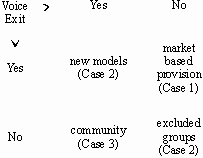
The relationship of voice and exit to economic and political responses to the provision of education is shown in Table 1 below, which sets out the implications of combinations of exit and voice within the educational sector.
I
n the north-east corner is the case allowing for the possibility of exit, but not of voice (Case 1). Here providers would respond to the threat of exit by parents/users of education, but would not face political opposition. This situation occurs where there is a market-based provision of education and providers of education are concerned about individuals voting with their feet when faced with poor provision. If the ability of users of education to withdraw from a particular provider becomes an economic threat, it could force private providers to improve the nature of provision. Exit, however, does not have adverse negative consequences for the providers in situations where educational provision does not depend on payment by the user.|
TABLE 1 Using the Notions of Exit and Voice in Education
|
|
|
In the north-west configuration (Case 2) is the situation where there is the presence of both exit and voice. This scenario emerges where parents could use both the options of exiting the sector as well as making demands on the provider when faced with declining quality of education and/ or returns from education. The possibility of using economic pressure and political representation places the parents/community in a strong position. The Case 2 scenario is dependent on parents/users having both economic and political wherewithal to use exit and voice respectively. Where the consumer is able to participate fully, it might be possible for partnerships to develop between the state and non-state providers to meet the demands for an improved and more effective provision of education.
I
n the south-west corner is located the case where there is a presence of voice, but with no exit (Case 3). Case 3 highlights the possibility of using political pressure on the educational provider to demand improvements in education. The resort to political action is dependent upon the collective action of the community concerned. An aware and active community can use political agency to put pressure on the educational provider to improve services. Case 3 might also be in operation in the case of traditional communities who tend to regard their group identity as a social marker and where exit is not seen as an option due to limited spatial and/or social mobility. Even if such communities enunciate their claims, a lack of financial resources and engagement with the larger economic sphere would make it harder for these claims to translate into improved schooling. Consequently, there would be little impact on the provision of education to deliver any benefits to the community.
F
inally, the south-east configuration is the case of no voice and no exit (Case 4), where the provision of education is marked by an absence of both economic and political challenge. The users of education are at a proverbial dead-end where they have no means to signal dissatisfaction with the education provided. Case 4 would be in operation where groups have neither political nor economic power. This can occur where there is a monopoly provider operating in very poor communities. It would also happen where there are groups that are denied educational access due to economic and social exclusion. As such, these groups do not regard educational provision as a reality and are thus unlikely to make any use of exit or voice. These groups have traditionally been outside of the domain of provision and would not regard education as either an economic or political right.These four scenarios provide a starting point for mapping how the economic logic of the market and the power of political representation affects the financing and provision of education by a range of providers, both state and non-state. It would be valuable to learn whether market driven solutions are equally effective in ensuring both finance and physical provision by non-state providers in Case 1. In Case 2, which is the preferred arena for the new PPPs that operate to improve the demand side of educational provision, it would be worth exploring the extent of attention given to improving current provision and how quality improvements are measured. In Case 3 there is the possibility of charter schools where communities have a history of collective action. At the other end, there is also the case of traditional communities with little or no knowledge of market based processes where it would be important to know whether there is a deterioration in the quantity and quality of provision. In the context of exclusion identified in Case 4, it would be critical to explore the implications of being denied access to the educational system.
A
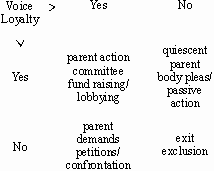
combination of voice and loyalty and the implications for the types of parental behaviour and political action that might result is shown in Table 2. The combinations of voice and loyalty in Table 2 map out the consequences of political action in the presence and absence of loyalty, understood to emerge from either identity politics or brand image on the collective action by the parent body and the forms of action undertaken as a response.In the north-west quadrant, where voice is used in the presence of loyalty to the provider, there could be a strong push for collective action to ‘rectify past wrongs’ or to make greater advances in educational provision. The forms of political demands are likely to be collective rather than individual, based on fund-raising and other forms of parent contribution/action force.
|
TABLE 2 Types of Political Action Based on Voice and Loyalty |
|
|
In the north-east quadrant, loyalty does not generate voice and therefore no political action ensues as in the case of traditional communities. Such communities would display a strong sense of affinity with the provider on account of either shared communal values (as with NGOs and even more so with community/faith providers) or where it has been inculcated by externally generated brand loyalty (by corporate-profit providers) but would not automatically see an improvement in the quality of the education they receive. In extreme cases, where loyalty is high and there is near complete identification with the provider, the power relations are such that the provider could use such affinity to impose additional hidden costs on the community, charges or even hidden fees by emphasizing the theme of common objective and/or a greater display or market branding. The response from the community if any is subaltern and more akin to a plea rather than action.
I
n the south-west quadrant, there is voice, but no loyalty and so political action is seen as an individual right and based on strong forms of demand. The parents are likely to be proactive in presenting the school with petitions, but less inclined to contribute in time, kind or financial terms. There is likely to be more confrontational behaviour by the parent body and the response of the provider could therefore be conciliatory.Finally, in the south-east quadrant, neither voice nor loyalty exist and the only form of consumer action is through exiting the system, i.e., using the market mechanism or being excluded/deemed to exit by the educational system itself. So this quadrant can be seen as mirroring the Case 1 scenario as shown in Table 1. However, the social and political configuration of exit in Table 2 throws additional light on the nature of consumer choice. Here, market based choice could be the worst case default option where the consumer/ purchaser has to leave the sector altogether.
T
he overlay between the representations of exit, voice and loyalty that emerge from a joint examination of Tables 1 and 2 indicate that bringing all three concepts together in an expanded and interconnected manner gives greater depth to our analysis.The ability to expand Hirsch-man’s original exit, voice and loyalty framework can demonstrate the political and social dimensions of the provision of education. Through expanding the original model, the exclusionary and financial implications of exit, voice and loyalty become more explicit. Also, the interactions between these three features show that decisions regarding school choice and voice might be influenced by the social status and affiliations of the household. This framework has been adopted in the research on Public Private Partnerships that was conducted under the RECOUP research conducted during the period 2005-2010.
2The research has identified actions that could be designated as exit, voice and loyalty traced from parental actions with regard to the schooling choice and experience of their youth. The complex manner in which economic, social and political aspects of everyday life are intertwined, indicate that rather than there being a single action that denotes exit, voice and loyalty, there could be a set of types of each action.
* This paper draws substantially on two earlier working papers written as part of the RECOUP research outputs: S. Fennell, Public-Private Partnerships and Educational Outcomes: New Conceptual and Methodological Approaches, RECOUP Working Paper no. 37, 2010; S. Fennell, Tilting at Windmills: Public Private Partnerships in Indian Education Today, RECOUP Working Paper no. 5, 2007.
Footnotes:
1. The spread of the charter school movement through districts can be regarded as an achievement of voice.
2. RECOUP was a research consortium over the period 2005-10, supported by DFID. Both quantitative and qualitative data was collected over seven different research projects. Information on the research and access to research outputs can be found on the consortium website, http://recoup.educ. cam.ac.uk
References:
G. Akerlof and R. Kranton, ‘Identity and Schooling: Some Lessons for the Economics of Education’, Journal of Economic Literature, XL, 2002, 1167-1201.
S. Ball, Education plc. Routledge, London, 2007.
T. Burchardt, Boundaries Between Public and Private Welfare: A Typology and Map of Services, Case Paper No. 2, London School of Economics, 1997.
Charter Schools, USA. http://www.charter schoolsusa.com
J. Chubb and M. Moe, ‘Politics, Markets, and the Organization of Schools’, The American Political Science Review 82(4), 1988, pp. 1065-1087.
D. Coady and S. Parker, ‘Cost-effectiveness Analysis of Demand- and Supply-side Education Interventions: The Case of PROGRESA in Mexico’, Review of Development Economics 8(3), 2004, pp. 440-451.
R. Common, ‘The East-Asian Region: Do Public-Private Partnerships Make Sense?’ in P. Osborne, Public-Private Partnerships: Theory and Practice in International Perspective. Routledge, London, 2000.
S. Fennell, Future Policy Choices for the Education Sector in Asia. Background paper for the DFID organized Asia 2015 conference, 6-7 March 2006, London.
S. Fennell, Tilting at Windmills: Public Private Partnerships in Indian Education Today, RECOUP Working Paper no. 5, University of Cambridge, 2007.
S. Fennell, Public-Private Partnerships and Educational Outcomes: New Conceptual and Methodological Approaches, RECOUP Working Paper no. 37, 2010.
H.M. Treasury, Private Finance Initiative. www.parliament.uk/commons/ lib/research/rp2001/rp01-117.pdf
A. Hirschman, Exit, Voice and Loyalty: Responses to Decline in Firms, Organizations and States, Harvard University Press, Cambridge, 1970.
A. Hirschman, ‘Exit, Voice and the State’, World Politics 31(1), October 1978, pp. 90-107.
C. Hoxby, ‘School Choice and School Competition: Evidence from the United States’, Swedish Economic Policy Review, vol. 10, 2003, pp. 9-65.
J. Di John, ‘Albert Hirschman’s Exit-Voice Framework and its Relevance for Problems of Public Education Performance in Latin America’, Oxford Development Studies 35(3), 2007, pp. 295-327.
P. Osborne (ed.), Public-Private Partnerships: Theory and Practice in International Perspective. Routledge, London, 2000.
H. Patrinos, Education Contracting: Scope of Future Research. www.ksg.harvard.edu/pepg/PDF/events/MPSPE/PEPG-05-23patrinos.pdf, 2005.
P. Srivastava, Neither Voice Nor Loyalty: School Choice and the Low-Fee Private Sector in India, Mimeo, 2007.