A plea for liberal education
SUDHANSHU BHUSHAN
THE undergraduate level is by far the largest constituent of higher education in India. According to the Annual Report of the MHRD (2009-10),
1 out of a total of 14.6 million students enrolled in higher education, 1.9 million (13%) are in university departments and 12.7 million (87%) in colleges. Colleges thus constitute the foundation of this level of education whether in the arts, humanities, science, or technical fields. Undergraduate education is critical for providing an equitable basis for social and economic development and is crucial for nation building. Hence, the inevitable question: Is our current system strong enough to realize these aims?Present debates are dominated by a concern for the ‘employability’ of India’s graduates. This goes unquestioned by the general public and even in policy and academic circles, with reform being largely geared towards improving employability. But will the greater employability of our graduates strengthen the foundation of higher education? I believe that it will not, and that the purpose of higher education should instead be the provision of a liberal education, including the ‘cultivation of mind’ that is necessary for a progressive society. The market driven craze for technical and professional courses is eroding the foundations of liberal education at the undergraduate level.
C
an independent India today claim that our system of higher education has been a vehicle for greater inclusion? Here we must examine whether the undergraduate level has enabled the entry of diverse social and religious groups and classes. How unequal is education at the undergraduate level? An important challenge, therefore, is to free liberal education from elitism and make it more democratic.A third issue relates to inter-disciplinarity as the basis of knowledge creation. The pedagogic models of the 19th and early 20th centuries, where the deepening of knowledge took place within disciplinary boundaries, are no longer sufficient. Problems today are sought to be redressed from different disciplinary perspectives in multidisciplinary institutional contexts. Therefore, we need to ask ourselves how our undergraduate system, composed predominantly of teaching on a disciplinary basis, can be transformed to become an active agent in the production of knowledge. In short, each of these dimensions of liberal education urgently need to be debated, but in order to do so we first need to review the historical context that produced the university system we now have.
D
uring the colonial period, our universities were modelled after London University as affiliating bodies catering to a large number of colleges;2 they regulated admissions, conducted examinations and conferred degrees. The elaborate regulations framed for these purposes had the consequence of curtailing the freedom of the teacher.3 The declared aim of education was the diffusion of the arts, science, philosophy and literature of Europe. English became the medium of instruction by virtue of a preference for it in public employment. In 1916, Calcutta University sought to break fresh ground through the creation of postgraduate departments, thereby encouraging teaching directly in the university. Till 1949 there were just four purely affiliating universities, twelve affiliating and teaching universities, seven purely teaching universities, including a teaching and federative university such as Delhi, and a federative, affiliating and teaching university such as Madras. Many teaching universities became teaching and affiliating universities and many more such universities were established in the post-colonial period, thus continuing the colonial legacy.An important feature of the colonial legacy was the elitist character of higher education, exemplified in the divide between undergraduate teaching in the affiliated colleges and postgraduate teaching in the university departments. Moreover, the affiliating structure constrained the autonomy of colleges and restricted disciplinary advancements in knowledge.
Post-colonial developments ensured a continuation of this colonial legacy. The UG-PG divide was further aggravated as colleges did nothing but teach, and university departments turned into teaching and research institutions. Matters got worse with universities extending affiliation to colleges almost without limit. In a recent sample of 82 universities (drawn from the Universities Handbook, AIU), an average university has 114 colleges and 83,503 students; the largest university has 516 colleges and 4,19,000 students enrolled!
I
n recent years two arguments have been presented against the affiliating system. The first relates to its tendency to keep growing, thereby creating problems of governance. Thus, the 11th plan advocated an optimal size of the university through measures to reduce the number of affiliated colleges. Another argument is that the affiliating system stifles academic freedom and innovation. This line of argument recommends the integration of undergraduate affiliated colleges with the postgraduate departments of the university so that the benefits of university faculty can be shared at all levels.4While overly large universities may not be desirable, there is no determinate relation between the size of the university and its quality, since a mere reduction in size may do nothing to improve quality. On the other hand, the suggestion of the Yashpal Committee favouring a federal structure with affiliated colleges as federal units may have high cost implications in terms of the large number of universities that will be created as a result. Many states may not be in a position to bear such costs. Hence, in actual practice, it may be difficult to do away with the affiliating system altogether. It could be argued that there was nothing wrong with the affiliating system had affiliation been undertaken with some restraint. In actual practice, however, the growth of affiliating colleges was in violation of the minimum standards set by the university. Either the condition of entry was relaxed or post-entry monitoring and other mechanisms were poor.
5
G
iven the fact that the colonial legacy of affiliating colleges continued by virtue of its comparative cheapness, and that a federal structure involves heavy expenditure, a rational way forward would be to move towards an appropriate mix:1. The structure of control and regulation as envisaged in the affiliating system should continue with a simplification of rules, greater autonomy to the colleges and transparent monitoring. Conditions of entry should be strictly enforced and all those in violation given a timeline within which they must meet the norms or else face disqualification. In the case of technical and professional colleges, minimum standards should be as prescribed by the concerned technical and professional councils. An upper limit for the number of affiliations must be set. All institutions – whether privately managed and funded, and partly privately managed but aided by the government – should be part of the affiliating structure. While the hierarchy between postgraduate and undergraduate levels might persist, it may be mitigated by various reform measures suggested below.
2. To break the hierarchy between affiliated colleges and university departments, colleges could be treated as autonomous federal units, with a separate governance structure for each college and with technology-enabled governance being introduced to improve decision-making. The concept of colleges as constituent federal units needs to be defined along with a structure of autonomy and accountability in a manner similar to Centre-state relations in the Constitution of India. The optimal size of a university too needs to be defined in terms of the critical number of departments, faculty, colleges and programmes, and the number of students and physical proximity necessary for the cross-fertilization of ideas in the generation of knowledge. It should enable mobility of students, teachers and programmes between colleges, and allow for effective linkages with university departments. All government managed and funded and privately managed government aided colleges on a selective basis should be part of the federal structure of the university.
T
his leads to two models of governance – affiliating and federal – with autonomy of colleges ensured in both. In the former the control of the university will be greater than the latter. Also the UG-PG divide will persist in the former but may be minimized in the latter. All state governments should encourage a mix of both the models. Reforms in the affiliating system may be considered along with alternative proposals which treat colleges and departments at par, or allow sufficient autonomy while guarding against commercialization, and strengthen quality norms.|
Social Group Disparity in Participation |
|
|
The nature of liberal education in universities needs to be redefined in the new context of post-colonial India. Universities must welcome and integrate persons – both men and women – from all castes and religions. A genuinely liberal tradition can progress only when higher education ceases to be elitist and takes on a mass, that is to say, a democratic character.
I
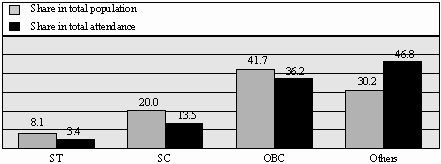
f we look at different caste groups in the age group 18-24 years and compare their share in the total population with their share in total enrolment in higher education (i.e., after 10+2 years of school education) clear disparities are visible (see figure below). The gap between these two proportions can be taken as an index of inequality, calculated as the ratio between shares in enrolment and general population. In the case of ST, SC, OBC and Others (upper castes) the ratios work out to 0.43, 0.67, 0.87 and 1.55 respectively. Thus the relative marginalization and associated privileges of these groups are directly visible in higher education after sixty years of independence.Of course, the exclusionary effect visible at the higher education level is in large part due to the differential dropout rates at various levels of school education. But even after taking this into account, the probability of enrolling in higher education remains unequal across social groups, as is shown by their ‘entry ratios’. The entry ratio has been defined as the proportion of those who are enrolled in the first year of a higher education course and those currently attending the 12th year of school education. While on average, 76% of all young Indians who complete 12 years of schooling go on to enter college, this percentage is only 51% for the Scheduled Tribes, 77% for the Scheduled Castes, 71% for the OBCs and 83% for the ‘Others’ (or effectively the upper castes).
6 This shows that access to higher education remains unequal, and calls for continued state intervention for democratization.
T
he necessary democratization of our universities requires large resources, and this necessarily implies state patronage of higher education. At a time when the state is redefining its own role and functions in political governance, the relationship between the state and the university system needs to be nurtured very carefully. An exclusive reliance on the patronage of the state poses a grave danger of destroying the autonomy of the community of scholars which liberal education requires for the pursuit of critical knowledge. While there is little disagreement that liberal education is never free from politics, yet healthy politics through sound democratic structures and practices outside the university is a must. Even as the relationship between the state and the university is a dynamic one, it need not be hostile if built through cooperation and on mutually accountable terms.
A
longside accommodating pressures for inclusion and building healthy relations with the state, it is also important that excellence and scholarship are given due recognition. Regulatory institutions have to be given the responsibility of maintaining standards within and outside the university. This in turn requires crafting policies relating to the recruitment and promotion of teachers, research infrastructure, library and laboratory facilities and so on. Above all, the structure of governance and the search for academic leaders must facilitate the sustenance of a community of scholars. Factors that result in the decline of the professoriate will invariably sound the death knell of liberal education.Various critical reviews of higher education present a number of hypotheses to account for its current failures. According to the report of the National Knowledge Commission, the structure of state control and regulation was said to be strangulating it.
7 Still others have focused on both insufficient and declining (in relative terms) funding by the state.8 Vested interests and confusing policies, neither favouring the market nor taking clear directions from the state, have also been cited.9 A.M. Shah10 argues that the burden of large affiliating undergraduate colleges on universities and failed policy initiatives by the UGC over time have been responsible for the decline in higher education. Failures in the coordination of the regulatory councils by governments at the central and state levels created many problems, particularly expansion with no control over quality, according to Singh.11The apathy of the state in the funding of general higher education is evident as merely 39% of the much hyped allocation of around Rs 47000 crore is expected to be spent during the 11th plan period, 2007-12.
12 To make the situation worse, a major share of this outlay – as much as 71% – was allocated to the universities, with over 6000 undergraduate colleges receiving only 29%.
I
n short, we have failed to develop a system of liberal education with the requisite independence to redefine its scope in a relation of mutual trust between the state and the academic community. The lack of sound democratic politics in the sphere beyond the university allowed for adverse political interventions. The result was that a university system lacking resources could not shape itself autonomously, restructuring departments, creating effective linkages with undergraduate colleges and promoting practices to make the teaching-learning process an enjoyable experience. Examinations remained the driving force for learning. The undergraduate and postgraduate levels of education were not treated at par, and even departments remained dependent on the university bureaucracy in academic and research matters.Further, the presence of a strong market orientation in the current period has created the illusion that education should be driven by employability and that liberal education is unimportant. This is an illusion because liberal education alone provides the sound foundation in the basic disciplines of the humanities and the natural and social sciences that is essential for the applied disciplines to develop. Hence, with adequate restructuring of the universities, ways can be found to develop strong disciplinary traditions of knowledge that will also enhance employability.
M
ulti-disciplinarity is a much debated issue today. Higher education at the undergraduate level has generally been based in individual disciplines. The traditional lecture method, with tutorials now an extinct species, has neglected the learner and the learning process. Today’s teaching methods must address the issues of inter-individual variations in the pace of learning, and give due weight to the learners’ choices, involving them in the knowledge generation process as far as possible. This implies that teaching cannot be separated from research. Technology has added a new dimension to the knowledge revolution and needs to be properly understood and integrated into undergraduate teaching. All this means that teaching and learning must be innovative and flexible processes, and faculty development along with innovations in the curriculum, pedagogy, credit system, and evaluation practices should become an integral part of undergraduate education.The Yashpal Committee report notes that since disciplinary boundaries are porous, and problems are not specific to any particular discipline, interdisciplinarity can and must be practised from the beginning. However, in my opinion, interdisciplinarity requires a strong foundation of disciplinary knowledge which undergraduate education must provide. Besides, learners should be exposed to a rich variety of disciplines so that they are prepared for pursuing interdisciplinary courses at the postgraduate level.
F
inally, it is necessary to address the important gaps in the existing database on higher education. The cause of liberal education cannot be taken up without adequate information and research on participation, financing, research, quality and equity indicators. Currently, the Census, the National Sample Survey Organization (NSSO) and the Selected Educational Statistics series of the Ministry of Human Resource Development are our principal data sources. Although some of their shortcomings are being addressed through the All India Survey on Higher Education undertaken by the MHRD, there are further research gaps to be filled. Unfortunately, the Higher Education Policy Research Institute proposed in the 11th plan, which was meant to act as an Inter University Centre of the UGC and bridge these gaps, has become a victim of bureaucratic indecision.Policy and planning documents on Indian higher education refer to the present phase as the second wave of institutional expansion. But the missing element here is a vision of liberal undergraduate education on a mass scale that can prepare us to meet future challenges. This requires something more than just a blueprint – far sighted institutional leadership.
Footnotes:
1. MHRD, Annual Report (2009-10), MHRD, Government of India, Delhi, 2010.
2. It is important to note that soon after the establishment of Indian universities in 1857, London itself gave up ‘affiliations’ and substituted for its constituent colleges a system of open examinations without regard to candidates’ place of education (Radhakrishnan Commission, 1949, p. 19).
3. S. Radhakrishnan, The Report of the University Education Commission, vol. I. Ministry of Education and Culture, Government of India, Delhi, 1949.
4. Yashpal Committee Report, Report of the Committee to Advise on Renovation and Rejuvenation of Higher Education, 2009. http://www.academics-india.com/Yashpal-committee-report.pdf
5. S. Bhushan, ‘Perspectives on Affiliating System Reforms in Indian Higher Education’, Perspectives in Education 25(4), October 2009, pp. 274-283.
6. Figures computed by the author from the 64th Round Survey of the NSSO.
7. National Knowledge Commission, Note on Higher Education, 29 November 2006. www.knowledgecommission. org/
8. J.B.G. Tilak, ‘Absence of Policy and Perspective in Higher Education’, Economic and Political Weekly 39(21), 22 May-28 May 2004; S. Bhushan, Public Financing and Deregulated Fees in Indian Higher Education. Bookwell, Delhi, 2010.
9. Devesh Kapur and Pratap Bhanu Mehta, Mortgaging the Future? Indian Higher Education. Brookings-NCAER India Policy Forum 2007-08, Volume 4, 2008, pp. 101-157.
10. A.M. Shah, ‘Higher Education and Research: Roots of Mediocrity’, Economic and Political Weekly 40(22), 2005.
11. Amrik Singh, Fifty Years of Higher Education in India: The Role of the University Grants Commission. Sage Publications, New Delhi, 2004.
12. Planning Commission, Eleventh Five Year Plan 2007-2012, Volume II. Planning Commission, Government of India, Delhi, 2008.