Taking a long view
RAJIV KUMAR
THE noughties, have been a particularly good decade for India. The country has achieved the second highest rate of economic growth globally and made sustained efforts to improve equity. Democracy has been deepened and social transition moved further along with leaders from the lowest castes now occupying the highest political offices in several provinces. At the same time Indian companies have emerged as aspiring multinationals with major acquisitions abroad and ready to take on larger challenges. The world, having recognized these achievements, has apparently decided that despite some ostensible weaknesses in public governance – persistent poverty, low levels of human development indicators and rising left-wing extremism – India should be given a place at the global high table.
The process of admitting India to the global high table can be traced back to the BRICS report by Goldman Sachs, which simply projected prevailing GDP growth rates to show that the Indian economy will be the third largest in the world by 2050. Higher rates of growth sustained over the present decade, despite internal political upheavals, external shocks and global crisis, have further reinforced India’s claim to be included in any new architecture for global governance. This was reflected by India’s inclusion initially as member of the O-5 group that along with the G-8 made up the HAP process, which unfortunately met an early demise. India was then given a prominent role in the G-20 grouping and its working groups and in the reconstituted Financial Stability Board.
India’s arrival on the global scene is best captured in that heads of state of all five permanent members of the UN Security Council visited Delhi between July and December 2010. In the words of President Obama, which brought huge cheer to the Indian elite, India was not just an emerging but an emerged power. And to further reinforce the sentiment, both President Obama and subsequently President Sarkozy, during their visits endorsed India’s bid to secure a permanent seat in the UN Security Council to which it has already been elected as a temporary member for two years starting 2011.
This recognition by the existing powers fulfils a long-standing desire of the Indian elite and establishment of being treated as a global player and not being relegated to a mere regional power or worse, being bracketed with Pakistan. The Indian political leadership, its diplomats and civil servants, in pursuit of this recognition, have in the past persistently tried to punch above the country’s weight (short-term for composite power). The leadership of the non-aligned movement, followed by that of the G-77, our stance in global negotiations like the WTO rounds or climate change or nuclear disarmament and going after senior positions within the UN and the multilateral development banks and associated agencies, reflect our elites’ desire to carve out a global role for the country. The question is now that it has been given a place on the high table, can India rise to the occasion and, moreover, start to act as an ‘emerged’ or global power?
S
ome could argue that India should not and, given its relatively meagre resources, cannot afford to play such a global role which is hardly justified in terms of any universally agreed criteria of economic or other measures of hard power. On these counts, India may well not qualify for a global role. There is some merit in this argument. With a nominal per capita income barely above a thousand dollars and with more than three hundred million living in absolute poverty, it is still a poor country. India’s human development indicators are comparable to, and in some cases worse than, sub-Saharan Africa. Specially critical are the woefully low child malnutrition levels that certainly do not auger well for the future. And we will be hard put to achieve any of the MDG targets by 2015.Our share in world GDP and trade is less than two per cent and our total exports are less than the trade surplus that China generates each year with an export volume that is nearly eight times (800%) India’s. Our defence expenditure at about $30 billion is less than half that of China and less than a tenth of the US, by far the largest defence spender in the world. More critically, we continue to import more than 70% of our defence equipment and as Kumar and Kumar (2010)
1 have shown, of the 43 future technologies identified by experts, India has yet to even make an entry in six, ranks the lowest in 12, and has developed an internal capability and more (approaching ‘world class’) in 13 when compared to countries such as the US, China, Japan, UK, Korea, Taiwan, Germany, Singapore, France, Argentina, Switzerland and Israel. With an expenditure of only about 2% of GDP on R&D, India is also not forging ahead in global rankings of knowledge economies. Thus, sceptics argue that on the basis of social, economic and strategic parameters, India can hardly claim a rightful position on the global high table.
T
he apprehension is that India has been brought on to the high table by western powers seeking to use India as a counterweight to China, which has crashed into the exclusive club on the basis of its historically unprecedented performance over the last three decades. There is simply no denying the reality that China’s actions and performance today have as much, if not a stronger, bearing on global economic and financial phenomenon than most members of the G-8. With its two trillion dollars of foreign exchange reserves compared to India’s about $298 billion (RBI Bulletin, Dec. 2010), and having emerged as the world’s second largest economy and the largest exporter, China is duly entitled to a place on the global high table. India has to also guard against the possibility of being used by others to achieve a balance vis-a-vis China, when its long-term national interests may not warrant this. Nevertheless, having been invited to the high table, an invitation it can hardly turn down, India has to now ensure that it can use this opportunity to its advantage.
T
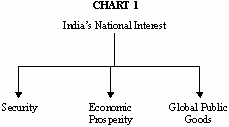
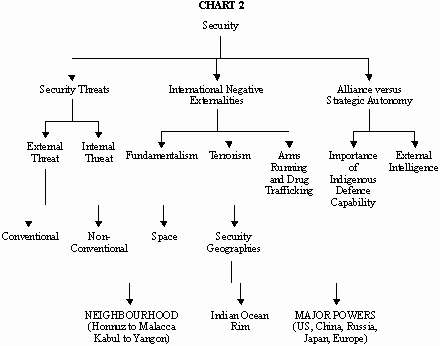
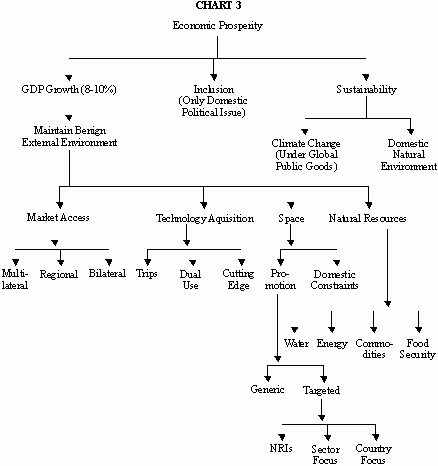
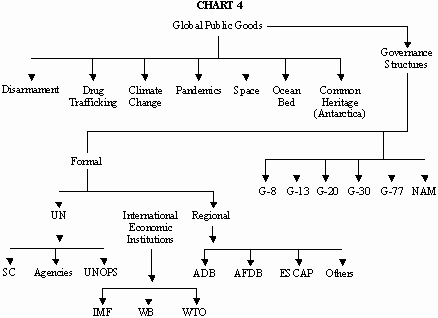
he first step must be to try and define as unambiguously as possible the principal components of our national interest. Under Shiv Shankar Menon’s tenure as foreign secretary, the Ministry of External Affairs, having recognized the importance of rigorously defining national interest and aligning the country’s foreign policy to it, commissioned a full-fledged two year study on the subject. The study yielded a schema highlighting that at least for the next two-three decades, India’s national interest would be best served by single-mindedly pursuing the goal of achieving economic prosperity for the large masses. The direct implication of this conclusion is that the country’s ability to defend its sovereignty, and indeed territorial integrity, from external and internal threats, and its capacity to play any meaningful role globally is critically dependent on achieving sustained and rapid economic growth.|
|
This is certainly not new. In 1982, Deng Hsiao Ping set forward exactly the same goal for China. We know that the Chinese assiduously followed Deng’s advice and achieved three decades of double digit economic growth with results that are today stunningly visible to the whole world. The challenge for India is whether our political leadership, and rest of the bureaucratic and diplomatic establishment, can persevere with this long-term objective and subsume all other priorities as subsidiary to this strategic imperative of achieving sustained and rapid growth over the next three decades.
H
aving accepted sustained and rapid economic growth as our national priority, it is important to focus on a few critical drivers which need policy intervention today. The first is to give up the notion that the demographic dividend will materialize mechanically and accept the hard reality that it will have to be earned. Without taking the necessary steps in securing wider and more equitable access to quality education and vocational training for our young population, the demographic dividend can turn into a nightmare, with hordes of lumpenized youth swelling the ranks of fundamentalists, extremists and vigilantes. We delay reforms in the education sector at our great peril.
|
|
Second, the myth that the economy and the private sector can continue to grow ‘despite the government’ needs to be jettisoned at the soonest. Weak governance and worse still, malgovernance, if not addressed now, can erode all our institutions and render the country’s corporate sector globally uncompetitive. More importantly perhaps, malgovernance will exacerbate the dualism in the country at all levels and generate unsustainable social and political stress. Widely divergent growth in the regions and rising income inequality can unleash strong centrifugal forces that have historically seen nation states come apart. We have to prevent that from happening to us.
T
hird, energy shortages have to be overcome and capacities created to provide sufficient energy from preferably renewable but otherwise from any source to meet the needs of a modernizing agriculture and expanding industry. This is critical and all other concerns – whether environmental, geographical, social or political – must be subordinated to achieve this. It is sad to see narrow sectional interests being successful in thwarting much needed energy projects without adequate thought to the severely negative consequences that can emerge with continued lack of energy needed to expand industry and agriculture where our youth can be gainfully employed.
F
ourth, agriculture modernization, which implies raising yields that have been practically stagnant over the last three decades, and increasing the income levels of those engaged in agriculture, has to be urgently undertaken. India cannot hope to achieve double digit economic growth without agriculture being thoroughly modernized. This will require attracting private investment and new technology at all stages of agriculture production – from irrigation, sowing, harvesting, post harvest logistics and marketing. Space for the private sector has to be made by withdrawing the pervasive government intervention from this sector. Retail modernization, with due role of foreign direct investment, can play a critical role in agriculture modernization and must be pursued urgently.Finally, we should recognize that so far our urban growth has been largely unplanned, despite the existence of a plethora of laws and licenses which have only resulted in extensive rent seeking in this sector. This must change urgently if we have to cope with the coming waves of rural-urban migration that will see no less than 300 million Indians move to urban habitats. Without urgent and concerted policy attention, we are headed towards a major social and environment disaster and the costs of reversing the situation will be enormous. Special attention will have to be given to developing climate friendly public transport models for our towns and cities which will also have to be grown using the least possible quantities of water that is increasingly scarce.
These five measures have to be initiated right now because each need is urgent and the gestation period is long before positive outcomes are achieved. These necessary reforms will generate employment to absorb the rising numbers of entrants to our workforce. We must not forget that providing productive employment will continue to remain the most preferred form of inclusion, much better than making the people dependent on government handouts and dole.
A
ny country aspiring to be a global power should ideally be able to influence policy decisions in other major capitals. In realistic terms, such resources are available exclusively to the prevailing hegemon or its opponent seeking to contest the hegemony. However, the minimal condition for an aspiring power must be that its own policy is not always reactive and that it develops some capacity to pro-actively engage in the global game.
T
o achieve this proactive policy stance, India will have to shed its historically evolved self-perception of being a member of the ‘have-nots’ and allocate sufficient resources to the design and execution of its foreign policy commensurate with its newly acquired status as a member of the global high table. We will also have to give up the defensive posture that often makes us ultra-sensitive of our sovereignty and prickly at perceived or actual slight from others. A foreign policy regime informed by long-term strategic objectives and conducted with the assurance of the potential third largest economy in the world, will also make us less demanding of reciprocity from our smaller neighbours and other partners.
|
|
To be proactive and anticipate the trajectory that other global players will take in the coming years is perhaps best done in the form of working out possible scenarios for countries that we see as important to our strategic interests. The net assessment methodology can be useful in anticipating possible outcomes in important countries and global issues. Menon and Kumar’s effort represents a first step in this direction.
2 The exercise should be followed up with far more resources and sustained analytical effort, perhaps in the Policy Planning Department of the Ministry of External Affairs.3
T
he net assessment exercise must of course begin with our neighbourhood. The basic assumptions here is that we cannot be unaffected by developments in our neighbourhood and that the South Asian space, defined to extend from Kabul to Yangon and from Leh to Colombo, is India’s responsibility. By 2050 the region will have a population of more than 2.2 billion, surely a sufficiently large region to be engaged in. But we cannot even be perceived, let alone act, in a manner that seems to be dictating a particular course of action to any of our neighbours. That will only strengthen their opposition to the ‘big brother, often perceived as a bully.’
W
e may have to, in the short-term, accept some deals that may look to be not in our immediate interest. Viewed in this context, former Prime Minister Gujral’s doctrine of asymmetric concessions to our neighbours, also pursued by the present prime minister and his national security advisor, makes eminent strategic sense.4 An asymmetric approach would in future require that India makes an unconditional offer to Nepal and all its neighbours that it will accept any set of conditions stipulated by a multilateral development bank like the ADB or the World Bank, in conserving water resources and developing the hydro-power potential, so critically needed to eliminate the energy shortages in the region. Aspiring global powers are expected to act with such confidence that comes from having looked at alternate scenarios for our region and assuring ourselves that we have the ability to cope with the possible down-side risks.
|
|
It is evident that the most important and strategic relationship in the coming years would be the US-China-India triangle. We can go horribly wrong if our policy with regard to this triangle is allowed to evolve on an ad hoc or short-term basis, lurching from one episode to another. We have to be able to judge for ourselves the likely balance of power in the next three decades and tailor our policy accordingly.
T
o this end, Menon and Kumar draw up various scenarios on the likely evolution of the two powers over the next couple of decades. They put forward a combination of outcomes that vary quite widely. In one, the US declines secularly because of its inability, a la Japan, to fully emerge out of the great recession of 2008-09. On the other hand, China, taking full advantage of rising Asian prosperity and its own domestic growth, is seen to burgeon ahead to be able to effectively challenge the US hegemony. In another scenario, the two remain caught in a stagnant and downward spiral as neither can find the road to robust and sustained recovery that also maintains global economic balance. In such a scenario, the US and China, egged on by nationalist domestic forces, could enter into a ruinous protectionist war that would drag the world economy down with them.The third scenario sees the US reinventing itself on the basis of its inherent technological and R&D strengths that are brought to focus on green growth, IT enabled services and nano-technology. In this seenario, US rejuvenation could be combined with a struggling China that is unsuccessful in making the switch from an external demand led growth to one that is fuelled by domestic consumption and falters in its social transition. As we face the world today, all three scenarios are eminently possible. Armed with such scenarios, and their assumptions, an informed policy choice can be made to give India a proactive stance in the century’s key triangular relationship.
T
rue to their vocation of scenario builders, Menon and Kumar neither assign any probabilities to any of the scenarios, nor indicate their own policy preference. But I am consciously violating this rule here and giving my preferred option only in order to initiate a public discussion on India’s preferred foreign policy stance at the present time. Let me preface it by sketching a fourth global scenario (three were mentioned above). This fourth scenario is one in which the US and China rediscover the virtues of working together, as they have done in the past three decades, and regain economic momentum.This seemed far-fetched until I recently heard the suggestion from a senior Chinese official that China may be preparing to use its vast pool of foreign exchange reserves to build new capacities and generate much needed employment in the US. This could give the Sino-US duopoly easily another two to three decades of coexistence and growth. This, in essence, is the G-2 scenario in which, for the first time in world history, the existing hegemon and its potential challenger, agree to collaborate and exercise joint hegemony over the rest. India would find itself frozen out from this G-2 arrangement, as will the rest of the world.
T
his would not be a positive outcome for India; nor should it fall into the trap of believing the denials that are likely to emerge from both China and the US on colluding to produce such an outcome. India could either try to prevent the emergence of a G-2 or adapt to it as best as possible. By working to reinforce the G-20 and making it more credible and effective, India could weaken the case for a G-2. This would call for India’s active collaboration with other G-20 members, which might weaken G-2’s emergence.Simultaneously, India could bet on a possible US rejuvenation and reinforce its ties with the US as quickly as possible and offer it greater market access and new avenues for its firms to invest in India by further liberalizing the FDI regime. This would generate significant benefits for the US in terms of employment generation and expanding its exports to help achieve President Obama’s target of doubling US exports in the next five years. Thereby, the US incentive to depend entirely on the Chinese investments for its recovery may be considerably weakened.
Equally, India will have to manage its ‘rather fragile’ relationship with China and, if possible, make the bilateral trade more balanced and less lopsided. However, both China and India must recognize the mutually vast potential for bilateral trade and investment that exists in the ongoing modernization of these two continental size economies. This will provide the framework for putting the Indo-Chinese bilateral relations on a positive sum and dynamic trajectory.
As is evident, India’s emergence as a great power is taking place in an extremely complex global environment, which is presently changing and evolving at perhaps an unprecedented pace. This makes the task of framing a strategic foreign policy far more challenging. But this is a challenge that Delhi has to rise up to if it has to play its due role in global governance and safeguard its vital national interests.
C
learly, this is not a one-time effort. Undertaking the scenario building exercise will train us to keep an eye on the critical drivers and allow mid-course corrections in good time. It can be argued that policy can often go wrong despite inputs from the most sophisticated and resource consuming net assessments and scenario building exercises, as is evident from the US intervention in Iraq. But this also points to the extreme complexity and uncertain nature of the present-day global situation where even the most well-prepared strategy may not suffice. However, it certainly does not provide a case for doing nothing!Therefore, the government should be giving the highest priority to putting in place a strategic scenario building capability. This should engage not only civil servants and diplomats but also the armed forces, agencies and the strategic academic community. This will allow India to leverage its newly found global status to its advantage and at the same time play a more constructive role in the emerging architecture of global governance.
Footnotes:
1. R. Kumar and S. Kumar, In the National Interest: A Strategic Foreign Policy for India, Business Standard Books, November 2010.
2. R. Kumar and R. Menon, The Long View From Delhi: To Define the Indian Grand Strategy for Foreign Policy. Academic Foundation, August 2010.
3. The scenarios can be greatly improved with more detailed and systematic analysis. The government should be actively creating the capacity for strategic thinking both within and outside the government. The first step in this regards would be to follow the Japanese, Koreans and the Chinese in making it attractive for young talented Indians to return home from foreign universities and think tanks and provide the necessary fire power for these efforts. This will require that the remuneration of such returning academics and policy analyzers are globally comparable and not firmly tethered to levels in the bureaucracy. By its unwillingness to pay good money to attract the required talent, the government is doing a big disservice to itself and to the country’s aspirations for emerging as a global power.
4. In this context, the criticism heaped on Gujral’s Ganges Water Treaty with Bangladesh and the Sharam-el-Sheikh communiqué after the Indo-Pak summit, is misplaced and short-sighted.