A new economic agenda
SONAM TSHERING
THE end of 2007 saw the beginning of one of the worst economic recessions since the 1930s. While there are signs of recovery in many countries, the recession is far from over. Countries all over the world have been hit. Many blame the current recession on the collapse of the housing boom and sub-prime lending in the USA. The global economy today is far more integrated than what it was since WTO came into being. While the world has benefited from globalization, a major downturn in large economies such as the US invariably spreads to the rest of the world.
Whatever be the reason for the current economic crisis, few countries have been spared from the impact of the so-called financial meltdown. Optimists prefer to waive off the current crisis as part of an economic cycle. The world has seen unprecedented growth in the last two decades and as such, some argue, a relatively short dip in the global economy is nature’s way of providing a balancing act. In order to find a lasting solution, it is imperative to identify the problems which need to be addressed if the solutions are to be sustainable.
If I were to list three problems that the world needs to address urgently, they would be: terrorism, climate change, and population pressure. Let me try to briefly explain each of these.
Terrorism does not recognize international boundaries. The world is no longer a safe place to live in. Daily through the media we learn of innocent people being killed or held hostage. Much of this is politically motivated. The security costs to the governments are far beyond what we could have imagined fifty years back. In many countries the economy is being crippled on account of civil war. Is it ideology, human ego, security perceptions or desire of power that creates all these conflicts?
F
or a long time the global community did not take climate change seriously. Many claimed that increasing temperatures is part of the climate cycle. Today scientists are of the opinion that unless we mend our ways, climate change will be irreversible. Since the Earth Summit in Rio, though countries have made commitments, we are far from reaching a solution that would save the earth. Climate change discussions have taken a North-South divide. COP 15 in Copenhagen was a failure; the only success being the non-binding commitments.Why is the global response to climate change so divided? Perhaps the answer lies in the fact that it is mainly the poor people who are affected by climate change. The rich and powerful live in houses that are protected from the ravages of weather, travel in cars that are weather-proof and thus, many remain unaware of the seasonal climate changes. As a result, they are unwilling to mend their ways to reduce the carbon footprint. The mitigation measures offered by industrialized countries are just not enough and proposals such as ‘polluters pay’ tend to be highly clichéd.
In the 1960s, the world population was about three billion. Today it has more than doubled. According to forecasts, the world population could reach over nine billion by 2050. Food security will be an issue. Here again it is the rich that consume and produce far more waste than what is required to feed the poor. The anthropogenic activities have contributed to environmental degradation. In today’s crowded world, man and animal are fighting for space. The result is a loss in ecological balance.
The above three issues are in some ways related to the wide economic disparities that exist in our world. When the world tends to measure economic growth using the conventional GDP tool, we tend to undermine the after-effects. It is not my argument that GDP growth is unimportant. It is important to measure levels of economic activity in a country and it is the responsibility of every government to uplift poverty.
The issue and concern arises when we encourage over-consumption and over-spending. The natural resources, both renewable and non-renewable, are dwindling. Unless the world is serious about addressing the problems in a holistic manner, the situation is only likely to worsen.
T
o quote from a speech made by the Hon’ble Prime Minister of Bhutan, H.E. Lyonchhen Jigmi Y. Thinley, at the 10th Sustainable Development Summit in New Delhi on 5 February 2010: ‘Let me be honest at the very outset. The kind of development we have embraced, particularly in the last one century, has not been of the kind that has advanced human civilization. It has not refined human behaviour by employing the finer senses. Ours is a world driven by the raging greed of a society obsessed with an excessive desire to consume. The insatiable nature of this obsession is evident in the way we have adopted the GDP based development model that promotes "limitless" economic growth and expansion as the means to human well being and satisfaction. It is evident in the way we have employed our genius to develop an amazing array of science and technology to exploit and abuse our planet.’GDP as an economic indicator needs to be modified so that it is mindful of the implications of economic activities that in the long run impose far greater costs on the economy than the intended benefits.
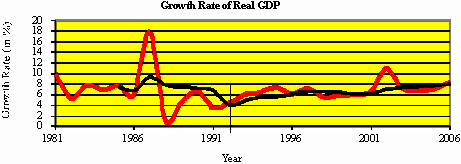
The Bhutanese economy has been registering a positive growth since development started in the 1960s. The economy has taken off on a higher growth trajectory since 1980, registering a long-term average annual growth rate of (real GDPfc) 7.6% in the 26 years after 1980. The average annual growth rate in the 1980s was 7.4%, which decelerated to 5.9% in the 1990s, but accelerated again to 7.9% in the first six years of the present decade. This growth performance is remarkable as it has been sustained for more than two and a half decades. The GDP per capita in 2008 was US$ 2152.
The greatest boost to the economy is still provided by foreign aid and driven by large scale hydroelectric projects. In 2006, EGW contributed 35.6% to the overall GDP growth rate. Without this, GDP would have grown only by 5.5% and not by 8.5%.
I
n the backdrop of this situation, let me draw your attention, to the Himalayan Kingdom of Bhutan. When the rest of the world was being clearly guided by a GDP driven agenda, His Majesty King Jigme Singye Wang-chuck, the 4th King of Bhutan, felt that development entirely aimed at achieving GDP growth alone would not be sustainable. He felt that whatever governments did, the end result must be to enhance the happiness of people, thereby introducing to the world the unique concept of Gross National Happiness (GNH).|
|
|
Source : MoEA |
So is GNH the answer? Let me try to share with you this new economic agenda that the Bhutanese government is slowly trying to spread to the rest of the world. Growth that is in sync with the environment, people’s aspirations and that leaves plenty for future generations.
GNH in many ways is a practical approach that brings about a balance between its four pillars, viz. sustainable socio-economic development, promotion of culture, environmental conservation and good governance. Building on these four pillars, the Centre for Bhutan Studies (CBS) has come up with nine domains and 72 indicators. Details on the nine domains and 72 indicators are available in the CBS website. The Royal Government of Bhutan in a bid to mainstream GNH, renamed the Planning Commission as the GNH Commission and the Planning and Policy Divisions in each ministry as the GNH Committee.
M
erely renaming these institutions, however, is not the final answer to mainstream GNH. The intention is to ensure that the nine domains and 72 indicators are applied while making our policy and plans and implementation thereafter. The CBS is also in the process of developing a decision-making matrix which planners can use for screening of policies and projects. Once fully developed, these tools will allow evaluation of policies and projects based on numerous indicators to see whether a certain policy or project is desirable from a GNH perspective.The Royal Government of Bhutan recently released two important documents which are intended to help achieve the economic aspirations of the Kingdom of Bhutan. The documents are the Economic Development Policy (EDP) and the Foreign Direct Investment (FDI) Policy. Both documents are available on the website of the Ministry of Economic Affairs www.moea.gov.bt. The EDP takes a GNH approach for long-term sustainability. The Royal Government has identified growth areas which are based on the strengths of Bhutan and which rely on sustainable use of local resources. The FDI, while it follows a negative list, will screen project applications that are not in the priority list using the GNH project screening tools. Polluting industries are not given priority and industries that take the additional mile on environmental conservation are rewarded.
I
mplementing GNH will definitely be a challenge. Many sceptics view GNH as an intellectual discourse. So far five international conferences have been held on GNH and the interest in GNH has been increasing. Developed countries such as Canada, France, Japan and Brazil have shown keen interest in pushing the GNH agenda forward. In order for GNH to be more than a concept, the CBS has been working on quantifying happiness. This is necessary especially if we want GNH to be the next economic model. As a quantified development model GNH is very much a work in progress at this stage. If it is to be accepted as a model for the future, adequate resources will need to be made available to continue with the research. Since many nations have already shown interest, it must be a collective effort.GNH has a cost. Bhutan is rich in natural resources such as forests, water and minerals. Our easiest development model would be to extract the forest in an uncontrolled manner, build limitless hydropower projects and allow rampant mining. This would be a short-cut to becoming rich, but will it be sustainable? The Constitution requires that Bhutan maintains a minimum of 60% forest cover. At COP 15, we pledged to remain carbon neutral for all times to come. But unless we see such seriousness being displaced by global leaders, concerns on climate change may be mere rhetoric.
W
e must not confuse between socio-economic development and GNH. GNH indicators must be universal; application could differ. Basic human development and social upliftment should be the development objectives of the government and GNH indicators should be used while deciding on the path to achieving the objectives. The challenge of developing GNH tools must not be underestimated lest we lose out on the opportunity. An objective assessment is necessary. Further, different weightages need to be fixed for different indicators depending on national priorities.Bhutan has set the GNH ball rolling. It is already being main-streamed in the development of education, in governance and in the economic arena. The challenge is to win over the sceptics, at home and abroad. Both a bottom up and top down approach is necessary. The leaders need to be convinced just as much as the followers. Efforts should be made to involve governments in future GNH conferences. If possible a UN Summit should be held.