Interview

The recently concluded Wills Lifestyle India Fashion Week (WIFW) saw the first ever catwalk presentation by style gurus David Abraham and Rakesh Thakore. Their label, Abraham & Thakore, launched in 1992/3, was primarily focused on the international market, but a fast-growing Indian clientele inspired them to set up boutiques in Delhi, Mumbai and Bangalore. These increased their visibility and the demand for the Abraham & Thakore label. Thereafter, the next logical step was to join the fashion fraternity and participate in the carnival that is Fashion Week.
The success of the show gave David Abraham a chance to reflect on the ‘spirit’ of their collection and why the WIFW gave them the perfect opportunity to ‘re-articulate the philosophy behind our brand.’
Aruna Ghose: What was your design brief for the show?
David Abraham: The basic premise behind our collection for Autumn/Winter 2010-2011 was to focus on the urban Indian woman, and not an international clientele. Although Abraham & Thakore has a strong retail history of both fashion and textiles in the international market where the product has been tailored to meet global needs, we saw this as a separate exercise.
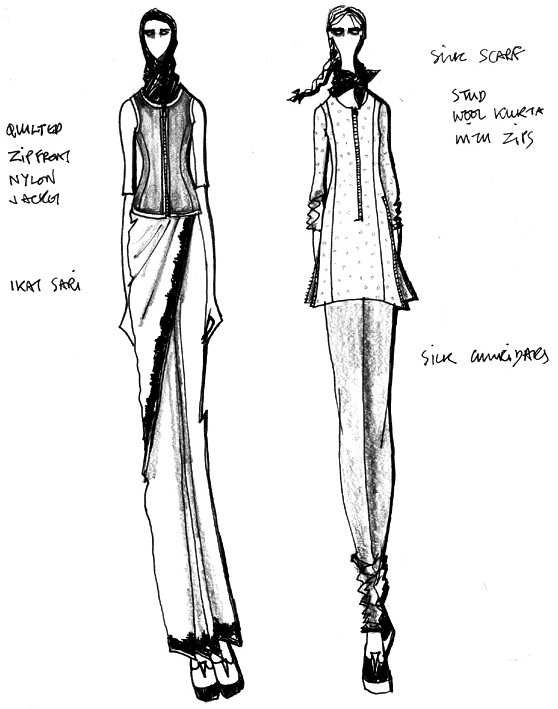
Our intention was to present a point of view that clearly states that it is possible for a woman, particularly a fashionable urban professional, to look at traditional Indian garments, such as the sari, the dupatta, salwar kameez, churidar and, of course, the kurta, as viable modern fashion alternatives. We wanted to present clothing that could express the timelessness of fashion, yet retain the spirit of tradition, as well as coexist with the spread of western labels.
Are we then slowly making a shift towards western norms of appropriate dressing?
Historically, fashion is western-centric in nature, with trends emanating from Paris, London, New York and Milan. The initial influence began under colonization and then spread to developing economies after World War II. In India, menswear was the first to undergo substantial change as Indian men across all economic levels accepted the trouser and the shirt in place of the dhoti and kurta. Often it was convenience that instigated the change. In the current environment, however, where trends sweep across continents at the speed of ones broadband connection, these movements are, by their very nature, international.
Fashion requires periodic change to remain relevant, and in order to bring in ‘newness’, styles need to be re-worked, re-proportioned and made up-to-date. It is crucial that this is done bearing in mind the larger international trend cycle, because if fashion slips out of this context it will start to lose its relevance and ‘desirability’.
Is it possible to develop a fashion vocabulary that is specific to India, one that can be stylishly mixed with the new fashion language that we are importing?
This can be a provocative argument given that the globalization of the fashion market in India is bringing the best of western trends and styles to this country, thereby making western clothing solutions easily available to the Indian customer.
Added to this is the explosion of fashion media in India, which has largely been joined by very powerful and influential western publishing houses that, though indigenized in management, have a very strong role in providing editorial support to western brands and labels. This is mainly because they have the clout to draw mega advertising rupees. The Indian design industry is too small and fragmented to have a major presence in advertising. It is also a nascent industry, in the process of finding an independent creative voice in the midst of unprecedented change and social upheaval.
How relevant are Indian textile traditions and clothing for the young and not so young fashion conscious urban woman?
We believe that textile crafts and handloom fabrics provide a unique advantage to the Indian fashion designer. The very nature of the small scale manufacturing process lends itself to limited production – an advantage to a high-end operation whose premise is exclusivity. Khadi is a relatively unique process as well, mainly because it’s entirely done by hand. This gives the fabric a beautiful and unpredictably erratic quality that only the human hand can achieve.
In this collection contrast by juxtaposition is an important statement. We have used man-made with the machine-made, natural fabric with the synthetic. Exposed industrial zippers have been added to a traditional kurta, while metal studs, typically associated with biker and punk-inspired clothing, ornament a khadi sari. We have also combined khadi with laminated polyester in the same garment, playing on the extreme contrasts between machine-made fabrics and the handspun and handwoven cloth. Both are totally unlike each other.