Bringing workspaces to life
APARNA PIRAMAL RAJE
RABBIT warrens, white-collar factories or Dilbert-esque cubicle farms. Our mental image of a modern office usually consists of monotonous lines of computer-laden workstations, a smattering of private offices and meeting rooms, with perhaps a lively cafeteria or a well-dressed reception thrown in for good measure. Startups fare a little better, conjuring images of inventive garage entrepreneurs or dynamic hotshops, as long as they do not backfire and descend into sweatshops or, even worse, graveyards.
These instinctive characterizations are rather unflattering to both the organization occupying the space and its end-users, but are often considered inevitable; occupational hazards for workplace designers. After all, how exciting can an office be? Computers, desks and crow-black task chairs are inescapable. For many interior designers, the mere phrase – open-plan office – heralds the deathnail of creativity.
And yet these archetypes have an unexpected dimension. They reveal our unconscious tendency to think of spaces in terms of how they behave, as opposed to just how they look and feel. The more boring an office, the more shackled we feel to it, the more we are inspired to come up with a metaphor that sums up our perception of how it behaves – even if that metaphor happens to be a ‘cold prison cell’ or an ‘army barrack’. This revelation in itself doesn’t make white-collar factories any more interesting, so why do I dwell on it?
I believe this notion of spatial behaviour (i.e. how spaces perform and operate in reality), has the potential to liven up our daily lives. Having been in the business of office furniture, I’ve had the opportunity to get a closer look – perhaps a little too close – of this omniscient creature in our lives, and come to the conclusion that since most of us spend half our waking hours at work, we deserve workspaces with a little more imagination. The interesting thing about office spaces – unlike other forms of the built environment that we inhabit, such as shops, hotels, restaurants, bars, cinemas, museums and even homes – is that they operate at two levels of scale: design for the individual and design for the organization.
A sprawling shopping mall, stuffed with shoppers, might appear to operate on a grander scale than an office. However, malls do not require consumers to interact with each other in the same way that office spaces demand their workers to collaborate. Malls are essentially designed for multiplied versions of the same individual.
R
etail consumers, even thousands of them who happen to be straining outside the gates of an Apple store, are not really expected to engage with others beyond a point. Of course, group shopper behaviour is a visible and documented phenomenon. Retailer Kishore Biyani, in his autobiography, describes the herd mentality of what he terms ‘India Two consumers’ or ‘the serving class’ which, according to him, ‘moves and finds a lot of comfort in crowds. They are not individualistic.’1 But in spatial terms, an individual’s influence on a group of people in a public space (and vice versa) is limited to the time she spends in that particular space. There is no expectation that aggregated individuals will constitute a larger entity with its own identity. A cinema owner must predict an audience’s collective reaction to a fire emergency to provide adequate means of escape, but that is probably the extent of his concern about the social dynamics of the individuals inhabiting his space.
O
ffice spaces, on the other hand, are intrinsically concerned about dual entities: the individual and the organization. A well-designed workplace will necessarily enhance individual comfort and productivity, and have a bearing on the organization’s work patterns and culture. The continued existence of bricks-and-mortar office spaces relies on the premise that ongoing interaction between co-workers will result in something that is larger than the sum of its parts. This belief alone justifies the expense of creating such facilities. Otherwise, in today’s virtual era, we would all be ‘digital nomads’ with laptops at home. There would be no need for us to undergo the daily ritual of transporting ourselves to another location.|
|
|
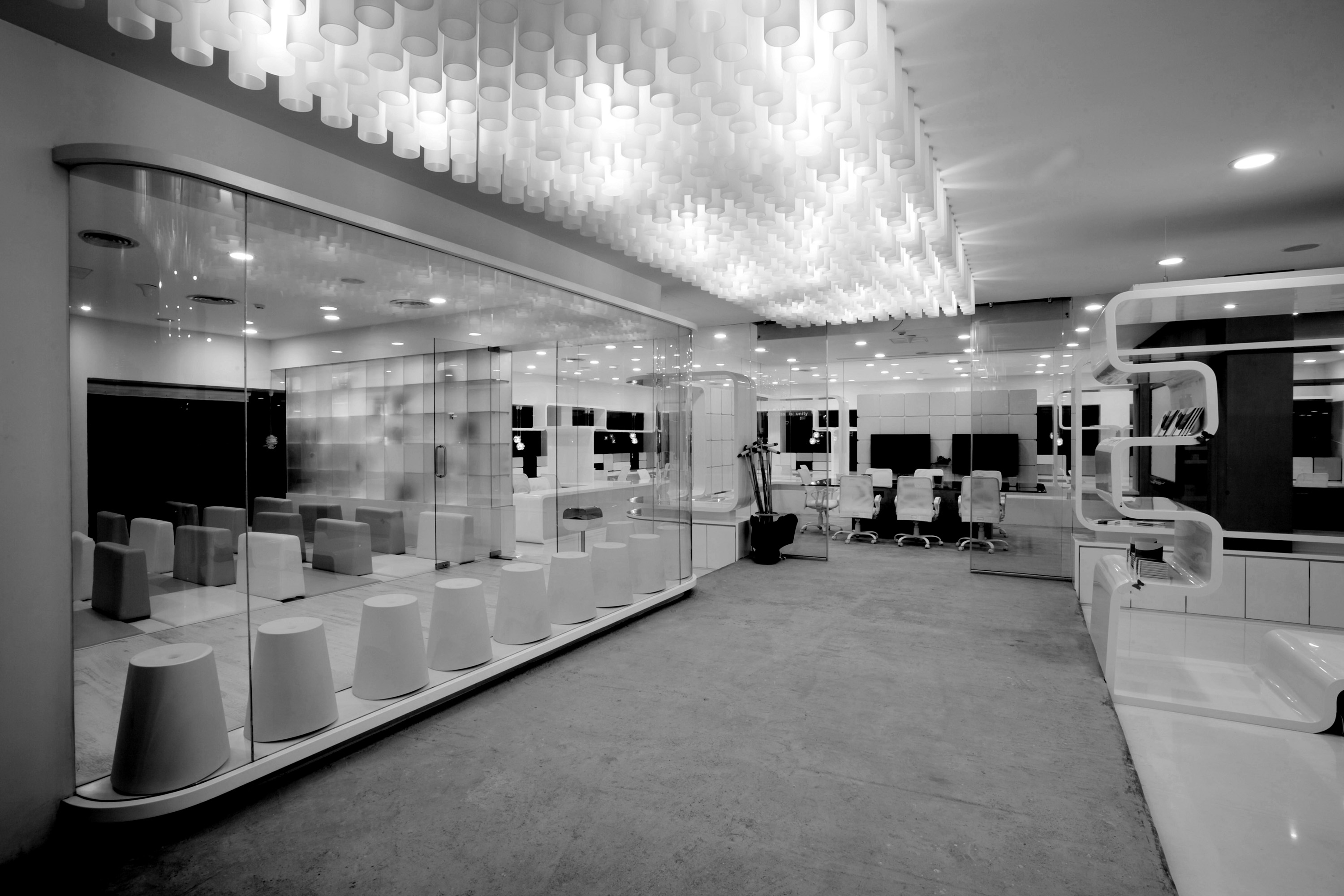
Godrej Space office, courtesy Godrej Industries. |
Homes too operate at two levels of scale; enhancing each individual family member’s well-being, as well improving the quality of family life as a whole. But with families drifting into nuclear life, homes operate on a relatively small physical scale: a few thousand feet at most, for a handful of occupants. The design challenge in residential interiors can arguably be condensed to one level of scale, rather than two, and is conceptually differentiated from that of office spaces. Schools, on the other hand, operate at two levels, emphasizing student performance and on creating an institution. But educational design does not face the peculiar challenges of workplace design, as schools are far more inspirational zones.
M
y observation that an office is designed to meet the needs of a company and its employees, like any other well-meaning insight, seems blindingly obvious in hindsight. If an office is not designed for a company, then who else is it designed for? But its implications are potentially powerful. In my experience, this challenge of operating at two scales is rarely taken into consideration by client or interior architect. Clients are usually unable to translate their vision or their organization’s work culture into physical dimensions. Architects are not trained either to delve into the nuances of organizational behaviour.By default, design thinking ends up concentrating on the needs of the individual employee, or on the personal preferences of the head of the organization (frequently, the chairman’s wife). More sensitive clients may identify work patterns and organize spaces by activities (some are even inspired by architect Francis Duffy’s path breaking book on this subject, The New Office).2 But social dynamics of office workers, and their relationship to physical spaces, is not generally a common conversation starter between CEOs and their architects. The discourse remains anchored in surface materials and cost-per-square-foot thinking. Designers are asked to walk a tightrope between providing individual comfort and maximizing employee productivity. Unsurprisingly, an office landscape results in multiplied versions of a single workstation unit, devoid of character, emotion or inspiration.
|
|
|
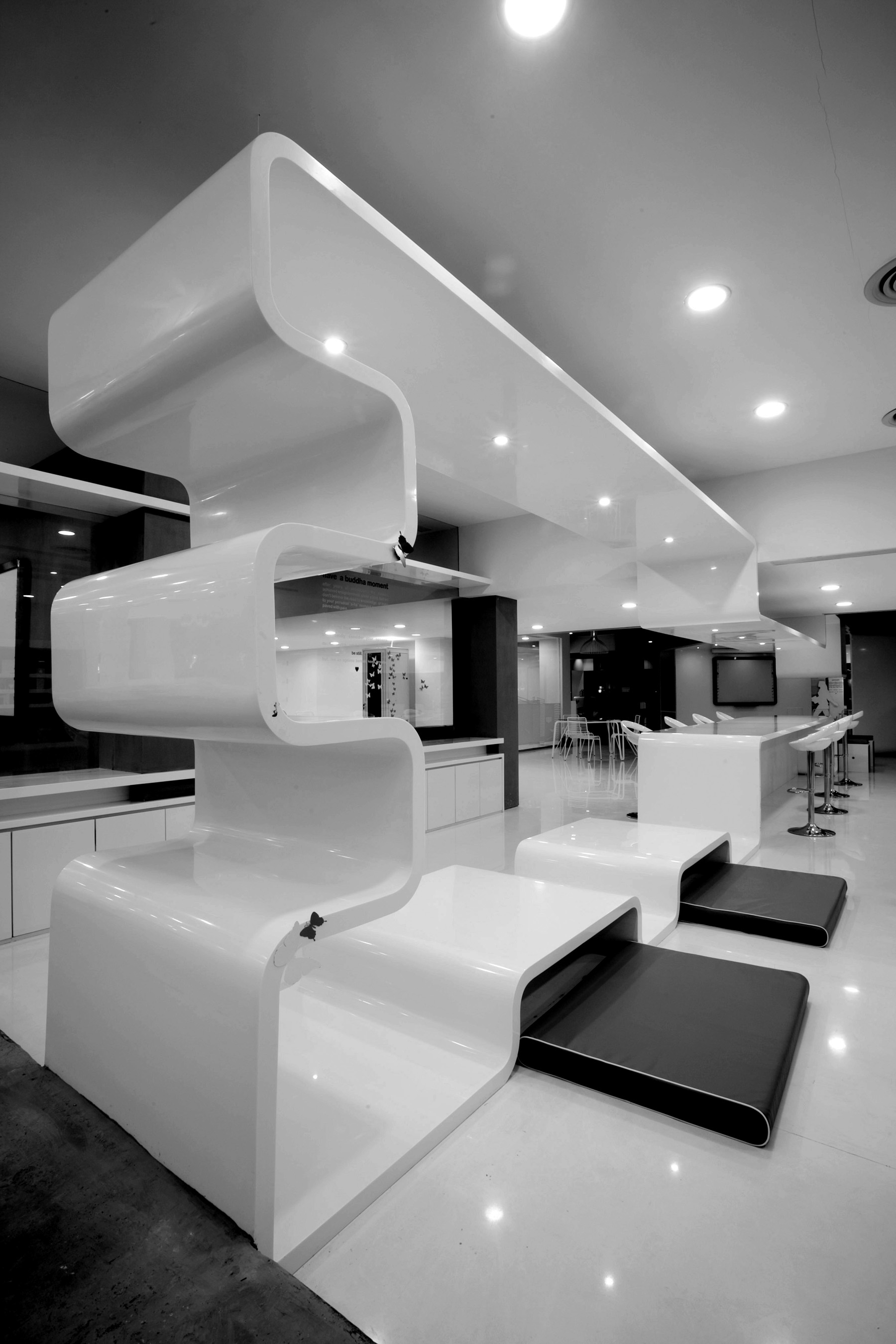
Godrej Space office, courtesy Godrej Industries. |
|
|
|
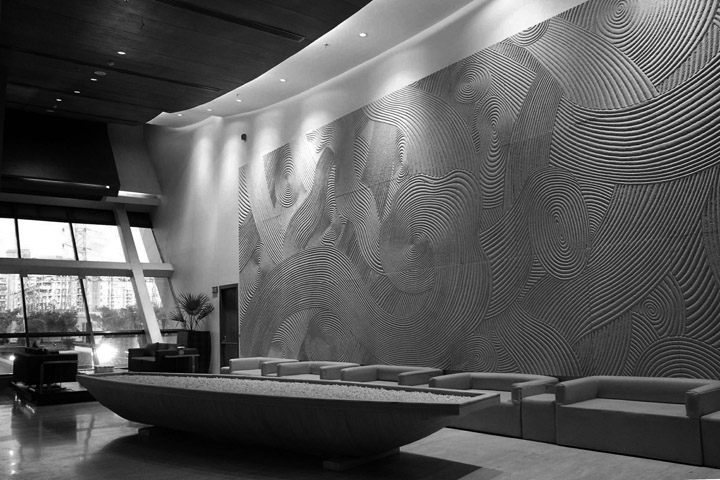
DP Jindal corporate office, courtesy Morphogenesis. |
And this is precisely where spatial behaviour can play a role: as a practical vocabulary to connect the two different languages of architects and CEOs. The concept of spatial behaviour allows both stakeholders to make sense of the idea that they are designing for an organization, not just masses of individual employees.
H
ere is how it works: when designing a new workspace, think about the social dynamics of its office workers. How would you like them to interact with each other? As friendly neighbours, creative thinkers or informal classmates? Next, think of non-office environments where such behaviour is visible. This could be a village, a street café, or a high school. Are there any learnings from those spaces that you can apply to your office? A metaphor for group interaction, tailored to your organization, should emerge. This is spatial behaviour in a nutshell.
A
s a tool for workplace design, spatial behaviour is not merely intellectual abstraction. It is live and kicking in a number of corporate offices, many of whom I reviewed as part of my ongoing series on workplace design for Mint, the business newspaper. At the corporate headquarters of Tata Chemicals in Bombay House, Anuradha Parikh of Matrix Architecture drew on the company’s rural roots to create a ‘work village’, responding to the CEO’s desire for a space that would reflect the company’s business origins and build a sense of community among its people. A centrally located chauraha encourages spontaneous interaction, much like a village tree. Cubicles are lined with ledges, inspired by otlas or masonry projections found outside Gujarati homes to welcome visitors. Each desk has a lit cut-out, which can be personalized with a picture of a deity. Her interpretation of village social dynamics, and its application to a contemporary business setting, is subtle and effective.At the other end of the creative spectrum is the Godrej Space office in Mumbai’s Vikhroli, a radical suite of workspaces, defined by gleaming white finishes, fluid visual forms and a resolutely modern work culture. The versatile space operates as product showroom, working office, conference room, training centre and lounge. Its primary goal, though, is essentially narrative: its sponsors wanted to bring Godrej’s new brand identity to life in a cutting-edge, three-dimensional environment.
T
here are several other illuminating examples. The new Andheri corporate headquarters of Hindustan Unilever is probably the most ambitious attempt at leveraging spatial behaviour to drive cultural change. The centrepiece of the sizable campus is a five storey high, 72,000 square foot atrium dubbed the ‘street’. Traversed by several bridges and lined with branded kiosks, the street is a deliberate architectural device to foster collaboration between the company’s strictly codified departments, in line with a specific brief by the company’s then CEO, Doug Baillie, to architectural practice Kapadia Associates.
M
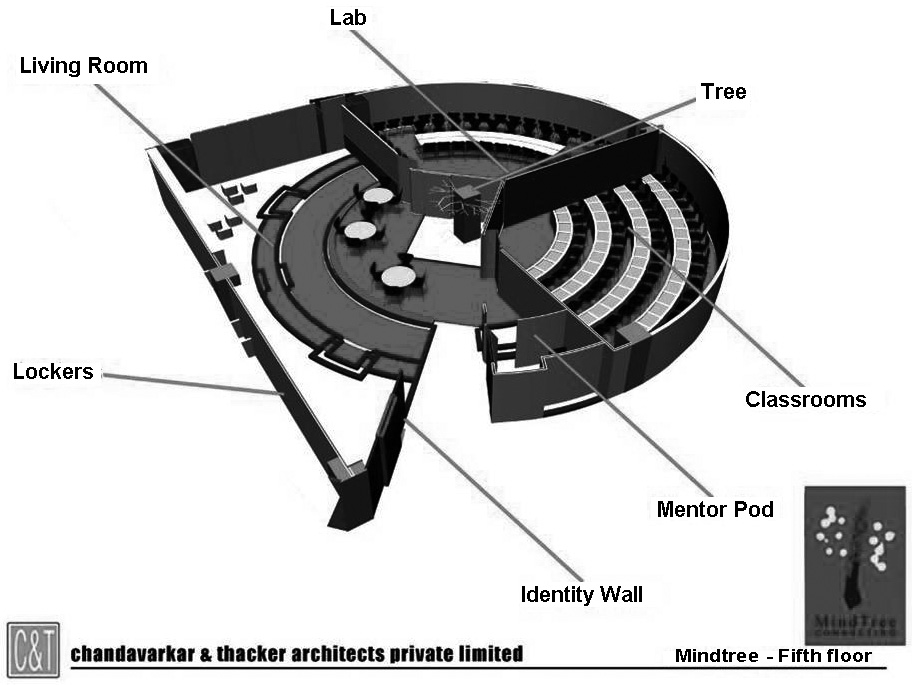
indTree, a software company in Bangalore, is one of India’s most progressive companies in terms of its ability to articulate the relationship between tangible, physical infrastructure and intangible, intellectual assets. Subroto Bagchi, MindTree’s cofounder and board director believes that ‘looking at the physical infrastructure as a cradle for the intellectual and the emotional helps us create a very different organization. As you walk around MindTree, you will be enveloped in an integrated experience – the physical delivers an emotional message and together they enable superior intellectual performance.’ The Orchard, its learning centre for raw campus recruits, designed by Prem Chandavarkar and his team at CnT, was specifically designed to behave as a surrogate ‘home’ inspired by boarding-school houses.
|
|
|
MindTree’s Orchard Learning Centre, Courtesy Chandavarkar & Thacker. |
Other offices are less imaginative in their briefs, and consequently, less successful in execution, although they deserve a round of applause for their attempts, as they are a small minority amongst commercial Indian buildings to pay attention to spatial behaviour. The corporate office for industrial conglomerate D.P. Jindal in Gurgaon, designed by Morphogenesis, is comparable with a boutique hotel with a fabulous art gallery, reflecting its promoters’ aspirations for a metropolitan, contemporary look. Advertising agency Ogilvy & Mather’s flagship office in Mumbai’s northern suburbs attempts to bring the outdoors into a boxy high-rise office block, with a garden-themed palette of décor, finishes and furniture, which interior architect Mihir Thaker and stylist Nita Joshi perceived would enhance individual creativity. The metaphor’s connect with business intent is weaker than those of Hindustan Unilever, MindTree or Godrej Space, but should not be overlooked.
A
ny design solution is only as effective as its brief. Much of the problem with bland office spaces is that they are products of limited vision, rather than lack of design inspiration. If a CEO cannot think beyond a command-and-control company, then it is hardly surprising that the visual manifestation is an army barrack with manicured rows of workstations for foot soldiers and lavish quarters for the company’s generals.It is equally critical to ensure that the vision correlates with its target user group and the company’s business model. In the early days of India’s software renaissance, several companies offered country club-like amenities such as tennis courts to their employees. But the spaces misbehaved – the country-club culture was alien to the average soft-ware engineer. Similarly, the heady dot-com atmosphere revolved around bringing leisure into workplaces, with minimal connection between these grown-up toys and tech-driven business models.
W
orkplace design experts Jeremy Myerson and Philip Ross provide a succinct classification of business objectives of modern workplaces in their book, The 21st Century Office.3 Their framework helps to bind CEO business vision with design elements. The duo writes that spaces can be ‘narrative, nodal, neighbourly or nomadic.’ A narrative office enables brand experience, the nodal office serves as a knowledge connector, the neighbourly office unfolds as social landscape, and the nomadic office performs as a distributed workspace. I would add more a further characterization: the nurturing office, devoted to enhancing individual well-being, inspired by MindTree’s approach.On their own, these terms do not roll off the tongue very easily, and may not ignite a lively conversation between CEOs and architects. However, when supplemented with metaphors derived from spatial behaviour-led thinking, a more practical vocabulary emerges. The accompanying table connects the dots between business objectives, types of spaces and design solutions using spatial behaviour-led metaphors.
|
Business objective |
Type of space |
Design solution in terms of spatial behaviour |
|
Experience the brand through its workspaces |
Narrative |
A crucible for innovation (Godrej Space office for strategic marketing teams) Art gallery and boutique hotel (DP Jindal corporate HQ) |
|
Build a sense of community through workspaces |
Neighbourly |
The ‘work-village’ (Tata Chemicals corporate HQ) The street (Hindustan Unilever corporate HQ) |
|
Promote workplace flexibility |
Nomadic |
Elements of Hindustan Unilever, Godrej Space and Jindal corporate offices |
|
Promote individual well-being at work |
Nurturing |
The schoolhouse (The Orchard, Mindtree’s Learning Centre) The garden (Ogilvy & Mather corporate HQ) |
In fact, Myerson and Ross’s most recent book, Space to Work,4 is constructed along the lines of spatial behaviour-led metaphors. They concentrate on knowledge work, and classify workspaces into four ‘realms’ of knowledge work. The corporate realm of knowledge work is the academy, the professional realm is the guild, the public realm is the Greek agora and the domestic or private realm is the lodge. The book has some stunning examples, such as Zaha Hadid’s design for BMW, where the car production line slices through administrative offices.
A
lthough ‘guild’ and ‘agora’ do not particularly resonate in India, as our knowledge economy is not as advanced as western nations, ‘lodge’ and ‘academy’ are promising avenues for office design. Numerous blue-chip companies already model their sprawling campuses on colleges or universities. The office as ‘home’ is a less prevalent notion, but a very promising one, particularly to the legions of small business owners operating out of semi-residential spaces. Larger organizations striving to build community might do well to consider establishing a kitchen, a cafe or even a bar, in the heart of their spaces, rather than on the peripheries, as food and drink are universal connectors.A more tongue-in-cheek interpretation is office as theatre: with designated spaces to take off our daily masks, and others that demand a rehearsed performance (boss’ cabin, perhaps?), although this metaphor may not be easily linked to business intent.
Spatial behaviour thinking can easily extend to other types of spaces, even to those whose centre of gravity is the individual, and not the organization. It is a particularly helpful approach when dealing with complex briefs and multiple goals. Blue Frog, Mumbai’s premier live music venue, is simultaneously a bar, nightclub, concert arena and a restaurant. Its compact yet multi-functional space works because its design was conceived using specific spatial behavioural metaphors. As Kapil Gupta of Serie Architects explained to me, ‘The Blue Frog has a plan like a restaurant and a section like an opera to deliver a highly acoustic, yet very intimate viewing experience.’
H
ospitality design in India is finally transcending historic palatial references and I wonder if more inventive metaphors will be adopted by hotel owners, for travellers seeking holistic wellness and business connectivity. As worklife creeps into our homes, it could be interesting to use spatial behaviour to give life to a third type of space altogether. Loosen your imagination to generate spatial behaviour metaphors, and your spaces can travel beyond materials and surface treatments.
Footnotes:
1. Kishore Biyani with Dipayan Baishya, It Happened in India, Rupa & Company, New Delhi, 2007.
2. Francis Duffy, The New Office, Conran Octopus, London, 1997.
3. Jeremy Myerson and Philip Ross, The 21st Century Office, Laurence King Publishing, London, 2003.
4. Jeremy Myerson and Philip Ross, Space to Work, Laurence King Publishing, London, 2006.