Way forward to inclusive growth
RAJIV KUMAR
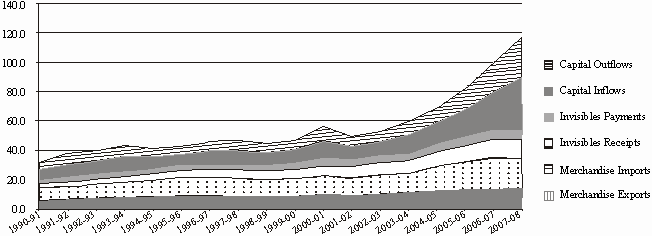
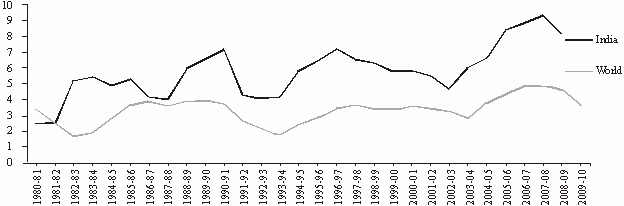
2008 has been a roller coaster year for the Indian economy. I recall vividly the bravado of the Indian corporate leaders in Davos in January when they declared that the Indian economy had decoupled and would not be affected by the global slowdown. I had written then, that to talk of any decoupling was simply unwarranted, given the fact that external sector transactions (exports and imports of goods and services and remittances) today account for more than 50% of the GDP. Charts I and II give the share of the external sector in India’s GDP and brings out the uncanny correlation between global and Indian economic growth rates.
|
Chart I: Current Account and Capital Account as a % GDP
|
|
Chart II: GDP Growth – India and World (3-Year Moving Average)
|
Given this correlation, one did not need to be a clairvoyant to say that a global slowdown will singe India badly. It did. World food prices were going through the roof and export bans were the order of the day in the first quarter of this year. India’s food stocks had virtually run out and imports were on the anvil, not to bring down inflationary pressures but simply to avoid food shortages. Today, as a result of record foodgrain procurement, domestic warehouses are overflowing and world commodity prices have crashed. Oil was $100 per barrel in January 2008 and rose to $146 per barrel in June, with several experts predicting $200 per barrel before the year end. And now we are at five year lows of $40 per barrel!
In April and May there were fears of an over-appreciation of the rupee hurting our exports and the economy attracting unmanageable volumes of foreign direct and foreign equity inflows resulting in a huge build up of foreign exchange reserves. And now we have seen our reserves decline by more than $60 billion between May and November as FDI inflows have sharply declined and there has been a net outflow of more than $2 billion by equity funds. From the highs of thinking of India emerging as one of the engines of global economic growth, we are today faced with a sharp deceleration and the talk is that of trying to prevent the downturn from becoming avoidably long and deep. One couldn’t have imagined that a mere twelve months could pack so much economic drama into them. Interesting times indeed.
|
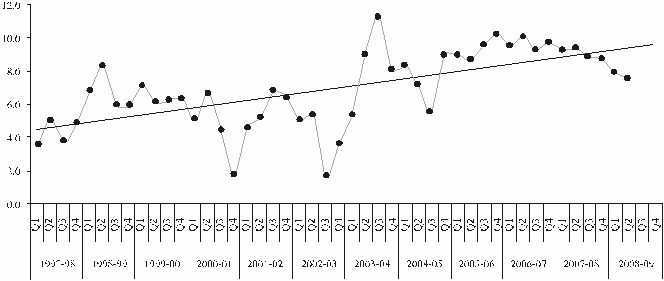
Chart III: GDP Growth 1997-8Q1 to 2008-9Q2
|
The food and fuel price hike in the early months of this year, which caused the inflationary scare, also masked the reality that the economic downturn had already started in the second quarter of 2007. This is clearly revealed in Chart III which shows that after enjoying high GDP growth rates for over four years, the Indian economy had begun to slow down about twelve months ago. However, monetary policy continued to be tightened until July 2008 to bring down inflation. This contractionary stance was also prompted by the knowledge that economic growth remained higher than the economy’s potential growth rate that had been estimated at between 8-8.5% by the IMF and the OECD.
W
ith economic growth of higher than nine per cent in 2006-07 and also 2007-08, a justifiable fear was that the economy was overheating and, if not corrected, inflationary expectations would take root. What was perhaps not noticed was that the current inflationary rate as measured by the month on month inflation rate (as different from the year on year measure, commonly used to describe inflation) had already begun declining since June 2008 and so there was not much danger of re-igniting inflationary expectations. As it turned out, however, contractionary macro policies combined with the global slowdown resulted in the GDP growth rate in the first half of 2008-09 (April to September) coming down to 7.6% as compared to about 8.5% during the first half of 2007-08.
|
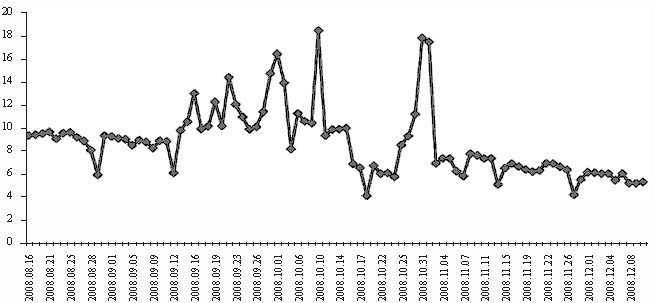
Chart IV: Daily Call Money Rate (Sep 2008 to Dec 2008)
|
T
he Indian economy was, therefore, already precariously positioned when it was impacted by the shock of the global financial sector meltdown that started with the demise of the Lehman Brothers and the subsequent nationalization of AIG, the world’s largest insurance company. Driven by the withdrawal of liquidity from global inter-bank markets, Indian financial markets also suffered severe liquidity shortages as demonstrated by the sharp spike in overnight interest rates which touched nearly 20% in September 2008 (see Chart IV). By October, it was clear that the global financial sector crisis that started in August 2007 had engendered a serious economic downturn in North America, the Euro zone and Japan. According to some observers this was perhaps the only real crisis in the centre of capitalism since the depression of the 1930s. It is bound to affect all the economies in the periphery.It was, therefore, not surprising to find that Indian exports declined in October and November and industrial growth rate became negative in November for the first time in the last twelve years. The Indian economy has well and truly entered the downward phase of the business cycle. The longest industrial sector boom that had lasted more than 62 months and which had generated irrational exuberance amongst our industrialists and political leaders had finally ended. Henceforth, policy must focus on measures to make this downturn as shallow and short as possible.
|
Chart V
|
T
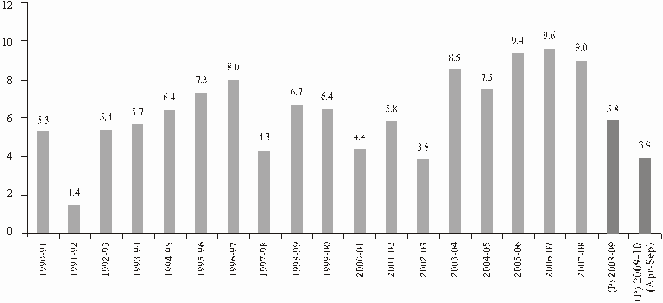
he prognosis for the second half of the current year (2008-09) and the first half of next year (2009-10) is, however, not bright. The Index of Leading Economic Indicators (LEI) that has been developed by a group of researchers working at ICRIER1 forecasts that economic growth in the second half of this year (2008-09) will come down to about 5%, yielding an overall GDP growth rate of about 6% for the year as a whole. This is well below the rates achieved in the previous three years. (See Chart V for annual growth rates since 1991.)More importantly, this estimate is nearly two percentage points lower from forecasts made at the beginning of the year, demonstrating the extraordinary speed at which the global and domestic environment for growth has deteriorated. More unfortunately, our estimates point towards a further slowing down of the economy in the first half of next year (April-September 2009-10) with the LEI index pointing to a GDP growth of about 4% for that period. Whether this slowdown will persist and gets worse or will we see an economic upturn in the second half of 2009-10, will depend crucially on the state of the global economy and domestic policy measures that are taken now.
F
ortunately for us, GDP growth, though linked to global economic performance, is not as dependent on it as for example that of China. As the accompanying Table 1 shows, net exports (exports minus imports of goods and services) contributed a negative -3.6% in India’s GDP growth between 2000 to 2007 as compared to a positive 7.9% for China during 2000 to 2005.|
TABLE 1 Decomposition of GDP Growth: China Vs India |
||||
|
China |
India |
|||
|
1994-00 |
2000-05 |
1994-01 |
2001-07 |
|
|
Final consumption expenditure |
63.2 |
37.6 |
75.2 |
56.2 |
|
Gross capital formation |
29.9 |
54.4 |
26.3 |
47.4 |
|
Net exports |
6.9 |
7.9 |
-1.5 |
-3.6 |
|
Total |
100.0 |
100.0 |
100.0 |
100.0 |
|
Source : Computed from WDI and CSO data. |
||||
Yet, the global economic scene will continue to affect us both negatively in the form of weak demand for our exports and lower level of remittances and positively in the shape of lower prices for essential imports like energy and other commodities. But a major concern should be the likely sharp decline in the Chinese economic growth rates. Its first negative impact will be a further decline in our exports of iron ore and other primary products that fetched us close to $10 billion in export revenues last year. Second, an increasing volume of manufactured exports from China will now be directed to the Indian market. We must also watch out for major global economic churning in case of an unexpectedly sharp decline in Chinese growth rates which could result in serious socio-political convulsions within China and in its extended neighbourhood.
T
he mainstay of our growth will be domestic demand. This needs to be shored up with appropriate fiscal and monetary policies that will stimulate both consumption and, more importantly, investment demand. Some initial steps have already been taken by the government when it announced a three pronged economic stimulus package at the beginning of December. This comprised reduction in fuel prices, lowering of interest rates across the board with special cuts for relatively smaller housing loans of up to twenty lakh rupees and a fiscal stimulus of about $6 billion or Rs 30,000 crore. These are steps in the right direction and will help boost the sagging consumption demand.
T
hankfully, there is sufficient space available to further bring down interest rates and lower the cost of capital, which will hopefully increase investment demand. On the fiscal side, however, there is not much headroom despite the decline in global oil prices which have sharply reduced the burden imposed by oil and fertilizer subsidies. Nonetheless, the government, in conjunction with state governments, should consider further lowering excise duties and sales taxes to try and push up consumption demand. Increasing the fiscal deficit will raise the level of public debt and this can be a cause of some worry. But, with the current (2007-08) public debt to GDP ratio of 77%, there is clearly some room for expanding public expenditure.
L
et me at this stage emphasize as much as I can the critical need for maintaining a high rate of economic growth. Growth is a necessary condition for tackling poverty. Maintaining a reasonable growth rate is also essential for social stability and peace. Growth provides the context for generating the much talked of ‘demographic dividend’ which is derived only when young people are absorbed in the workforce and are productively employed. They then generate incomes that fuel consumption and add to the pool of national savings. Without rapid growth, potential entrants to the workforce will not find a satisfactory job. This will heighten social stress and unrest. With middle class expectations now at an all time high as a result of the decade-long growth and the media explosion, job losses or lack of employment opportunities can have significant and avoidable social and political fallouts. Therefore, it is important for policy-makers to give growth the due importance while addressing the inevitable trade off between growth, equity and price stability.2
I
t is important to realize that while fiscal stimulus and loosening of monetary policies can help to raise demand and growth rates in the immediate and short term, they cannot be relied upon to sustain a high growth rate over time. To sustain growth, the structural constraints on investment and capacity expansion that are essential to generate the necessary supply response have to be removed. Therefore, policy attention needs to be focused on removing these structural constraints that prevent our potential growth rate from rising above eight per cent.India needs to achieve a potential growth rate of ten per cent or more if we are to eliminate dehumanizing poverty in the foreseeable future and also meet the rising aspirations of our burgeoning middle classes.
The most important constraints on raising the potential rate of growth of the economy are: poor delivery of public goods and services; infrastructure underdevelopment; and rent generating government procedures and regulations. The scope of public goods and services needs to be adequately defined. This is important because in India as in some other emerging economies like the Philippines or Latin American countries, it is mistakenly believed that growth can be achieved not only without the government playing its due role but even ‘despite the government’. This is a dangerous mantra which unfortunately is too often parroted by India’s capitalist class and even the intelligentsia, which should know better.
T
his perhaps comes from our centuries long lack of trust in the ruling authorities and expecting nothing from the country’s rulers expect exploitation and arrogance. This prompts all of us to try and find a private solution rather than look to the state or its various agencies for the more appropriate public solution. This ranges from law and order, which has become the fastest growing industry in our country, to potable water, electricity, sanitation and judicial arbitration. This is simply not workable as it is not only an exclusionary model of development but is unviable on all counts, whether social, political or environmental. A development model that does not factor in the due role of the state cannot generate the desired rate of growth. If somehow the desired growth rate is achieved ‘despite the government’, it will end up trapping all of us in a most inequitable society that will be full of stresses and unsustainable. This is certainly avoidable.
T
herefore, we must now work to achieve a greater accountability of the state and its agencies in delivering the entire gamut of public goods and services. These will include education, health, social security, urban utilities and security. While each of these five components is critical for achieving inclusive and sustained rapid growth, perhaps the most critical is the provision of good quality and equally accessible public education at all levels. The key to the East Asian success in achieving rapid and equitable growth is the provision of high quality public education duly supplemented by private providers who fill the gaps as they emerge.The Sarva Shiksha Abhiyan should be lauded for raising our primary school enrolment ratios to hundred per cent, but quality is still badly lacking as repeatedly revealed by the painstakingly undertaken Pratham surveys. Dropout rates remain unacceptably high. How can India hope to compete in the knowledge intensive global economy with less than 13% of our children reaching higher education? The present government should be given the credit for significantly raising allocations for education and expanding the number of universities, model schools and the number of scholarships. But let us be clear that this is just the mere beginning. This effort at making our education more accessible and generating better quality must be sustained over the next few decades, if we are to achieve our true potential and avoid social upheavals.
I
n the realm of higher education, serious consideration should be given to winding up the UGC and letting multiple accreditation agencies be established to certify the quality of education being provided in both the private and public sector institutions. It is time also to think of endowing our universities with a large enough corpus so that they can become financially independent and achieve the necessary autonomy from political and bureaucratic interference.
T
he necessity for addressing our perennial infrastructure weaknesses has been discussed at length in our country. Here I want to emphasize only two aspects. First, that hopefully vote bank politics or the pressure to appear politically and socially correct will not take away from the importance of developing our urban infrastructure. The poor will be increasingly concentrated in urban slums with unacceptable living conditions as more than 400 million migrate to towns over the next three decades. At present urban development for the most part is practically completely unplanned and private sector driven with all its attendant problems. This must change if we are not to end up in an unholy mess where neither human beings, animals or nature will be able to survive.Second, we cannot continue to flog the private-public partnership horse for too long. The much vaunted PPP model has significant practical problems, the least of which is generation of significant rents with the increase in the private and public sector interface. It has not delivered the desired results in any country so far. The public sector has been the mainstay and the chief provider of physical infrastructure in all those countries which have successfully tackled poverty and achieved the desired high rates of economic growth. It is time for us to ask the government at all levels to recognize its duty and efficiently deliver the infrastructure we need.
T
he security conundrum that faces us perhaps does not need much elaboration after the tragic Mumbai incidents. But let us not make the mistake that raising special forces and passing new legislation will solve the country’s security and law and order problems which are very deep seated. All these ‘specialized efforts and schemes’ will come to nothing if the more fundamental reforms of our police and security system is not undertaken. Commission reports gather dust and political classes in cahoots with bureaucracy continue to use the security establishment for serving private objectives. The men in uniform do not enjoy the respect and trust that is necessary for them to perform their functions. Instead they are seen as persons who are best avoided and in any case cannot be relied upon.
U
nless the basic causes for this sorry state of affairs are addressed, the security system will not improve. And how can we have economic growth if entrepreneurs fear for their lives and the safety of their near and dear ones. Can each state government identify five to six districts in which authorities are assigned annual law and order targets that are are monitored at the highest level?Rapid and equitable growth will be generated when our small and medium enterprises find that the business environment encourages and supports them. I focus on the SME sector because they currently contribute the largest share of employment, mostly in the informal sector, and generate the majority of India’s exports. This sector generates strong growth impulses and given its spread across the country, it can make growth also regionally balanced. But today it is weighed down by a plethora of rules, regulations and procedures that impinge on every aspect of its operations. The large majority of these rules and procedures are such that their compliance will render all the SMEs uncompetitive and loss making.
C
onsequently, almost all these rules, regulations and procedures are observed in their breach. They thus effectively become a web of rent-seeking and corruption that sucks out all the vitality and surpluses from the SMEs and the self-employed, leaving them quite incapable of further expansion and growth. Entrepreneurs and workers engaged in this sector are consequently destined to a life of low productivity and stagnation. This state of affairs must change if India is to take full advantage of its vast reservoir of entrepreneurial talent and energy.The entire gamut of these rules and procedures needs thorough review and simplification. Some minimal rules like not allowing child labour or observing reasonable working hours and paying a small premium for social security provisions that matches the workers’ contribution should be put in place and strictly enforced. The present system of having a very large number of rules, which can never be enforced is completely dysfunctional and only breeds dishonesty and corruption.
The belief that India can grow only on the basis of a globally competitive services sector and does not need a vibrant and expanding manufacturing sector is not valid. The services sector cannot hope to absorb the rising numbers of entrants to our workforce. We need the manufacturing sector to grow rapidly and compete effectively with Chinese imports which are increasingly visible in our markets.
An economic downturn is a good time to focus on these structural reforms as both the policy-makers and the industry have more time and energy to devote to these issues. If implemented, these reforms will ensure that India’s manufacturing sector can become globally competitive and take on the Chinese exporters both within the Indian domestic market and abroad. This will ensure that the next upturn is stronger and is sustained for even a longer period than previous ones.
Footnotes:
1. The macroeconomic unit at ICRIER comprises, Rajiv Kumar, Mathew Joseph, Karan Singh, Dony Alex and Deboshree Bannerjee. The estimates and views are solely of this group and cannot be attributed to ICRIER.
2. An employed young person can work harder to keep up with the prices that threaten to erode his/her living standards. Being unemployed leaves one completely vulnerable to all kinds of economic distress, including of course price rise.