Dhamma land
PREMOLA GHOSE
I first visited Sanchi some thirty years ago. It was a bright, dusty spring morning when we disembarked from the Delhi train and dashingly galloped up the hill in a tonga which was probably the only transport available then. Sanchi, a 3rd century BC Buddhist monastic settlement, was one of the several ‘finds’ of Indian archaeology in the 19th century, and is undoubtedly one of the most beautiful sites in India.
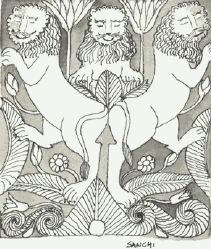
One should see it during the monsoons, when the sky is filled with vivacity, alternating between scudding clouds and erratic sunshine and the bright green hill and rain drenched stupas are illuminated by a pale gold halo. One of my visits was on 15th August – Independence Day – when the stupas were bedecked with the tricolour, fluttering merrily alongside bewhiskered sandstone lions. There were chattering families, dressed gaily on this national holiday, and several circumambulating monks from Sri Lanka, giving the place an air of a happy garden party. Independent India and the Mauryan Lion! – we see ourselves the direct heirs of the Mauryas, followers of the Dharma. It was all there that morning in Sanchi, the tricolour with our wheel and the Mauryan lions and their wheel!
Sanchi lies in the state of Madhya Pradesh and can be reached very comfortably by train, disembarking at the dusty station of Vidisha. A nice place to stay is The Retreat, run by Madhya Pradesh Tourism. Located a few kilometres away, it comprises of modern cottages and from the entrance one looks out at the hill and glimpses the Great Stupa. The food too is good and combined with the peace and quiet, there is nothing more pleasurable than wandering around Sanchi and its environs.
F
orgotten places, backwaters of provincial India, are remembered today only for their rich historical legacy. Once, long ago, Sanchi was a thriving Buddhist monastic settlement, and with other monasteries in the vicinity – Sathdhara, Sonari, Andher and Murel Kund – formed a much larger religious landscape. Sanchi is today a Unesco world heritage site, both well-preserved and much visited. Sri Lankan chroniclers claim that the children of Ashoka, the great Mauryan emperor, left from Sanchi, carrying the message of Buddhism to the king of Sri Lanka. They also carried a sapling of the sacred Bodhi tree. The Bodhi tree was returned to India some decades ago or more than 2000 years later. Today it is fully grown, decorated with the brightly coloured prayer flags of the Tibetans and faces a modern Sri Lankan vihara.|
|
R
ecently, H.H. The Dalai Lama consecrated the relics of Sariputra and Maudgalayana which the Sri Lankan government presented to Bodh Gaya. They were close disciples of the Buddha, and are often seen flanking him in thangka paintings. The early Buddhists enshrined the relics of the Buddha and other holy men in hemispherical domes, stupas. At some stage these relics got divided and further divided and some found their way to Sri Lanka and other Buddhist centres – perhaps from Sanchi – since we know that relics of the same two gentlemen were found in Stupa No. 3!There is evidence of continuous building activity on the hill of Sanchi from 3rd century BC to 12th century AD with the establishment of the monastic settlement during the reign of Asoka (273-236 BC), when he built the Great Stupa. Buddhism extended its frontiers along with the Mauryan empire and the monasteries of this area prospered, patronized by the rich merchants of nearby Vidisha which lay on the busy trade routes linking the capital city of Pataliputra with Broach.
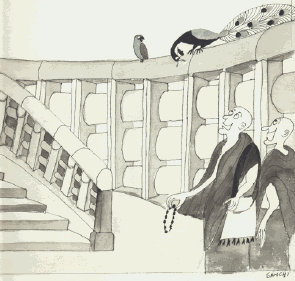
Sanchi has done well for itself, however, and has settled down comfortably in a landscaped park, approached by a well maintained asphalt road, although the monks who still come in large numbers can be seen picturesquely climbing the stone steps to the summit. Ashoka’s stupa was encased and ornamented with a lovely sandstone balustrade under the Sunga kings in the 2nd century BC and the four cardinal points were marked by gateways or toranas which were added a century later by the Satvahana kings.
|
|
These gateways, which recall the Japanese torii, were exquisitely carved, we are told, by craftsmen who were ivory carvers. The panels narrate stories from the Jatakas – the previous births of the historic Buddha when he was a bodhisattva, the life of Gautama Buddha, and events in the history of Buddhism. Here the Buddha is represented through symbols: a tree, feet, umbrella, as it was in the days before someone first hit upon the image in either Gandhara or Mathura. The summit and the slopes of the hill are dotted with the remains of smaller stupas, temples and monasteries. There is also a feverish restoration and cleaning work going on and we saw several ‘restorers’ hard at work with toothbrushes!
A
cultural resurgence occurred during the golden centuries of the Gupta kings who, in the 4th century AD, added Buddha images and built a temple which is renowned as an early example of temple buildings. The 7th and 8th centuries were a prosperous time and much of the building activity in Sanchi can be traced to this period. Though Sanchi remained an important site until the 13th century, no one really knows how the great monasteries and shrines lost their patronage. The archaeologist’s spade has, interestingly, excavated sculptures of Brahmanical deities which belong to this period of decline.
I
n 1818, General Taylor ‘discovered’ the stupas initiating the period of excavations. Unfortunately the Asokan pillar, which once stood tall and erect near the Great Stupa, was broken up into pieces and used as a sugarcane press by a local zamindar. Only a hundred years later were serious excavations undertaken by Sir John Marshal and what we see today is largely due to his efforts. The site museum which houses some very fine sculptures, including the four headed Ashokan lion, is a located below the hill, near Marshal’s house.The sangha that inhabited the great monastic settlements in this region was linked to the agricultural communities through a system of sustainable irrigation as shown by the remains of dams found in this area. A recent survey of the region not only revealed an extensive network of dams but curiously Naga shrines, indicative of Buddhism’s seamless assimilation and compromise with local beliefs.
The Satdhara stupa looks larger than the Great Stupa and when the monsoon rains fill every depression and gully with flowing water, the crumbling stupa looks as if it is marooned on an island, like a local Borobudur. Though excavations are still going on at Satdhara, some years ago it was rather tough traversing fields and slushy roads in search of the site. We failed to get to the other sites although windblown boards pointed to other obscure corners of fields. It is quite amazing that such a large area in the middle of India was covered with so many monasteries. The Buddha, we know, never reached this region and so the credit for such a large and flourishing sangha must go to Ashoka’s queen, Devi, the daughter of a Vidisha merchant!
N
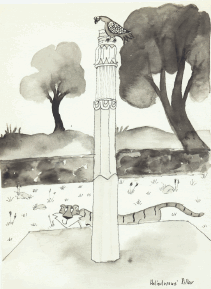
ear the fly-blown town of Vidisha is a village of Besnagar. Some decades back it was a small village with straggling goats and chickens grazing in the empty fields. No one went there as its only claim to fame was a stone column with an inscription attributed to a Greek ambassador, Heliodorous, who was sent to the Sunga court in Vidisha by the Indo-Bactrian king, Antialkidas in 140 BCE. The column, known locally as Khamb Baba, was erected when Heliodorous became a follower of Vishnu. Our old history textbooks took great pride in the Besnagar Pillar inscription because we felt that it was a great honour to have links with Greece. Of course, all this changed in the 21st century when we ‘discovered’ that the Aryans came from India and all that is ‘civilised’ is a home-grown product. Heliodorous was probably nothing but an early Hare Krishna follower!
|
|
The Garuda that once crowned the pillar has long since disappeared and a small ‘park’ encloses the site. But the adjoining undulating mounds along the Bes river, at one time the site of the sophisticated and cosmopolitan city of Vidisha, are being steadily ruined as unplanned shanties have dug deep into the archaeological site and the locals tap the mound for antiquities.
S
ome four kilometres away, along a tree-lined country road, is the hill of Udaigiri with its stunning rock-cut caves dating to the period of the Gupta king, Chandragupta II (382-401 ACE). Cave Five has the famous frieze of the cosmic myth where Varaha (the Boar incarnation of Vishnu) rescues the earth goddess, Prithvi, from the ocean. The Devas and the Asuras watch this event from their ringside seats and the Ganga and Yamuna descend merrily from the heavens, accompanied by celestial musicians and dancers. Carved out of hard rock, the interplay of light and shade animates the drama of the cosmic myth. Cave No. 13 contains the Sheshashayi Vishnu which, alas, lies behind a PWD iron grille.The most rewarding part of this excursion – in good monsoon weather – is to climb the steep stairway to the top of the hill, where Jain monks lived in miniature, austere cells. There, under an erratic sky, one can see for miles and somewhere thick clouds release rain and somewhere else the sun’s rays slant down on the green earth – it is a magical moment and a time to remember the verse from the Dhammapada: ‘He has completed his voyage; he has gone beyond sorrow. The fetters of life have fallen from him, and he lives in full freedom.’