Layers of living history
AMITA BAIG
TRAVELLING in India invariably generates memories of smell or fragrance, howsoever one perceives it. Cochin or Kochi as it is now called, has the most diverse and evocative smells of any place I have been to – spices in one street, coconut oil in another, drying or frying fish in a third, while the delicate perfume of the malligay poo, or jasmine defines temple precincts. Cochin represents a rich amalgam of cultures, so wonderfully vibrant that it draws one back, time and again. It captures the essence of contemporary India, evolving yet deeply rooted in its past.
A small traditional town with a bustling international economy is how Cochin has retained its unique selling proposition.
In India, monuments tend to be the main focus of our heritage; an inherited stock of architectural splendours consumes our perception of historicity or heritage. Surprisingly, Cochin, a vibrant small multicultural town, was for long off the radar, despite being one of the world’s longest continuously living global cities. As a port with an incredible wealthy hinterland, it attracted Phoenicians, Moors, Chinese, Dutch and Portuguese and the English, who not only traded in but sometimes even colonized Cochin. Equally Gujaratis, Tamils and Kannadigas who came from far afield centuries ago to trade, stayed, retaining their cultural ethos and yet integrating seamlessly into the business which drove the city.
Today more than thirteen languages are spoken in Cochin. Christians, Jews, Muslims and Hindus work in a linked business framework which survives the opportunism of political divisiveness. Churches, synagogues, temples and mosques within walking distance of each other speak volumes of well-integrated communities. The state has amongst the highest development indices in the country with literacy, education and health accessible to all. The generally high standard of living, as well as the fact that it is an old hand at absorbing ‘foreigners’, makes Kerala a far more receptive and definitely less pressured destination.
With the arrival of Vasco da Gama towards the end of the 15th century, the European colonial settlements established in the Cochin peninsula came to be known as Fort Cochin. With the Dutch overlaying the Portuguese fortifications and the British superseding all, Fort Cochin was invariably a fiercely contested site, as different powers sought control over this most important port. For centuries it was the centre of southern Indian trade and a midpoint between East and West as ships plied from Lisbon to Macau and beyond. Its strategic importance was such that whoever controlled the port, effectively commanded all hinterland trade and, more crucially, East-West trade as well.
C
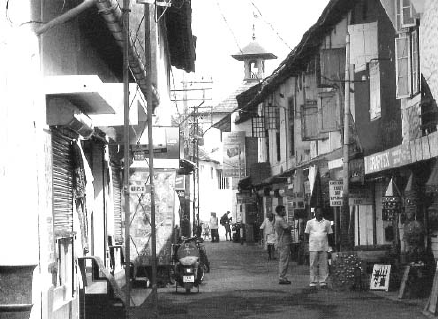
ochin’s Fort area is a quaint remnant of the 19th century, distinguished by grand houses around the Parade Ground, even though a larger part of Cochin island is still predominantly a village of fishermen. And though Anglo-Dutch architecture dominates, it however retains a curious amalgam of cultures. Interestingly, the Portuguese Church where Vasco da Gama was buried before his remains were taken to Portugal, has been converted to an Anglican church. Though a nationally protected monument, it is little more than a tourist curiosity. Even as the Portuguese and Dutch largely used the fort as a strategic outpost, it was the British who gradually remodelled its interior into the residences of British traders and later, company executives. These are exceptionally large mansions distinguished by sweeping verandahs with sea front vistas and rooms so immense that they are today almost unusable.
A
ll this has changed, often for the worse. Take the case of Bastion Bungalow, the residence of former governors, both Dutch and English. Being the most imposing on the waterfront the Bastion Bungalow was expectedly appropriated to serve as the residence of a senior government functionary. Today it is occupied by the Regional Development Officer. On a visit to Cochin in the 1980s, we suggested that given Cochin’s rich history, this imposing building was ideally suited to house a museum of the history of Cochin.|
|
The RDO who occupied only a section of the large entrance hall, since she feared snakes or worse must occupy the rest of the building, was however adamant that this was in fact the only building befitting her stature. NGO driven museums and other such frivolities would not be considered, even if alternative and perhaps better accommodation was found for her in one of the huge Port Trust bungalows with a prominent position on the sea-front fortifications. Expectedly, government missed the boat and a privately owned Museum of the History of Cochin was established in Kalmaserry, some twenty kilometres from Cochin. Strategically located on the new airport highway, it is now a major destination for visiting nonresident Malayalis.
Fortunately, the Gulbenkian Foundation involved itself in Cochin Fort, initially funding the restoration and archiving of the records of the Bishop of Cochin, of vital historical interest to Lusophone scholars. Their importance lies in the fact that although the Portuguese presence in Cochin was not sustained and their seat of power shifted to Goa, the Diocese of Cochin continued to control a huge swathe across eastern and southern India. The archival recovery of these records is therefore crucial for understanding regional history.
The next proposal was a Museum of Christian Art, similar to the museum established at the seminary at Rachol in Goa, also to be located in the Bishop’s house. The Cochin Museum was finally housed in a new building, adding yet another layer to Cochin’s rich urban fabric. Both these museums will help preserve and protect the rich collections of Christian art owned by the churches of the Diocese currently suffering neglect.
I
n Cochin this is a huge challenge as the churches scattered over a large area are being redeveloped so rapidly that accessing, cataloguing and obtaining sacred art objects for the museum becomes a race against private dealers and collectors. The pace of recycling is such that the Gulbenkian Foundation even had to buy selected pieces from a local shop to restore them to the museum. What distinguishes this museum is that it ensures that objects revert to their churches for festivals and ritual needs whenever required, ensuring that the museum lives very much as a part of Christian contemporary ritual. Another interesting feature of this museum is the retention of the archaeological remains of the fort walls which were exposed while digging the foundations of the museum, as an integral part of the museum design. Certainly, this is the only museum I know of in India that has incorporated archaeology.In recent years much of the fort area has, in response to tourist market forces, been converted into boutique hotels or shops. Nearby are the famous Chinese fishing nets, romantically thought to have been brought to Cochin by traders from the court of Kublai Khan. Though still actively used, these are definitely endangered as trawlers and mechanized fishing squeeze out individual fishermen. Enticing little signboards, ‘you buy we fry’, define the entrepreneurship of the local community and, you can buy and eat freshly fried fish as fast as the fish comes off the nets. That this bustling street food business is located alongside some of Cochin’s smartest hotels speaks volumes of the way development in Cochin has managed inclusive growth.
H
owever, the heart of Cochin is and always has been Mattencherry. The former seat of the Raja of Cochin, the original port was set inland and thus protected from the fury of the monsoons. Mattencherry still bustles with storage godowns and the single bazaar street that connects Cochin and Mattencherry is now crammed full of trucks. Nearby is the charming palace of the erstwhile Raja, curiously called the Dutch Palace. It has exceptional murals depicting the Ramayana and deserves far better preservation and presentation than it enjoys at the moment. Today trade in Mattencherry ranges from a dizzying array of antiquities of ritual and everyday art competing with products like ginger, rice, rubber or cashew and other items of traditional trade.Unchanged in all the years I have returned to Cochin is Jew Town. A small community of Jews who fled the inquisition in Spain were given shelter by the Raja of Cochin adjacent to his palace, providing protection from the Portuguese who introduced the inquisition to Goa. This small community settled down and was absorbed seamlessly into the multi-cultural town. Although the community has dwindled to no more than sixteen today, it retains its spirit, culture and unique traditions. The elders of the community conduct their rituals with an absolute integrity that sustains the faith and remain fiercely proud of their heritage.
T
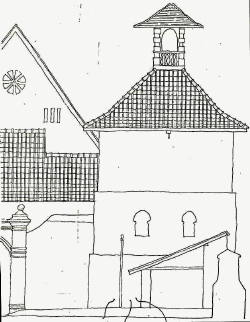
he main attraction of Jew town is the sixteenth century synagogue with its incredible Chinese blue tile flooring and superb altar. Though its Dutch style clock tower, unused for more than sixty years, had fallen into decay, the World Monuments Fund raised money for its restoration. It is truly a cultural oddity because clocks were not integral to synagogue ritual or architecture. On a distinctly colonial edifice, a multilingual clock face on each wall addresses all sections of society – a Hebrew clock faces the synagogue, there is a Roman one for the main Jew street, and Malayalam numerals overlook the old city.I
ntriguingly, the wall that faces the Cochin palace has no clock, perhaps in deference to the Raja, reflecting the timelessness of the king. The building is a microcosm of the rich diversity of this small town. Today its custodians are not just trying to establish the ownership (since it was only a royal decree that allowed the synagogue to be built) but, more importantly, to alter its politically incorrect name, the ‘paradesi synagogue’.
|
|
Together these historic structures – the Dutch palace with its circular copper roofed temple, the synagogue with its clock tower, Jew street and many other community based enclaves – reflect Cochin’s tryst with multiculturalism long before the phrase became fashionable and polarized communities.
The city grew, drawing strength from royal, civic and sacred architecture to establish its own identity. Though colonial in origin, the architecture never transgressed Indian norms of high art and so with the arrival of the foreigners, stone and wood buildings gave way to laterite brick and later, basel tiled roofs. It is this admixture that defines the architecture of Cochin. Though elsewhere in Kerala the recent huge influx of Gulf money has resulted in massive redevelopment, in Mattencherry the small shops with their courtyard houses continue to retain their form and thus the space remains familiar and valued. And while it is the fort area which has been declared a heritage zone because of its very legible urban colonial vocabulary, it is Mattencherry, labelled ‘marginal’ by our government, that is the soul of the culture of Cochin. Not only do historic enclaves like the agraharams of Tamil Brahmins remain as they have been for hundreds of years, other communities too live within their own areas, interdependent and diverse communities giving Cochin its distinctive character.
B
ehind the waterfront and well-traversed roads of Mattencherry are a labyrinth of inland waterways which connect the hinterland, vital especially in the monsoons as this was the safest way to travel. Kettuvallams that were once used to transport rice through these waterways are now the mainstay of backwater tourism. Islands previous accessible only by boat are reached by bridges, and warehouses destined for demolition have reappeared as boutique hotels with enviable waterfronts.That said, huge courtyard houses with low-density occupancy offer unique opportunities beyond hoteliering in services, infrastructure and other fields which must serve as an economic buffer. Mattencherry is poised to become part of the Cochin boom – it must have a road map for its development. Securing its future will demand injecting fresh business opportunities in addition to creating infrastructure. Today, most homes in the centre of Fort Cochin have become boutique hotels or shops as the most obvious solution to preserve an amazing building stock. It does however vitiate the energy of a city to be occupied by foreigners alone, though perhaps since that is how Fort Cochin was envisaged in the first instance, it could even be justified. But whether a future can be ensured by tourism alone is questionable.
W
hat makes Cochin a unique experience is that its peoples have reaffirmed their identity in response to contemporary development challenges. To simultaneously satisfy the demand for development and yet retain the character of both habitat and community is difficult. At one level it appears that Mattencherry’s fate is safe only as long as the Government of India’s draconian environmental laws control coastline development. But if the fabric of the area is to be preserved it will need a far more proactive injection of new economies.Fort Cochin has reinvented itself as a tourist hub, its success driven through private entrepreneurship while the government addresses infrastructure concerns. Even as one acknowledges the role of the state in improving the urban environment, drinking water shortages and woefully inadequate drainage continue to plague the city. Clearly there is much more serious work to be done, not just here but also in Mattencherry.
There is, however, a real risk of over-exploiting its tourism potential. And unless we go beyond that it may well become the moor’s last sigh.