Comment
The market: medium, message, everything

THE question to ask is, do newspapers have an obligation to deliver the news to you? Tradition built up over the last couple of centuries tells us that the answer is ‘yes’, and in fact it’s mildly shocking to even consider that there might be another answer. And yet these days, newspapers in India – especially the old lady herself, the Times of India – are raising that very question and forcing us to answer it.
What’s happened here? Simple: the management at the Times now looks at their newspaper from an entirely different perspective than they used to, than we readers are used to. This is clear to us from the look and feel of the paper; but the management has also explicitly said so, behaved so. They see the paper as a product, one that earns money for its manufacturer like any other product. Being what it is, a newspaper, it will earn money most efficiently when it is best able to deliver an audience to its advertisers. Therefore, such delivery becomes the raison d’etre of the newspaper.
You consider a newspaper in that stark light, and everything about the Times these days starts making sense. Or some kind of sense. What goes into the paper is what will draw and keep an audience. Simple. The news? That’s incidental, even irrelevant.
This tends to offend a lot of people, but strictly, why? There’s no God-given law that says newspapers must supply news. If I decide to print a pamphlet filled entirely with lies; if I call it a newspaper; if there are people out there willing to buy it to the extent that I can attract advertisers and make piles of money – why should I not do it? In fact, there is the entire tabloid press in the UK and the US that, arguably, does just that. It prints lies, at least most of the time. What’s more, the tabloids comfortably outsell the more ‘respectable’ newspapers that focus on news. In India, the Times has discovered a formula that makes money by the bucketful. If news is a tiny, unimportant variable in that formula, why should the management at the Times lose sleep over that? Only because some of us are offended?
You think this is a cynical view of the press? You think the press has a ‘duty’ to the public, a role to play in a vibrant democracy? Well, I think so too. But the success of the Times formula forces me to understand that my notion of this role is hardly universally held. It may actually be a more ‘natural’ idea, in some sense, that a newspaper exists to make money, period – like any other product. Not for some noble social purpose.
Yes, then it starts making sense.
I remember the morning that the Sunday Times of India arrived at my door with its entire front and back pages blank, devoid of news. No, it was not the return of the censor we knew and adored during Indira Gandhi’s Emergency. It was an ad – one more ad – for one of the dotcoms that were then popping up like weeds.
Now as ads go, this was certainly an effective one. You noticed it. In fact, you couldn’t help noticing it. That I remember it years later is itself testimony to its effectiveness. But to a certain sort of Times reader, and I suppose I am one, this was one more nail in the coffin of a newspaper we once respected. Each nail has been greeted with wails and protests, some in the form of anguished letters to the editor. But each nail has been unerringly hammered in anyway. The result is that the Times is today a paper that those who knew it even a decade ago would recognize only with difficulty. But it is also today a paper that is clearly a lucrative success.
All of which is broadly OK. All of us move and evolve as the years roll by, and the Times of India need be no exception. But consider what we have lost as it has evolved.
The entire op-ed page was killed off. Just like that. The bloodshed spilled over onto the edit page. Where once we had a ‘Current Topics’ section of brief musings to provoke some thought, there is now a daily interview. A space for a second, shorter opinion piece vanished, taken over by a daily ‘Speaking Tree’ column on spiritual issues. Space for letters is slashed, now allowing for only two or three short ones. The main centre article is now the only spot in India’s largest newspaper for comment, opinion and analysis.
It doesn’t stop at the edit/op-ed pages. Across the board, on every page, hard news is more and more an endangered species. I’ve lost count of how often the front page has had reports singing the virtues of the search engine, or the email service, on the Times’ own dotcom site – presented as if such virtues were news. For weeks in 2000, a box in the middle of the front page urged you to take the search challenge: the Times’ engine against Yahoo. (Do you really care if Yahoo comes off second best in a search for ‘Lara Dutta’?) The visits of minor music celebrities to the Times’ own music store in Bombay also turn into news. And there is the obligatory, if always meaningless, Net poll. So every day, you can wake up to find out what percentage of mouse jockeys have visited the Times website to click ‘Yes’, ‘No’, or ‘I’m too boring to know’, to some inconsequential question.
And the ads. If the front page fake was unusual, there are full page ads nearly every day for everything from mobile phone services to cars. Not that full page ads are inherently repulsive, but six in one 20 page paper? Sometimes in a row? Besides, every other page is also plastered with ads. So much so, you are left to search for real news, hoping that when you find it, it won’t turn out to be an ode to a search engine.
And be still my thumping heart, I haven’t even mentioned Bombay Times (or Pune Times, or Delhi Times, you get the picture). As a grab-bag of gossip, fashion, agony-aunting and shots of cleavage and bikinis, this supplement is unsurpassed. Which is good, because even thinking of what might surpass it gives me a headache.
Being the largest, the Times has driven most other papers in the country in the same direction. So the Indian press is now a steadily growing menu of gossip, internet polls and fluffy supplements. Actual news gets harder and harder to find. (Maybe that’s why we need to be educated about the search engine). The few newspapers that still live up to the word are dismissed as stodgy and unattractive. Calcutta’s Statesman is one; and sure enough, it is regularly referred to as India’s worst newspaper.
Maybe, but at least it still offers news, not searches and clickable inanity. Last time I checked, anyway. Maybe it has also changed.
Given this long litany, you hardly need be surprised by recent revelations, first in Business Standard (2003) and then Mid-Day (2004), about what’s been an open secret for a while: how the Times charges to place ‘news’. On 11 May 2004, Mid-Day actually printed what amounted to a rate card for the Bombay Times. For example: pony up just over Rs 300,000, and you can get a 240 sq cm ‘front page window’ for whatever you want publicized. Including yourself.
The Times did not even bother to contest, let alone deny, Mid-Day’s article. But the real surprise, though perhaps that need not be one either, was how Shobha De, undoubtedly India’s best-known columnist these days, reacted. Charging for news space like this, she told Mid-Day, is a ‘courageous and path-breaking decision... legitimate and transparent.’ What’s more, she pronounced that ‘this is the trend of journalism for the coming years.’
Which brings us full circle: people have started to look at newspapers differently, journalism differently. If you gasp at the thought that paying to be written about is ‘the trend of journalism’, no less a person than Ms De thinks it is fine. ‘Courageous and path-breaking’, even. Just one more way for the paper to make money. Maybe it’s you who needs to reconsider your ideas about the press.
So where does all this leave us?
Before you are persuaded that this entire essay is a futile lament about our newspapers, let me make a small point. No doubt all the changes I’ve touched on are driven by the urge to corner the market. (In fact, Times editors in each city are no more called, as they used to be, Resident Editors. In Bombay, the lady in charge is the ‘Editor – Mumbai Market’.) No doubt the publishers want to make their profits as any other businesses do. All of which is fair enough.
Except that the press is not quite like other businesses. In a functioning society, a strong democracy, we envisage a role for the press. It must inform and protect us, expose those who subvert democracy, ask the questions that must be asked to keep a society thriving. This is why our Constitution, and others around the world, guarantees the press its freedom.
It does not, you will note, guarantee businesses their profits.
So when newspapers abdicate that role, their responsibility to deliver the news, and turn instead to films and fashion, we might all worry a little. Because you could argue that that will only hasten us towards anarchy.
Driving in Orissa once, my travelling companion and I were chatting about the situation of that sometimes desperate state. The devastating cyclone in 1999, the poverty, the apathy of successive governments that stretches beyond party boundaries, the state of the press and more. Musing about that last point, he asked idly (I was the journalist, after all): Is there any arm of the press, anywhere in the country, that analyses and then follows through on issues? That goes beyond just reporting an incident and moving on to the next?
He wondered, because he had been going over a short list of celebrated crimes in the last several years. Whatever happened to the murder of Jessica Lal? The cash-filled suitcase that Harshad Mehta claimed to have handed to then-Prime Minister Narasimha Rao? The proceedings against various Advanis, Thackerays and Uma Bharatis for the demolition of the Babri Masjid? The glaring absence of any action against some of those very people for their roles in rioting after 1992? The travesty of justice that victims of the violence in Gujarat in 2002 have had to live with? Why did the havala case meander into nothing despite diaries full of as much evidence of corruption as you are ever likely to get? Why has the Bombay bomb blasts case dragged on for a decade now; who will account for the lives of those incarcerated all these years who will be found innocent? What about Sukh Ram and his bedsheets full of bundles of cash, millions of rupees worth? In fact, what about the vast scandal about relief material for the Orissa cyclone?
We read about each of these when they happened, but rarely, or never, since. No wonder Sukh Ram is still a powerful politician, even widely respected, in Himachal Pradesh. No wonder Advani spent years as our Home Minister, in charge of administering the very law and order he helped grind into the dust of that mosque in December 1992. No wonder Harshad Mehta wrote avidly-read columns and Narasimha Rao writes bestsellers.
And no wonder I could only reply ‘No’ to my Orissa travel-mate’s questions. If we had a press less obsessed with Net polls, perhaps the Advanis, Raos, Sukh Rams and Thackerays would at least be facing the trials they have so deftly side-stepped.
Editors, whether in the Mumbai Market or elsewhere, might give that a thought. For I still believe there is a role for the press, and in a democracy, it is a vital one. Amartya Sen has repeatedly made the point that great famines don’t happen in democracies. That’s because a vigilant and free press keeps government machinery working to head off, or mitigate, disaster.
Only, I worry it may not be able to do that too much longer. Because what if Shobha De is right about the ‘trend in journalism in the coming years’?
Dilip D’Souza
* A modified version of this essay appears in The Rape of News (Frog Books, forthcoming).
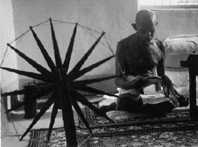
Spinning a nation: Margarete Bourke-White’s Gandhi
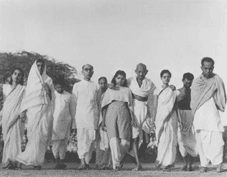
UNLIKE the French Revolution the dawning of Indian independence was a visual spectacle. While the movement gathered significance because of leaders who shouldered the responsibility of creating the idea of modern India, its final phase acquired an epochal reputation mainly because of the iconic photography which narrated its course – the final culmination a tie between victory and vice bafflingly represented by 15 August 1947 and 30 January 1948.
Like so many surprises of that era the most photogenic man in the leadership of the national movement was also its tallest leader, one who reinvented the national struggle for self-rule complete with a new dress code in which the topi replaced the imperial crown and became the unexpected prop in the photographic portraits of the era.
It was the camera that gave the Indian national movement a greater profile than the French Revolution in the Third World. It was this modern equipment whose presentation techniques made a movement critical of modern colonialism appear appreciative of the modern era. As a result, the Third World experienced its first bout of political modernisation by witnessing India attain independence. Perhaps that is why, despite a language imbued with ecological living, eastern wisdom and pious existence, Gandhi’s movement did not appear like one that would take India back to the pre-Christian era after its formal separation from the colonial superstructure. Of course, the western-trained leadership of the movement helped ensure that India would strive in the modern way of life at its own free will after the departure of the colonial masters. But, alongside free India’s modern European roots it was the definitive public photographic campaigns launched by the visual Columbuses like Margarete Bourke-White that were ultimately responsible for spreading the message that traditional India had reconciled with modernity. It was not a relation of antipathy; it was more a relation in sympathy with each other.
The position of Christianity vis a vis the modern western nation-state comes to mind when India’s traditionalism is juxtaposed against its modern statist urgings. The comparison of Gandhi with Christ did not materialise out of thin air; it drew on the benign iconisation of that great man in frame after frame of the Indian freedom struggle. Arguably, the western notion of struggle for freedom is depicted through a tiresome and sometimes vigorous movement best represented by the image of Liberty leading the agitating masses. This was markedly different from the iconic representation of Jesus who appeared as the apogee of worldly strength even when the political threat that he represented to the established authorities had been neutralised. The strength of an iconised Jesus lay in the icon’s ability to portray sorrow and anguish for the fallen of the mankind through his graceful tolerance of extreme physical pain. To the western gaze, non-violence is an attribute best represented by the Son of God, who won the war despite having lost the battle.